



Contents: Models without ABS ⬇ ABS equipped models ⬇
Warning! See warning at the beginning of the Section System design, description of individual units and mechanisms.
Models without ABS
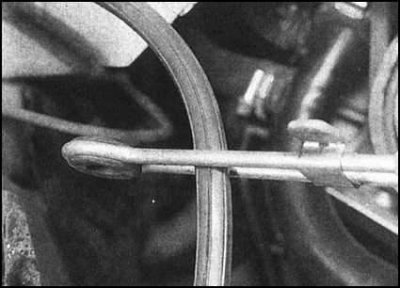
1. If it is necessary to disconnect a hydraulic tube or hose, take measures against excessive loss of brake fluid. Remove the brake master cylinder reservoir cap, place a piece of polyethylene film underneath it and screw it back on tightly - now the reservoir will be sufficiently sealed and the vacuum created in it when the fluid comes out will not allow its level to drop too much. Alternatively, you can use a special clamp to clamp the hydraulic hose closest to the nipple connection to be disconnected. The open ends of rigid hydraulic tubes/nipples can be plugged immediately after disconnection to prevent dirt from getting into the system. To collect spilled fluid, place a rag under the connection to be disconnected.
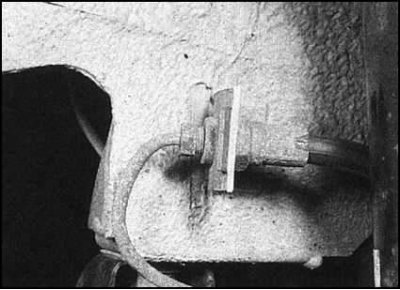
2. If it is necessary to disconnect the flexible brake hose, before removing the spring clamp securing it to its bracket, loosen the union nut of the union nut connecting the hose to the rigid tube.
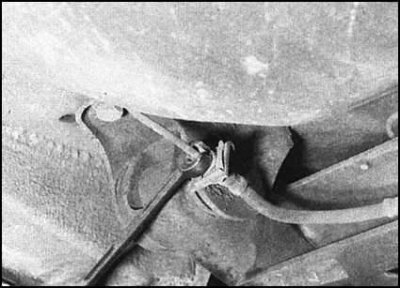
3. It is best to loosen union nuts of union joints using a special wrench of the appropriate size - ask in car accessory stores. If you do not have a special wrench at hand, you can use an open-end wrench that fits tightly on the nut splines; however, if the nut is tightened tightly enough, this method is associated with the risk of rounding its corners as a result of the wrench breaking off. In this case, you should try to loosen the nut using a self-locking reinforcement wrench (Swedish). If the splines are damaged, the nut must be replaced together with its tube. Before disassembling a union joint, always wipe it thoroughly from the outside to prevent dirt from getting into the system. When disconnecting more than one connection, try to remember the exact order of installation of the sections to be removed.
4. Replacement brake pipes of various lengths with flared ends and union nuts can be purchased at Skoda service centers. Having selected a section of the required length (corresponding to the removed) all that remains is to give it the necessary shape for proper placement on the car. Alternatively, brake pipes can be made to order in a car service workshop from parts produced in sets. You just need to accurately measure the length of the original removed from the car. The best thing to do is to take the old pipe with you to the store or workshop.
5. When installing, do not tighten the union nuts too tightly - the tightness of the connection is not at all proportional to the tightening force of its components, but is determined by the correctness of their assembly.
6. Make sure that the brake pipes and hoses are routed correctly. Make sure that the lines are not twisted and are securely fastened in all the brackets and intermediate fasteners provided. When the procedure is complete, remove the polyethylene film from under the brake master cylinder reservoir cap and bleed the brake system (see section Bleeding the hydraulic system). Wash away any spilled brake fluid and check the system for signs of leaks.
ABS equipped models
Attention! On models equipped with ABS, before disconnecting the hydraulic brake lines, it is imperative to disconnect the battery. The battery should be connected only after all hydraulic lines of the brake tract have been connected. Violation of this requirement may result in air entering the hydraulic modulator, the removal of which during normal bleeding of the system is not possible and requires the use of a special electronic tester (VAG 1552).
Perform the procedures described in paragraphs 1 through 6. If it becomes necessary to disconnect the brake pipe from the hydraulic modulator or master cylinder, special care should be taken to immediately seal the open ends of the separated tract to prevent air from entering the components. Before connecting the pipe, fill it with (and fitting on the component) with fresh brake fluid.
(Material is available on the website www.SKODABOOK.ru)