



Note: See warning at beginning of Section Replacing the front disc brake pads.
Removal
1. Loosen the rear wheel mounting bolts, support the front ones with wedges. Jack up the rear of the car and place it on supports. Remove the wheels. Release the parking brake completely.
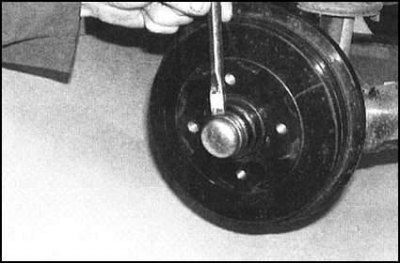
2. Using a hammer and a large flat-blade screwdriver, carefully remove the protective cover from the center of the brake drum.
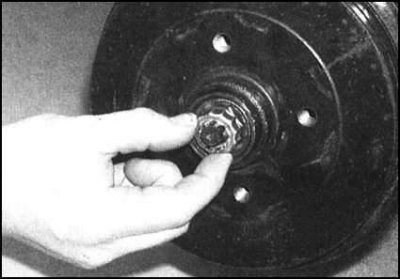
3. Remove the cotter pin, loosen the hub nut and remove the lock cap.
Note: During assembly, the cotter pin must be replaced without fail.
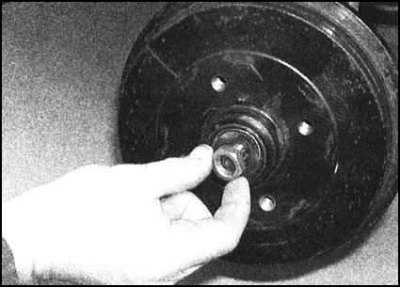
4. Loosen the hub nut, then remove the toothed washer and remove the outer wheel bearing from the center of the drum assembly.
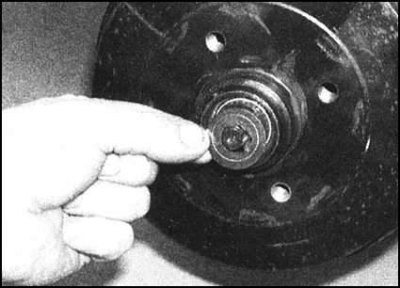
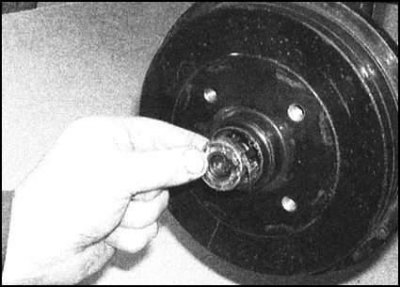
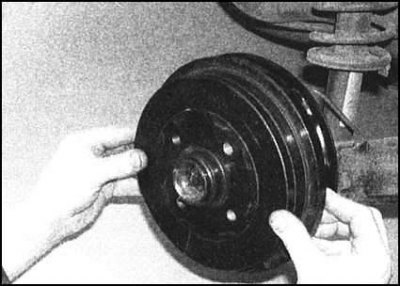
5. Now the drum should be removed from the hub by hand. The drum may not be removed either due to an excessively tight fit of the wheel bearing, or due to the brake shoes "sticking" to its working surface. If the problem is with the bearing, tap the drum around the perimeter with a soft-faced hammer, or use a universal puller, securing it with wheel bolts. If the shoes are "stuck", proceed as described below.
6. Release the parking brake adjuster completely (see section Adjusting the parking brake), providing maximum slack in the drive cable.
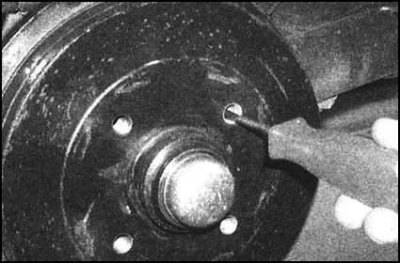
7. Insert a screwdriver through one of the holes for the wheel mounting bolts in the drum...
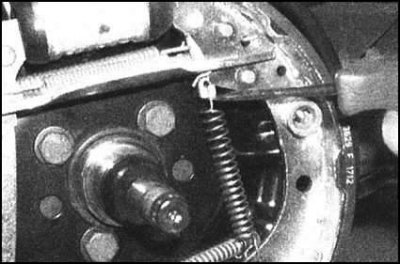
...and use it to pry up the spacer wedge, allowing the shoes to be pulled away from the drum as much as possible. Now the drum should come off the hub without any problems.
Examination
Note: Drums are always replaced in pairs for both brake mechanisms of a given axle to avoid loss of vehicle stability during braking.
1. Use a brush to remove brake dust from the surface of the drum - do not inhale it under any circumstances!
2. Thoroughly wipe the outside of the drum and check it for signs of wear and mechanical damage such as. Make sure there are no cracks around the bolt holes. A defective drum must be replaced.
3. Check the working condition (internal) drum surface. If deep scratches, burrs, cavities or grooves worn across the width of the shoes are detected, the drum must be replaced. The presence of light scratches should not cause concern. Use fine-grained sandpaper to remove rust and consolidated dust along the outer edge of the drum working surface.
4. Measure the inner diameter of the drum in two mutually perpendicular planes. By comparing the results of the two measurements, evaluate the degree of ovality of the drum. Drum turning is allowed within the permissible limits. If this is not possible, the defective drum is subject to replacement in a pair with the opposite one.
Note: The turning must be done for both drums simultaneously and to the same extent.
Installation
1. Before installing the new drum, remove any traces of preservative with solvent. If necessary, reinstall the inner wheel bearing components, thoroughly packing the latter with grease.
2. Before installing the drum, completely close the brake shoes by lifting the adjuster spacer wedge.
3. Lubricate the drum seal and carefully seat the assembly on the axle journal.
4. Install the outer wheel bearing and thrust toothed washer. Make sure that the teeth of the washer engage correctly with the groove in the axle journal.
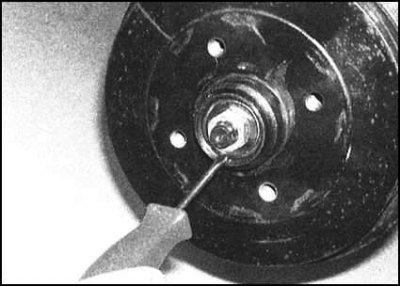
5. Install the hub nut and tighten it just enough to press it against the washer, while turning the drum to seat the wheel bearings. Gradually loosen the nut, allowing the toothed washer to move slightly with a screwdriver. Note: The washer should move with very little resistance. Once the hub nut is in the correct position, replace the locking cap and install a new cotter pin.
6. Place the protective cover on the central part of the drum, pushing it in until it stops.
7. Repeat the procedure for the second drum, adjusting the parking brake drive if necessary.
8. Once both drums are in place, adjust the fit of the shoes by firmly depressing the foot brake pedal several times until the pressure in the system is fully restored.
9. Finally, reinstall the wheel, lower the vehicle to the ground and tighten the wheel bolts to the required torque.