



Front Brake Caliper Components
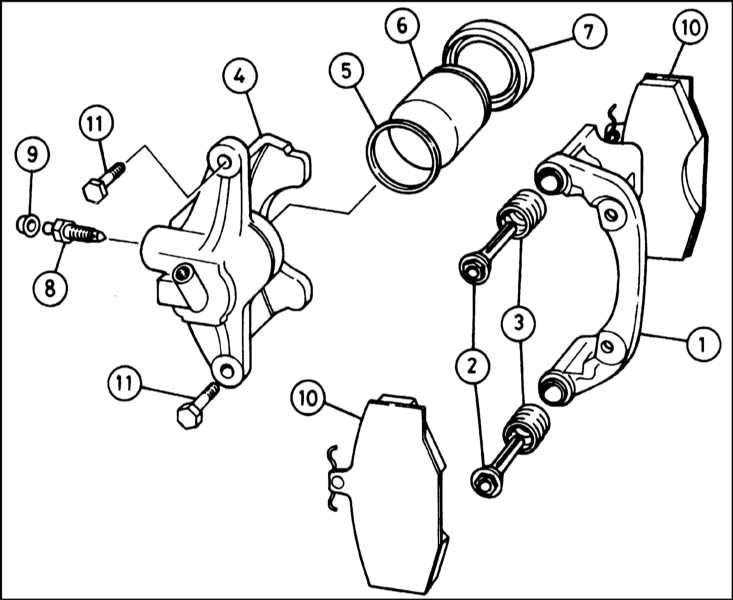
1 - Anchor bracket; 2 - Guide pin; 3 - Protective case; 4 - Caliper housing; 5 - Sealing cuff; 6 - Piston; 7 - Dust cover; 8 - Bleed valve; 9 - Dust cap; 10 - Brake pads; 11 - Guide pin bolts
Note: On models equipped with ABS, before disconnecting the hydraulic brake lines, be sure to disconnect the battery. Connect the battery only after all hydraulic lines of the brake system have been connected. Failure to do so may result in air entering the hydraulic modulator, which is removed during normal bleeding of the system (see section text) is not possible and requires the use of a special electronic tester (VAG 1552).
Before proceeding with the procedures, carefully read the warning text at the beginning of the Sections System design, description of individual units and mechanisms, Replacement of hoses and tubes of the hydraulic tract of the brake system.
Removal
1. Set the parking brake. Jack up the front of the vehicle and place it on stands. Remove the corresponding front wheel.
2. In order to minimize the loss of brake fluid, remove the cap from the master cylinder reservoir, then, placing a polyethylene film under it, screw it back onto its neck. This will ensure proper sealing of the reservoir, preventing the fluid level from dropping too much due to the resulting vacuum. Alternatively, fluid loss can be minimized by clamping the flexible brake hose connected to this caliper with a special clamp or clamp.
3. Wipe thoroughly, then loosen the fitting to be disconnected on the caliper.
4. Remove the upper and lower caliper guide pin bolts, using a thin open-end wrench to prevent the pins from turning. Remove the caliper from the brake disc and disconnect it from the brake hose, immediately plugging the open end of the latter to minimize leaks and prevent dirt from entering the hydraulic system.
Note: The pads can be left in their original location in the caliper anchor bracket.
Major repairs
1. Place the removed caliper on a workbench and thoroughly clean it from dirt and dust - try not to inhale brake dust, use a protective mask or respirator!
[Article posted on the website: SKODABOOK.RU]
2. Remove the partially protruding piston from the caliper cylinder and remove the dust cover.
Note: If the piston cannot be removed manually, it can be pushed out using compressed air supplied to the flexible brake hose connection nipple. A slight pressure created by a foot pump for inflating tires will be sufficient. Make sure that your fingers do not end up between the end of the piston and the caliper body when pushing it out!
3. Using a small screwdriver, remove the piston seal - try not to scratch the cylinder bore.
4. Thoroughly clean all components with methyl or isopropyl alcohol, or clean brake fluid (never use petroleum-based solvents such as gasoline or kerosene to clean parts - they are aggressive towards rubber parts!), then immediately and thoroughly dry them with a clean, lint-free cloth, or with compressed air - the latter is especially convenient for blowing out small channels and holes.
Caution! When using compressed air, do not forget to wear safety glasses!
5. Check the condition of all components, replace worn and damaged parts. Particular attention should be paid to the condition of the piston and its cylinder mirror - if scratches or the slightest signs of corrosion are found, the components are subject to replacement, which in practice means replacing the entire caliper body assembly. In a similar manner, check the condition of the guide pins and their bolts. Both the pins and bolts, when cleaned, should slide freely in their sockets, while being tightly seated in them at the same time. If you are not sure of the condition of any of the components, it is better to play it safe and replace it.
6. If the condition of the assembly components is found to be satisfactory during the inspection, prepare the appropriate repair kit, which can always be purchased in several different combinations at Skoda service centres.
7. During assembly, carefully check the quality of cleaning and drying of all installed components.
8. Wet the piston and its new seal with clean brake fluid. Lubricate the cylinder mirror with it as well.
9. Using your fingers, without using any tools, insert the new seal into the groove inside the cylinder.
10. Put a new dust boot on the rear part of the piston. Insert the inner lips of the dust boot into the groove in the cylinder mirror, then carefully, using rotary-translational movements, insert the piston into the cylinder. Having deepened the piston to the stop, insert the outer lips of the dust boot into the groove, making sure that the piston is perpendicular to the cylinder. Press the piston into the cylinder until it stops, then pull the dust boot onto the caliper body and seat it in the specially provided groove.
11. When installing the caliper guide pins, lubricate them with the special grease supplied in the kit, such as Lukosan M11 or M14. Install the protective covers, correctly seating them in the grooves on the guide pins and anchor bracket.
Installation
1. Carefully clean the threads of the guide pins and their bolts from old sealant. If damaged threads are found, the bolts should be replaced.
2. Screw the caliper onto the flexible brake hose fitting.
3. Make sure that the brake pads are seated correctly in the anchor bracket, then install the caliper in its regular place, making sure that the anti-squeal springs of the pads are placed correctly in it.
4. Lightly lubricate the bolt threads with a sealant such as Loctite 243. Press the caliper down and screw the bolts into their guide pins, tightening them to the required torque (keep your fingers from turning the open-end wrench).
5. Tighten the union nut securely and remove the clamp/clamp from the flexible brake hose, or remove the plastic film from under the brake master cylinder reservoir cap.
6. Bleed the hydraulic system (see section Bleeding the hydraulic system).
Note: If all measures were taken to seal the system during the process of dismantling the caliper, it will be sufficient to bleed only this particular brake mechanism.
7. Replace the wheel, lower the vehicle to the ground and tighten the wheel bolts to the required torque.