



Contents: Installation ⬇ Identification feature of the…⬇ Clutch disc installation position ⬇ Checking the ends of diaphragm…⬇ Checking spring and riveted…⬇
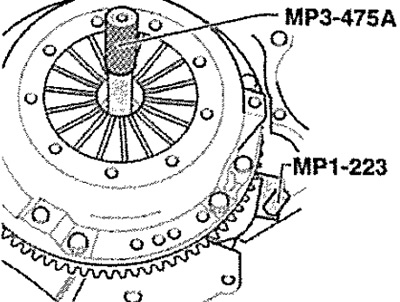
To prevent deformation of the clutch pressure plate when removing (which leads to jerks when starting off) the clutch pressure plate mounting screws should be loosened as follows: To loosen the screws, install the counter support "MP1-223 (3067)".
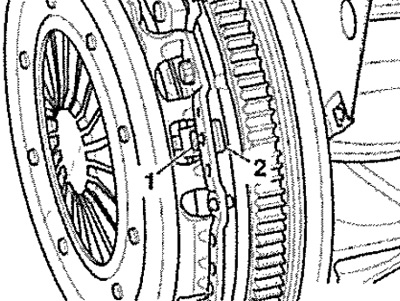
Loosen the screws step by step in a crosswise order. When the screws are loose, it is necessary to loosen the stop "2" with the finger "1". If the stop does not loosen: Press the finger in the direction of the flywheel. Remove the clutch pressure plate and the clutch disc.
Installation
Installation in reverse order.
Note: The pressure plate and clutch disc must always be replaced together. Select the appropriate pressure plate and clutch disc according to the engine designation. The dual mass flywheel, pressure plate and clutch disc are compatible with each other and must not be installed with components from other manufacturers.
(The original can be viewed on: skodabook)
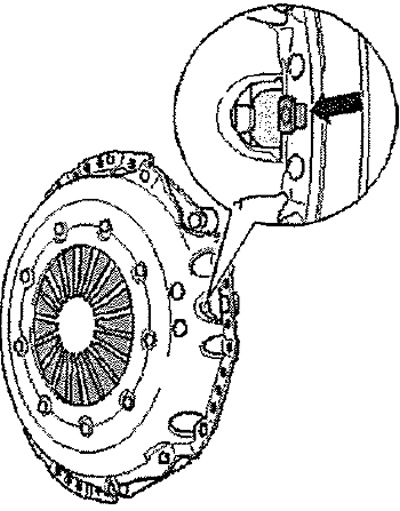
Identification feature of the self-adjusting clutch type "Sachs"
Clutch pressure plate with stop (position sensor) "see arrow".
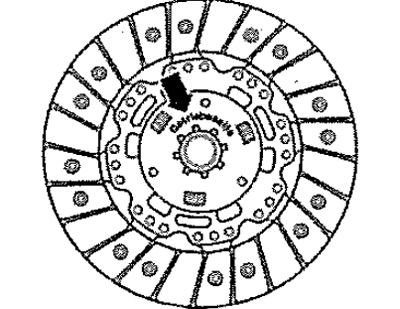
Clutch disc installation position
Inscription "Getriebeseite" facing the CP.
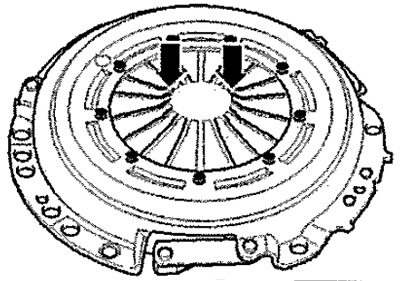
Checking the ends of diaphragm springs
It is allowed to wear the diaphragm springs up to half the thickness "see arrows".
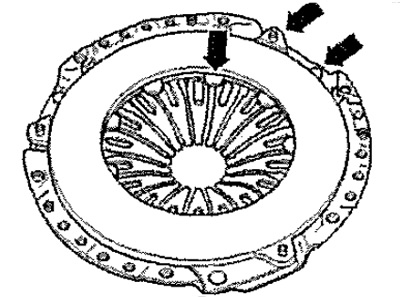
Checking spring and riveted connections
Check the spring connections between the clutch pressure plate and cover for cracks, and check the riveted connections for secure fastening. A clutch pressure plate with damaged spring connections or with loose riveted connections "see arrows" must be replaced.
Note: Replace the clutch disc and pressure plate with damaged or loose rivet connections. To reduce the smell when the clutch burns, thoroughly clean the clutch housing, as well as the flywheel and engine on the gearbox side. Clean the teeth of the drive shaft and, if the clutch disc has already been in operation, the teeth of the hub, remove traces of corrosion. Apply a very thin layer of grease "G 000 100" to the teeth. Then move the clutch disc on the drive shaft in one direction and then in the other until the hub moves freely along the shaft. Be sure to remove excess grease. The clutch pressure plates must be protected from corrosion and lubricated. Only the working surfaces can be cleaned, otherwise the service life of the clutch is significantly reduced. The working surfaces of the clutch pressure plate and the clutch disc linings must be completely adjacent to the flywheel before inserting the screws. Only then can the fastening screws be inserted.
When installing, use the counter support "MP1-223 (3067)" again to tighten the screws. Place the clutch pressure plate on the centering pins. Use the centering mandrel "MP3-475A (3190A)" to center the clutch disc. To prevent deformation of the clutch pressure plate during installation, (which leads to jerks when starting off) the clutch pressure plate should be installed as follows: Make sure that the thrust pin (position sensor) "see arrow" could move freely. Screw in all screws evenly by hand until the heads fit against the clutch pressure plate. Tighten the screws in stages in a cross pattern so as not to damage the centering holes of the clutch pressure plate and the flywheel centering pins, while it is necessary to lift the thrust pin "see arrow" from the clutch pressure plate. Tighten all 6 screws in stages to the specified torque. Install the gearbox.