



Note: Before you begin, please see the warning in Chapter 1.
Removal
1. Disconnect the negative cable from the battery.
2. If necessary, remove the rear seat. See Section 11.
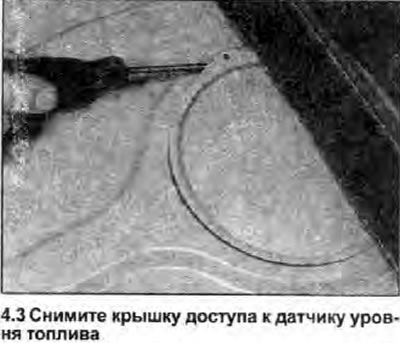
3. The sensor access cover is located in the floor, forward of the rear axle, and is removed from inside the vehicle. On some models, the cover is secured with two screws; in this case, unscrew them. Using a screwdriver, release and remove the cover (see illustration).
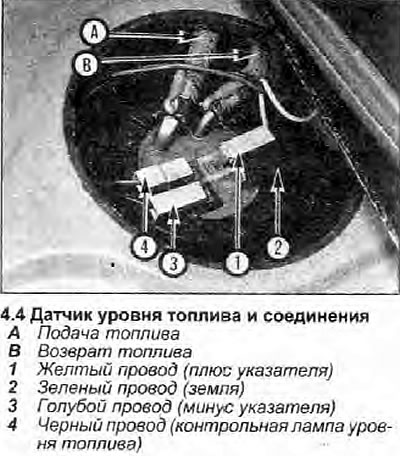
4. Note the location of the wiring and hoses, then disconnect them from the fuel level sensor (see illustration).
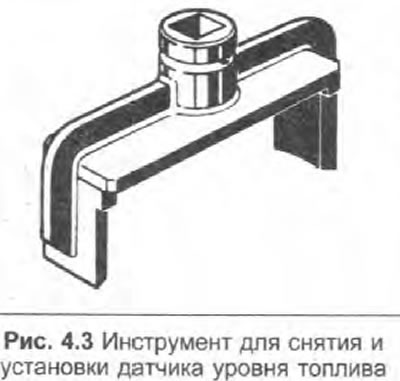
5. Release the sensor locking ring by turning it counterclockwise using the Skoda tool (MP8-502) (see Fig. 4.3).
6. Remove the sensor, noting the O-ring; it should be replaced if worn or damaged.
Installation
7. Install in the reverse order of removal. The float lever should be perpendicular to the vehicle's axis and tilted toward its left side.
Examination
8. The supply voltage to the fuel level indicator installed in the instrument panel is supplied from the instrument panel supply wire (through the ignition switch). It connects to the low fuel indicator light.
9. If the indicator does not work, first check the operation of other devices; if they don't work at all, check the instrument panel power supply wire. If the readings are unstable, there may be a fault that requires replacement of the printed circuit board (Section 12). If only the pointer does not work, check it as follows.
10. With the ignition on, disconnect the yellow wire: the instrument reading should drop to zero. Connect the yellow wire and disconnect the blue wire: the instrument reading should rise to maximum.
11. If the device behaves as just described, but its readings remain incorrect, the sensor is probably faulty. If the device's pointer does not move, the device or its wiring is faulty, but the sensor is most likely OK.
12. With the ignition on, disconnect the black wire. If the low fuel warning light was on, it should now go out. Ground the black wire, the warning light should come on.
13. If the indicator lamp behaves as just described, but does not light during normal operation, the switch in the sensor is probably faulty. If the indicator lamp does not light during testing, the lamp or wiring is faulty.