



High mileage does not necessarily mean a rebuild is necessary, and vice versa, low mileage does not eliminate the need for it. Maintenance frequency is the most important factor to take into account. An engine that has had its oil and filter changed regularly and other required maintenance performed. will last many thousands of kilometers without fail. Conversely, a poorly maintained engine may require overhaul at very low mileage.
Excessive oil consumption indicates that the piston rings are damaged. valve stem seals and/or valve guides (however, the possibility of leaks must first be ruled out). Perform a compression test to determine the probable cause of excessive lubricant consumption.
Check the oil pressure by setting the measuring device to the operating position of the oil pressure switch and compare the result with the data indicated in Specifications. If this pressure is low, the main and connecting rod bearings and/or the oil pump are probably worn out.
Loss of power, erratic engine operation, engine or valvetrain noises, and high fuel consumption may also mean that the engine needs to be overhauled, especially if all of these factors are present at the same time. If a full course of maintenance has not corrected the problem, regrinding worn components is the only solution.
An engine overhaul involves restoring all internal parts to new engine specifications. During the overhaul, cylinder liners, pistons and piston rings are replaced. As a rule, new liners of main and connecting rod bearings are installed; if necessary, the crankshaft can be replaced or reground; in addition, valves are serviced. During the overhaul of the engine, components such as the starter and generator can also be overhauled.
Note: When overhauling the engine, replace the coolant hoses, thermostat and water pump. Carefully inspect the radiator to make sure it is not clogged or leaking. In addition, it is recommended to replace the oil pump.
Before proceeding with the overhaul of the engine, read the description of all procedures and prepare everything necessary. If you carefully follow all the instructions and prepare the necessary tools and equipment, the work will not cause much difficulty, although it may take a long time. Check if the required spare parts are available. Most of the work can be done with ordinary tools, but precision measuring tools are required to inspect parts and determine if they need to be replaced.
Note: The engine must be completely dismantled and all components inspected before deciding which repairs to perform (especially the cylinder block and crankshaft) The condition of these components is the main factor that determines whether an engine can be rebuilt or should be replaced with a remanufactured block. Do not buy parts or repair any components until you have made this decision.
To ensure the maximum life of a remanufactured engine, ensure that it is reassembled with impeccable cleanliness.
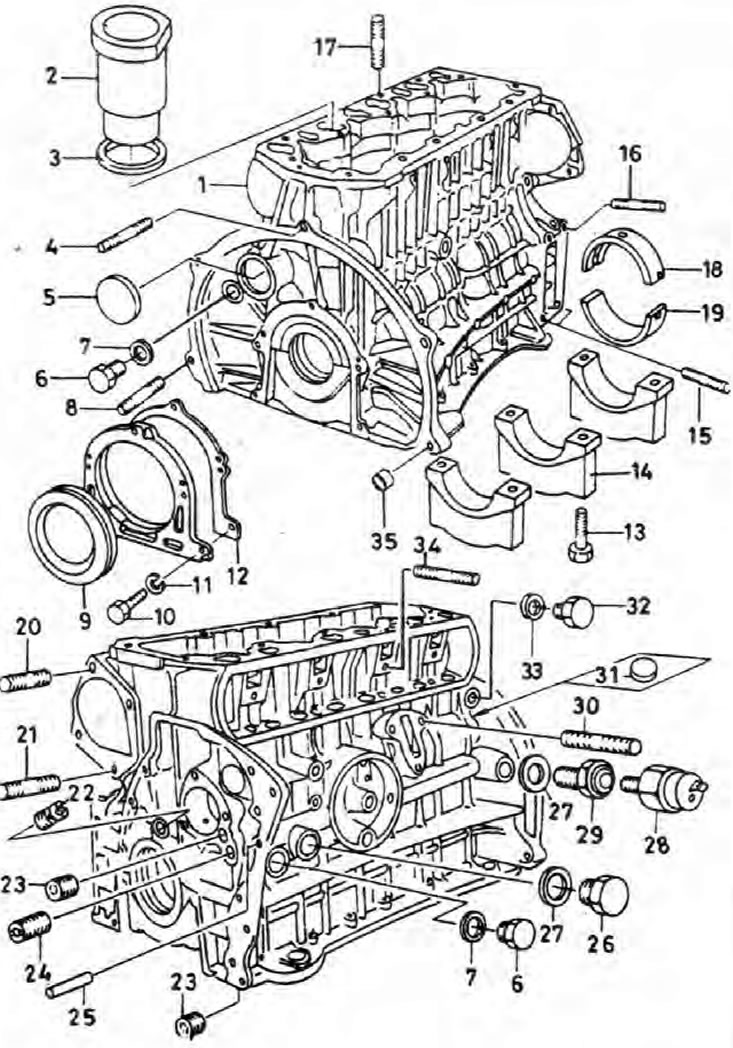
Pic. 2 IN 1. Cylinder block and related components
1. Cylinder block; 2. Cylinder liner; 3. Cylinder liner sealing washer; 4. Hairpin; 5. Cork; 6. Oil channel plug (thread 12 mm); 7. Sealing washer; 8. Hairpin; 9. Rear crankshaft oil seal; 10. Bolt - a casing of a back epiploon to the block; 11. Spring washer; 12. Gasket (where available); 13. Main bearing cap bolt; 14. Main bearing cap; 15. Hairpin; 16. Hairpin; 17. Hairpin; 18. Upper main bearing shell; 19. Lower main bearing shell; 20. Hairpin; 21. Hairpin; 22. Oil jet drive chain; 23. Oil channel plug; 24. Oil channel plug; 25. Locating pin; 26. Oil channel plug (thread 16 mm); 27. Sealing washer; 28. Oil pressure sensor; 29. Adapter; 30. Hairpin; 31. Cork; 32. Coolant drain plug; 33. Sealing washer; 34. Hairpin; 35. Mounting pin.