
Company vehicles Hyundai Company vehicles Kia Company vehicles Lada Company vehicles Mazda Company vehicles Mercedes-Benz Company vehicles Opel Company vehicles Mitsubishi
English Русский
Български
Беларускі
Український
Српски
Hrvatski
Română
Polski
Slovenský
Magyar
Articles   
Bookmark Contacts Sitemap
SkodaBook.ru


Fabia Rapid Octavia Superb Kodiaq Yeti Others
Favorit (1987-1994) Felicia (1994-2001)

Interior heating/ventilation system — general information (Skoda Felicia)

  • Main
  • Skoda
  • Felicia (1994-2001)
  • Power unit
  • Cooling system
  • Interior heating/ventilation system — general information
0

Assembly diagram of the interior heater
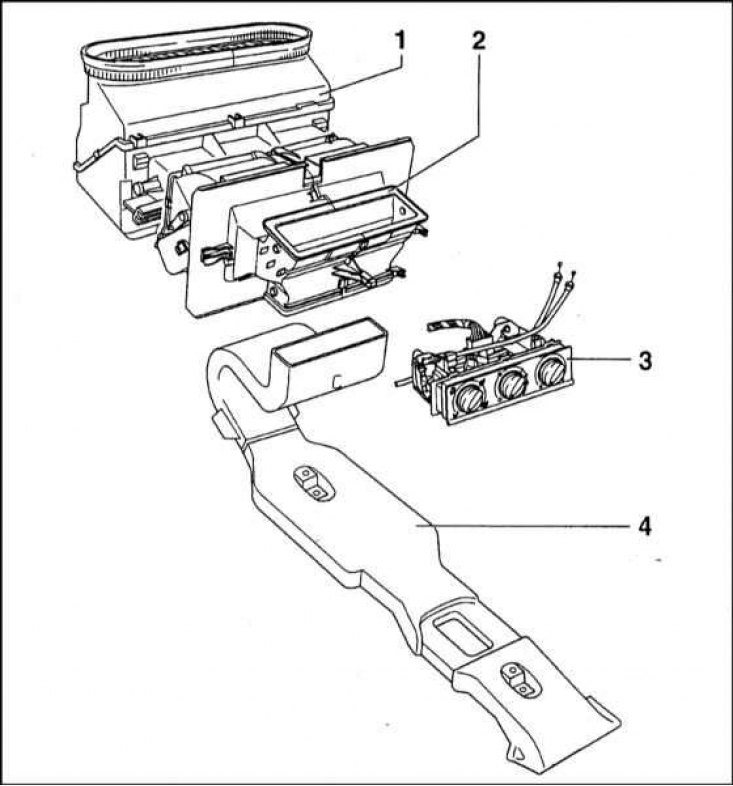


1 - Heater fan casing; 2 - Heater casing; 3 -…

1 - Heater fan casing; 2 - Heater casing; 3 - Assembly of control parameters of the heating/ventilation system; 4 - Air duct


Schematic diagram of the functioning of the interior heating/ventilation system
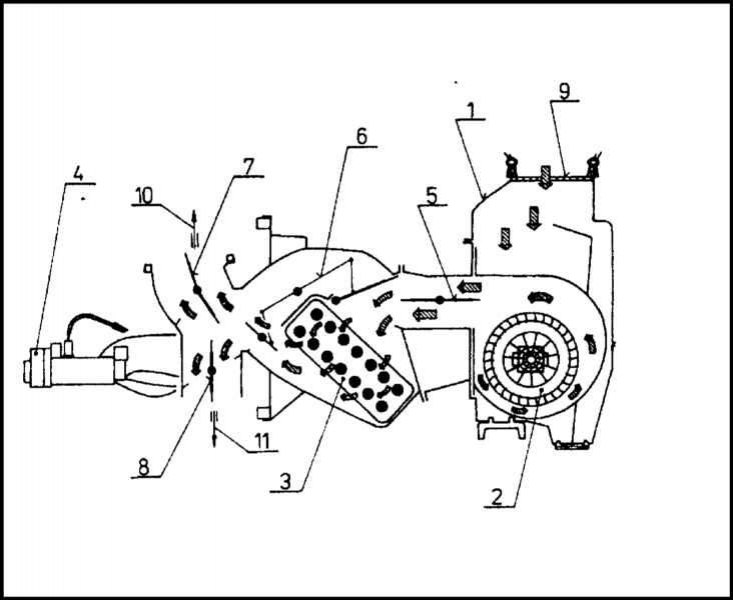


1 - Heater casing; 2 - Heater fan; 3 - Heat…

1 - Heater casing; 2 - Heater fan; 3 - Heat exchanger; 4 - Fan speed selection switch; 5 - Central flap; 6 - Heat exchanger shutter of the heater; 7 - Air distribution flap; 8 - Air distribution flap; 9 - Protective grille; 10 - For windshield blowing; 11 - Into the footwells


The heating and ventilation system provides air exchange and heating of the air in the car's interior. In addition to the standard set of air supply to the front part of the interior, there are also rear air ducts, the outlet diffusers of which are located in the rear doors. The system equipment includes: an air intake, a heater heat exchanger with a fan, air ducts for distributing air flows and outlet deflectors covered with decorative grilles.


Information published on the website SkodaBook.ru

The air duct that brings air into the cabin from outside is located just behind the edge of the hood, directly under the base of the windshield.

The fan-equipped heater heat exchanger assembly is housed in a two-part plastic casing, with covers at the front and back.

The bottom of the heat exchanger casing has a drainage hole for draining rainwater entering the assembly with outside air or during car washing. An air duct is connected to the bottom of the casing.

The operating diagram of the interior heating/ventilation system is shown in the illustration.

The models of cars under consideration use heaters manufactured by KSA. The heat exchanger is made of aluminum, the side chambers are made of plastic. Two pipes are led out of the side of the heater, onto which rubber hoses are attached and secured with clamps. The hose that supplies engine cooling liquid to the heat exchanger is connected to a pipe on the intake manifold, which is also heated by the liquid. The outlet hose is connected to the water pump pipe

A valve is mounted in the underwater pipe, allowing mechanical regulation of the flow rate of liquid passing through the heat exchanger, accordingly changing the intensity of heating of the air supplied to the cabin.

The placement of the heater fan electric motor in the cold air flow ensures its uninterrupted operation over a long period of time due to the highly efficient removal of excess heat.

It should be remembered that the fan can only function when the ignition is on (the key is in the "I" position). The fan is switched on and its speed mode is selected using the rotary handle located on the control panel. The control panel for the heating/ventilation systems is mounted in the lower part of the central section of the vehicle's instrument panel.


The position of the regulating valve, as well as the air distribution flaps located inside the heater casing, is also controlled using rotary handles located on the control panel.

In the heater casing, rheostats for controlling the speed modes of the heater fan are installed on a special connector, providing a stepwise change in the impeller speed. The rheostats are cooled by blowing air over them. A bimetallic fuse is installed next to the rheostats, which switches off the electric motor of the fan drive in case of its overheating or short circuit in the power supply circuit.

If necessary, the supply of outside air to the passenger compartment can be completely blocked by switching on the closed air circulation mode. This option allows you to avoid foul-smelling or heavily dusty air from entering the passenger compartment, but the mode should only be used briefly, due to the fact that air confined in a small volume quickly stagnates.
This article is available at russian, bulgarian, belarusian, ukrainian, serbian, croatian, romanian, polish, slovak, hungarian
Article verified: Ekaterina Blinova
Share with friends:
◀ Previous
Skoda Felicia: Cooling system
Next ►

Removal, installation, disassembly and assembly of the water pump
Checking, removing and installing switches and sensors of the cooling…
Checking, removing, installing, disassembling and assembling the cooling…
Removal, checking the serviceability and installing the thermostat
Removal, condition check and installation of the radiator
Removal and installation of heating and ventilation system components
Air Conditioning System — Information and Precautions
Removal and installation of air conditioning system components
Read similar articles on other Skoda models

➧ Ventilation and heating of the passenger compartment Skoda Fabia 1 (1999-2007)
➧ Heating and ventilation system controller — removal and installation Skoda Rapid 1 (2012-2022)
➧ Parts and components of the interior heating system Skoda Octavia 3 (2013-2019)
➧ Keys, remote control, single lock and keyless entry system «KESSY» Skoda Superb 2 (2008-2015)
➧ Heating and air conditioning system Skoda Kodiaq 1 (2016-2024)
➧ Troubleshooting — Power System Skoda Yeti (2009-2017)
Link to this article in various formats
Reviews and comments of visitors
No comments yet


Add two numbers: 32 + 23


Favorit (1987-1994) 
  • General information
  • Maintenance
  • Troubleshooting
  • Power unit
  • Engine in car
  • Engine overhaul
  • Cooling and heating
  • Fuel and exhaust system
  • Fuel injection system
  • Ignition system
  • Transmission
  • Clutch
  • Manual gearbox
  • Drive shafts
  • Chassis (running gear)
  • Brake system
  • Car suspension
  • Steering
  • Body and interior
  • Exterior (external elements)
  • Interior (salon)
  • Electrical equipment
  • Equipment and devices
  • Power devices
  • Electrical circuits
Felicia (1994-2001) 
  • General information
  • Introduction to guide
  • User manual
  • Maintenance (petrol)
  • Maintenance (diesel)
  • Power unit
  • Petrol engine 1.3 l
  • Petrol engine 1.6 l
  • Diesel engine
  • Engine overhaul
  • Cooling system
  • Fuel system (carburetor)
  • Central injection (SPFI)
  • Multipoint injection (MPFI)
  • Diesel power system
  • Decreased toxicity
  • Engine electrics
  • Transmission
  • Clutch
  • Car gearbox
  • Drive shafts
  • Chassis (running gear)
  • Brake system
  • Car suspension
  • Steering
  • Body and interior
  • Exterior (external elements)
  • Interior (salon)
  • Doors, locks and windows
  • Electrical equipment
  • Equipment and devices
  • Headlights and lighting
  • Electrical circuits
SkodaBook.ru © 2018–2026 | Mobile version | Articles on Skoda | Sitemap EN BG BY UA RS HR RO PL SK HU | Feedback | Site search | Bookmark
Fabia 1 (1999-2007) | Fabia 2 (2007-2014) | Rapid 1 (2012-2022) | Octavia 1 (1996-2004) | Octavia 3 (2013-2019) | Superb 2 (2008-2015) | Kodiaq 1 (2016-2024) | Yeti (2009-2017) | Favorit (1987-1994) | Felicia (1994-2001) |
By continuing to use the site, you agree to the use of cookies.