



Contents: Temperature sensitive sensor-switch…⬇ Coolant Temperature Sensor (CTS) ⬇ Fuel injection system temperature…⬇ Preheating system temperature sensor…⬇
Temperature sensitive sensor-switch of the cooling system fan
General information
The temperature-sensitive switch-sensor switches on the fan when the coolant temperature reaches 95÷99°C. The contacts of the switch-sensor open when the temperature drops to at least 88°C.
The sensor-switch is screwed into the right side radiator tank. The tightness of the connection is achieved by installing an aluminum sealing washer. The upper part of the sensor-switch housing is equipped with flats for a 27 mm wrench.
The body of the sensor-switch has two terminals for connecting the electrical wiring. Power is supplied to the sensor only when the ignition is on. Circuit protection is provided by fuse No.4 (15 A).
Examination
A detailed description of how to check the sensor switch is given in Section Checking the proper functioning, removal, installation, disassembly and assembly of the cooling system fan among the fan testing procedures.
Removal
Note: Before you begin removing the switch sensor, wait until the engine and radiator have completely cooled down.
1. The sensor switch is screwed into the radiator body.
2. Disconnect the negative battery cable, then drain the coolant until the coolant level is below the level of the switch. Alternatively, prepare a suitable plug that can be used to quickly plug the hole where the switch is installed. Try not to damage the radiator or allow debris or foreign objects to enter the system.
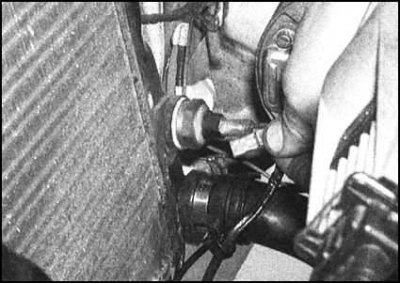
3. Disconnect the electrical wiring from the sensor switch.
4. Carefully unscrew the sensor-switch and remove it from the radiator. Also remove the sealing washer. If the coolant has not been drained, immediately plug the hole with the prepared plug.
Installation
1. Installation is carried out in the reverse order. Do not forget to replace the sealing washer. Tighten the sensor-switch with the required force, then add the required amount of coolant to the system.
2. Finally, start the engine and warm it up to normal operating temperature. Make sure the fan is working properly - it should turn on and off in a timely manner.
Coolant Temperature Sensor (CTS)
Examination
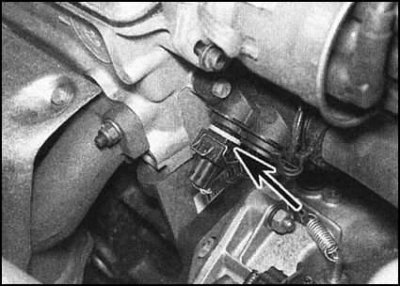
1. On petrol models, the CTS is located in the thermostat housing on the left side of the cylinder head.
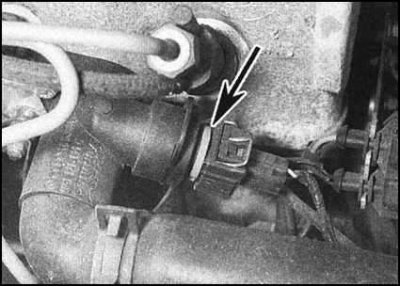
2. On diesel models, the sensor is located in the outlet pipe of the cooling tract in the front part of the head.
Note: On 1.3L models equipped with central injection (SPFI), the sensor is only connected to the temperature sensor. On all other CTS models it also serves to detect the temperature of the fuel injection systems (gasoline engines) or preheating (diesel engines).
3. Stabilized supply voltage to the temperature meter from the instrument panel (via ignition switch and fuse). The state of the meter's ground loop is monitored by the CTS sensor. The main component of the CTS is a thermistor - a resistor whose resistance drops with increasing temperature. When the coolant is cold, the thermistor's resistance is high and a small current flows through the meter, while the pointer is in the lower range of the scale (blue sector). As the engine warms up, the sensor resistance drops, the current increases and the pointer shifts upward, approaching the red sector of the scale. A faulty CTS must be replaced.
4. If the CTS fails, first of all, you should check the proper functioning of the other components of the instrument cluster - if they are completely de-energized, check for power on the panel. If the readings of the meters are unstable, the voltage stabilizer built into the printed circuit board of the instrument panel may be faulty and must be replaced (see Chapter On-board electrical equipment). If only the temperature sensor fails, perform the checks described in the following paragraphs.
5. If the gauge needle remains within the blue sector of the scale when the engine is warm, disconnect the wiring from the CTS and ground the corresponding wire to the cylinder head ground. If the needle deflects when the ignition is turned on, the sensor is faulty and must be replaced. If there is no change in the behavior of the gauge, remove the instrument cluster (see Chapter On-board electrical equipment) and check for conductivity in the circuit section between the sensor and the meter. If there is conductivity, the meter is faulty and must be replaced.
6. If the meter needle is constantly in the red range of the scale, not reacting in any way when the engine cools down, disconnect the wiring from the sensor. If the needle returns to the beginning of the scale when the ignition is turned on, the CTS should be replaced. Otherwise, check the rest of the circuit.
Removal
Note: Allow the engine and radiator to cool completely before attempting to remove the CTS.
1. Partially drain the coolant (below the CTS location level), or prepare a suitable plug.
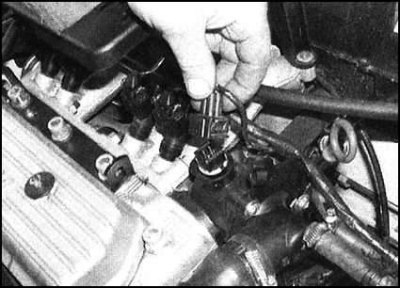
2. Disconnect the wiring from the CTS. Now you need to determine the type of sensor installed on your car. The sensor can have either a loose or threaded fit.
3. The threaded sensor simply unscrews from the engine. Do not forget to remove the sealing washer.
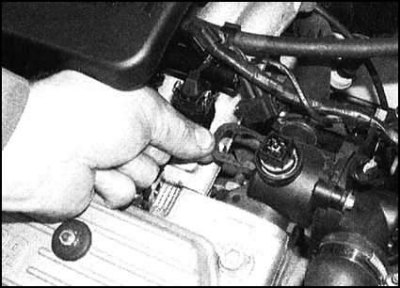
4. The free fit sensor is fixed with a special clamp, which must first be removed.
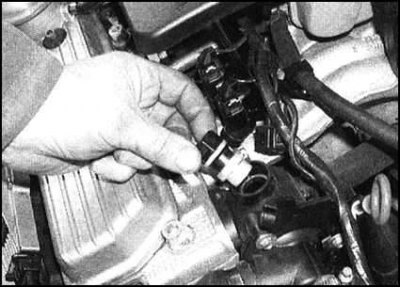
5. Then the sensor is simply removed from its socket.
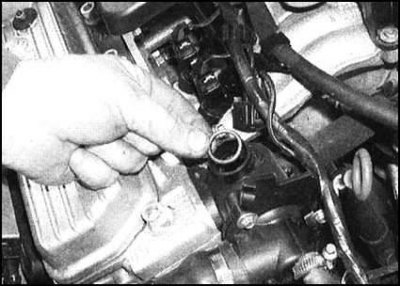
6. Finally, remove the sealing ring as well.
Installation
1. On a screw-in sensor, replace the sealing washer, then screw the sensor into place and tighten it securely.
2. For a loose fit sensor, install a new O-ring onto the sensor, then push the assembly into the housing and secure it with the clamp.
3. Connect the electrical wiring, then add the required amount of coolant to the system.
Fuel injection system temperature sensor (petrol models)
Examination
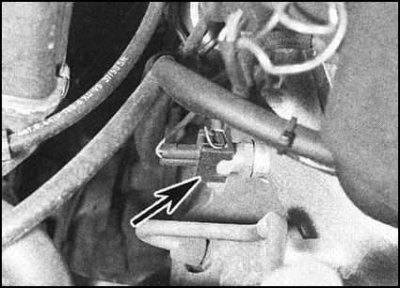
1. On 1.3 L models with central fuel injection (SPFI), the temperature sensor is screwed into the rear of the intake pipe. On all other engines, the sensor is combined with the CTS and installed in the thermostat housing at the left end of the cylinder head.
2. The sensor is a thermistor. The engine/fuel injection system's electronic control unit (ECU) supplies the sensor with power and measures the current flowing in the sensor's operating circuit, the value of which is determined by the thermistor's temperature. This information is then used, among other input signals, to determine the timing and duration of injector operation, idle speed, etc.
3. If the sensor circuit malfunctions, the ECU starts to ignore the signal generated by the thermistor, using instead a certain effective average value that ensures adequate functioning of the controlled systems. At the same time, a control lamp on the instrument panel lights up, warning the vehicle owner of the need to contact a service station. Checking the condition of the sensor itself is only possible using a proprietary diagnostic reader from Skoda. To avoid the risk of damaging the ECU, do not attempt to understand the situation using any other available means.
Preheating system temperature sensor (diesel models)
Examination
A detailed description of the procedure for checking the proper functioning of the diesel engine preheating system is given in Part Preheating system for diesel engines Chapters Electrical equipment of the engine.
Removal and installation
The sensor is integrated into a single unit with the CTS and is installed in the outlet pipe of the cooling tract, located in the front part of the cylinder head. The description of the procedures for removing and installing the sensor is given above.