



Cooling system fan installation diagram
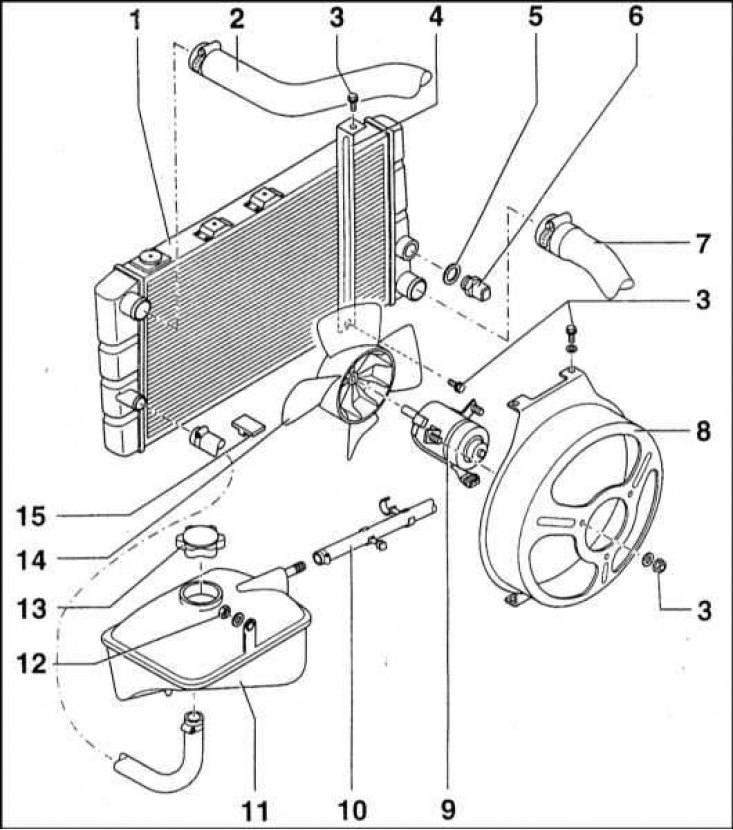
1 - Radiator; 2 - Upper radiator hose; 3 - Bolt; 4 - Mounting bracket; 5 - Sealing washer; 6 - Temperature sensitive switch; 7 - Lower radiator hose; 8 - Fan casing (diffuser); 9 - Drive electric motor; 10 - Air bleed hose; 11 - Expansion tank; 12 - Fastening nut; 13 - Expansion tank cap; 14 - Fan impeller; 15 - Rubber support cushion
Warning! Remember that when the engine is hot, the cooling fan may operate even after the ignition is turned off. Be careful!
General information
Models 1.3 l
The cooling system fan is designed to create a forced air flow through the radiator heat exchanger in order to ensure the required intensity of heat dissipation.
The fan is located behind the radiator and is driven by a PAL 443 132 166 010 electric motor with a power of 55 W.
A 4-bladed plastic impeller is mounted on the motor shaft. The electric motor is placed in a diffuser, which is secured to the upper and lower walls of the radiator heat exchanger using four M6x10 bolts. Three bolts are used to secure the electric motor in the diffuser casing.
The fan switches on when the coolant temperature reaches 97±2°C and switches off when it reaches 88°C (models without K/V).
1.6L models without CV
The fan has an increased diameter (280 mm). The drive uses an electric motor manufactured by Bosch with a power of 130 W.
Note: The same fan, but smaller (250mm) is used on 1.3L models equipped with A/C.
The fan switches on at a temperature of 95±2°C and switches off at 88°C.
Diesel models without CV and petrol models 1.6 l with CV
Caution! The electric motor circuit is designed in such a way that the fan can continue to operate even after the ignition is turned off - be careful!
The fan diffuser is offset to the left and is secured with two bolts on the left and one on the right. The fan impeller is 6-bladed and has a diameter of 300 mm.
The fan manufactured by Gate is attached to the diffuser with three bolts.
The first speed mode of the fan is switched on at a temperature of 95 ±2°C, and switched off at 84°C. The second speed mode is switched on at a temperature of 102 ±3°C, and switched off at 91°C.
Examination
1. Power is supplied to the cooling system fan via the ignition switch and fuse (see Chapter On-board electrical equipment). The circuit also includes a temperature-sensitive fan switch sensor screwed into the radiator wall.
2. If the fan fails, always check the fuses first. If there are no signs of failure, start the engine and warm it up to normal operating temperature, then leave it running at idle speed. If the fan does not start within a few minutes (or before the temperature gauge registers overheating), turn off the ignition and disconnect the sensor-switch wiring. Connect the two contacts of the electrical connector with a jumper and turn on the ignition again. If the fan now starts to function, the faulty sensor-switch should be replaced.
3. If the fan still does not operate, make sure that the sensor-switch connector is properly supplied with battery power (12 V). If there is no power, check the condition of the corresponding electrical wiring (perhaps the fan motor is broken or the fuse is blown). If no faults can be detected, check for conductivity between the sensor-switch ground terminal and the ground. If there is no conductivity, then the ground is broken and appropriate repairs must be made.
4. If performing all the above checks does not reveal the cause of the fan failure, the condition of the impeller drive electric motor should be checked. Disconnect the electrical connector and apply power from the battery directly to the motor terminals. If the motor still does not work, replace it as an assembly.
Removal
1. Disconnect the negative cable from the battery.
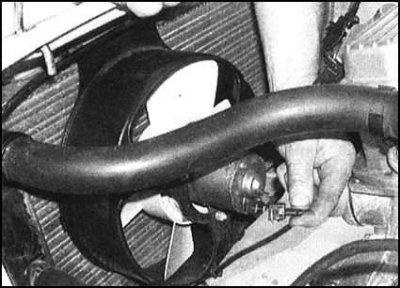
2. Disconnect the electrical wiring from the fan motor,
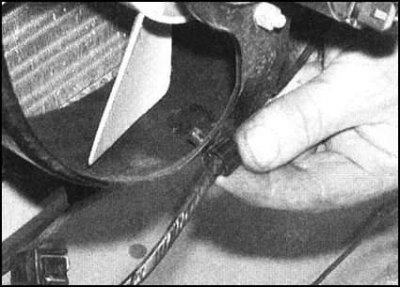
then release the wires from the intermediate clips on the casing,
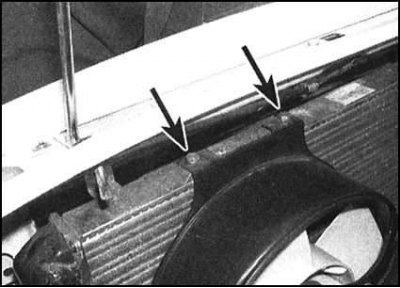
unscrew the mounting bolts
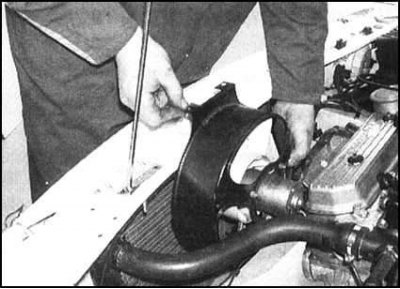
and remove the fan assembly shroud from the rear of the radiator.
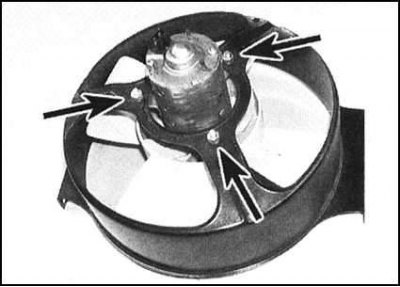
3. If necessary, loosen the mounting nuts, remove the washers and separate the motor from the assembly casing. The impeller can now be removed from the motor after releasing the mounting clamp.
Installation
1. Install the motor assembly onto the casing, put on the washers, then screw on the mounting nuts and tighten them securely. If removed, place the impeller on the motor spindle and secure it with the retainer.
2. Install the assembly on the radiator and secure it with bolts.
3. Restore the original wiring connection (don't forget to connect the battery).
Disassembly
1. Drain the coolant.
2. Disconnect the coolant hoses from the radiator.
3. Disconnect the electrical wiring from the temperature-sensitive switch and the fan drive motor.
4. Remove the mounting bracket.
5. Unscrew the fastening screws and remove the radiator assembly with the fan.
(Article posted on the website SkodaBook)
6. Loosen the diffuser fastener to the radiator.
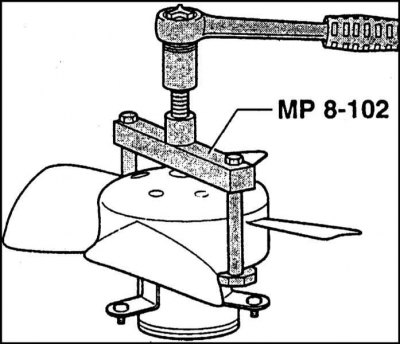
7. Unscrew the fastening screws and remove the impeller using a special tool (MP8-102).
Assembly
Assembly is carried out in the reverse order of disassembly. Pay special attention to the following points:
- a) The impeller must be pressed onto the assembly, but must not be jammed under any circumstances;
- b) Tighten all fasteners to the required torque;
- c) Ensure that the components are seated correctly;
- d) Don't forget to fill the system with fresh coolant.