



Heater and its installation in the car cabin
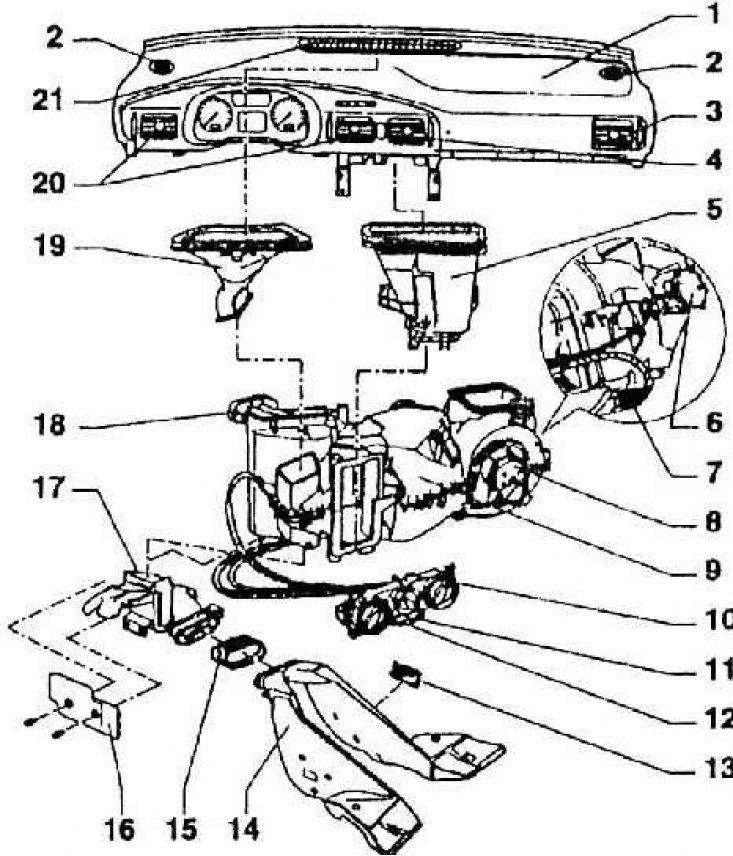
1 – instrument panel; 2 – ventilation hatch for demisting side windows; 3 – right ventilation hatch; 4 – ventilation hatch middle right; 5 – intermediate part of the air distributor; 6 – circulation damper servomotor; 7 – additional fan resistance; 8 – fan; 9 – air conditioner; 10 – heater control; 11 – fresh and recirculated air switch; 12 – Air conditioning switch; 13 – ventilation hatch; 14 – air distributor on the rear floor; 15 – intermediate part of the air distributor on the rear floor; 16 – front floor air distributor cover left; 17 – Front floor air distributor; 18 – heat exchanger; 19 – intermediate part to the ventilation hatch; 20 – ventilation hatch left and middle left; 21 – Ventilation hatch for defrosting the windshield
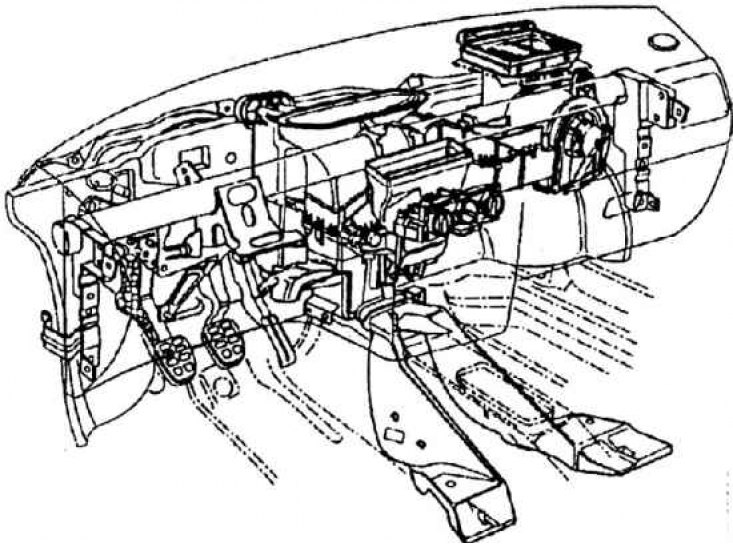
Installing the heater and fan assembly on the cross wall of the passenger compartment
Dismantling and installation of dust filter
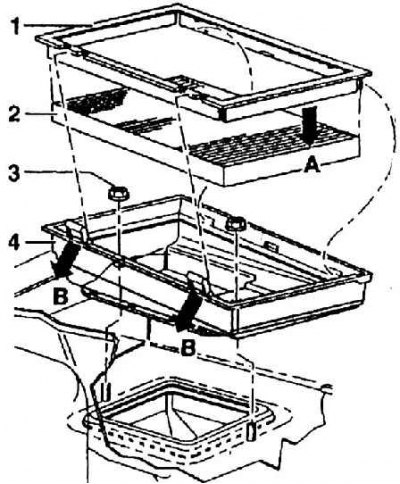
1 – frame; 2 – filter insert; 3 – plastic nut; 4 – filter box with seal
Dismantling: remove the right casing of the upper part of the cross wall; remove the filter box clamps in the direction of arrows B and remove the filter together with the frame.
Installation: the frame (1) must be pushed up to the first layers of the filter insert (A).
Air conditioner compressor and condenser
(The original article is located on: SkodaBook.ru)
Scheme of refrigerant circulation in air conditioner
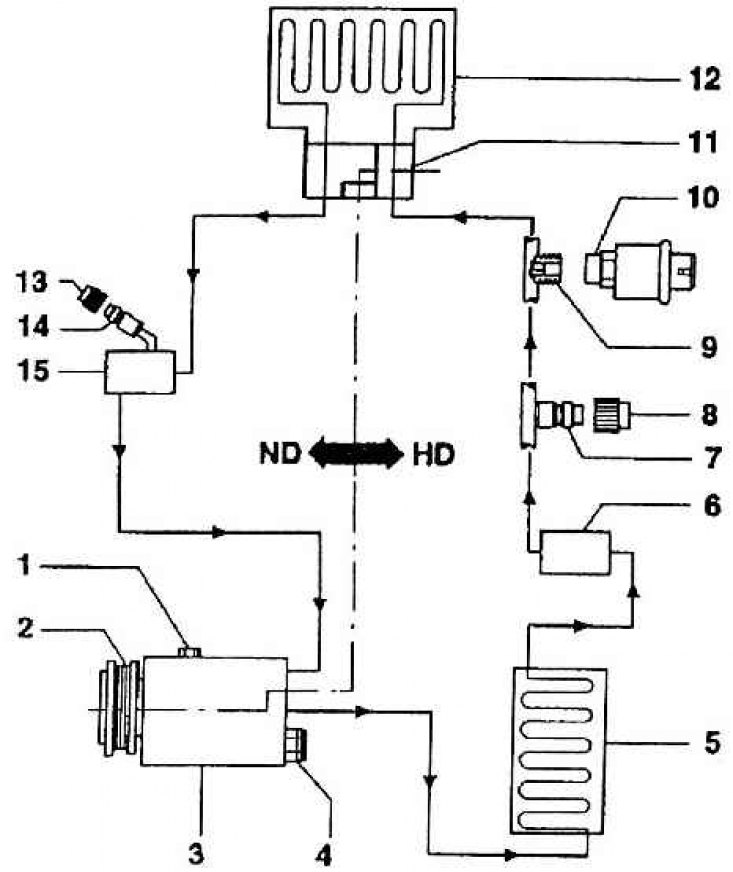
HD – high pressure branch; ND – low pressure branch; 1 – oil drain screw; 2 – electromagnetic clutch; 3 – compressor; 4 – overpressure safety valve; 5 – capacitor; 6 – tank for liquid with desiccant; 7 – valve for suction, filling and measuring; 8 – cork; 9 – input with valve; 10 – button to turn on the air conditioner; 11 – expansion valve; 12 – evaporator; 13 – cork; 14 – valve for suction and measurement; 15 – damper
One of the assembly units of the cross wall of the passenger compartment is the heater (see fig. Heater and its installation in the vehicle cabin, fig. Installation of the heater and fan assembly on the cross wall of the passenger compartment) or heater with air conditioning. It follows that a large number of parts are suitable for both the heater and the air conditioner. Moreover, this is one of the units unified with other VW concern cars. Specifically, both the heater and the air conditioner used in Skoda Octavia cars differ from the concern's version only in terms of the control panel and air distribution. The flow of coolant through the heater heat exchanger is constant, the heater does not have a valve in the coolant flow system. The amount of air passing through the heater heat exchanger is controlled. and, consequently, the heat exchanger power is controlled by the left rotating head of the regulator on the control panel. In cooling mode (regulator on blue field) the air flow is greater than when the regulator is in the red field. This is because there is more resistance, or back pressure, as the air passes through the heater heat exchanger. A detailed description of the heater, fan and air conditioner adjustments is given in the SERVICE INSTRUCTIONS. Air for the heater (or fan) is taken from a gutter in front of the windshield, covered by the hood. Air enters the heater through a dust filter (see fig. Dismantling and installation of dust filter). The filter is made of artificial fibers. The active surface of the filter is increased by folding the fabric. By removing the plastic frame, you can change the filter insert. The holder with the filter is placed in the gutter, and the outlet pipe from it runs along the bottom of the gutter and is fixed on the neck of the heater. In this neck there is a recirculation flap controlled by an electric motor (servomotor) switched on, as already mentioned, by a button on the heater control panel.
The air then enters the turbine wheel of the fan, on the horizontal axis of which is an electric motor. Flowing around the mixing valve, the air flow passes either through the heater heat exchanger or past it (in whole or in part). The heater heat exchanger is of standard design, which means that it is aluminum tubes inserted with rubber inserts into the side chambers. The tubes are equipped with sheet plates. Then, in the heater body, the air is distributed using flaps into the air distributor. All heater flaps are controlled by rotary regulators using rods in flexible shells.
In case of installation of the heater with air conditioner, the same elements are used for the heater as for a single heater, only between the fan and the chamber with the mixing flap there is also a box with an evaporator inserted. In the air conditioner, of course, there are more parts, which are not, however, part of the heater.
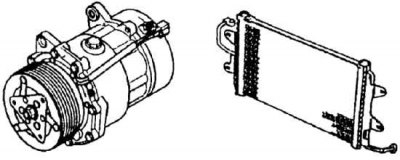
We are talking about the condenser (a narrow radiator located in front of the engine coolant radiator; see fig. Compressor and condenser of air conditioner), valve for filling and pumping out the cooling medium and for measuring (low pressure), compressor, liquid tank with desiccant, valve for pumping, filling and measuring (high pressure and expansion valve). The cooling medium is the environmentally friendly refrigerant R 134a, which is used to fill the air conditioners of all VW vehicles.
The operating principle of the air conditioner is as follows (see fig. Scheme of refrigerant circulation in the air conditioner): the refrigerant from the compressor under pressure in a gaseous state enters the condenser (radiator), where it liquefies. From there it enters the dryer, in which, like in a filter, moisture and, if any, oil are separated. Then through a hose it enters the expansion valve - all the time in a liquid state. In the expansion valve it expands and changes its phase state to gaseous while simultaneously entering the evaporator (cooling part of the air conditioner, inserted into the heater kit). There it takes heat from the passing air and returns it to the compressor. The compressor is placed on a common console with the generator. The mount differs for different types of engines. The air conditioner compressor itself is a seven-piston one with a smooth change in the piston stroke. The stroke changes according to the slope of the bevel of the plate, during the rotation of which the pistons move in the cylinders. The total volume of the compressor cylinders is in the range of 161.3–8.1 cm³. Each piston with a diameter of 29.3 mm has a stroke from 1.7 to 34.2 mm. Working speed – 8000 min. Maximum working pressure – 3.25 MPa. Oil filling in the compressor – 135±15 cm³. The oil is special and is not changed or topped up. However, a complete change can be carried out in the event of a leak of the air conditioner refrigerant. (Only at the Skoda service, which specializes in this operation!)
The air conditioner is switched on when the compressor is switched on. An electromagnetic clutch is inserted into the compressor pulley, which constantly rotates the pulley (while the engine is running), connected to the compressor drive shaft. The dehydrator is located on the right side of the condenser. A thermal switch, located in the plastic box of the thermostat together with the engine coolant temperature sensor, protects against accidental rise in engine coolant temperature depending on the operation of the air conditioner. The thermal switch turns off the air conditioner if the engine coolant temperature reaches 114°C (to prevent the engine from overheating).
In conclusion, it should be emphasized that the description provided is purely informative. Unqualified intervention in the air conditioner and its parts is unacceptable. Any defect should be eliminated only in the Skoda service.