



Contents: Examination ⬇ Adjusting the front wheel alignment ⬇ Checking the parallelism of the rear…⬇
The vehicle's handling and tread life largely depend on the accuracy of the basic settings of the suspension and steering geometry. Before adjusting the suspension geometry, make sure that the tires are inflated to the correct pressure, the rims are not bent, the wheel bearings are not worn, and the steering gear is not loose. All parameters that determine the suspension geometry are measured in degrees (linear units [mm] can also be used to determine toe-in). The wheel pivot axis is an imaginary line drawn through the suspension strut axis and extended to contact with the ground. The front suspension geometry is determined by four parameters.
Camber is the angle at which the planes of the wheels deviate from the vertical. Camber is called positive when the upper edges of the wheels deviate from the vertical outward. Otherwise, we speak of negative camber. Camber adjustment is not possible.
The longitudinal tilt angle of the wheel pivot axis is the angle by which the wheel pivot axis is tilted from the vertical in the plane of the disk. The angle is considered positive when the axis is tilted backwards with its upper end. This parameter is also not subject to adjustment.
Toe-in is the value by which the distances between the front and rear edges of the inner sides of the wheel rims differ. With positive toe-in, the rear edges of the rims are wider than the front ones, and vice versa. Adjustment of the front wheel toe-in is made by adjusting the length of the steering rods by loosening or screwing on the outer ends. The toe-in of the rear wheels is not adjustable.
The transverse tilt angle of the wheel's steering axis is the angle between the vertical and an imaginary line drawn through the suspension strut supports when looking at the car from the front or rear. Again, no adjustment is provided.
Examination
Due to the need to use precision equipment to measure suspension geometry, the testing and adjustment of parameters should be entrusted to service station specialists.
Adjusting the front wheel alignment
1. The toe-in is checked by measuring the distance between the front and rear edges of the inner rims of the wheel disks. Adjustment is made by adjusting the length of the steering rods.
2. For the purity of the measurements taken, the vehicle must have a net weight, i.e. be unloaded with a full fuel tank.
3. Before you begin adjusting, make sure that the vehicle is equipped with wheels of the required size, the tires are inflated to the correct pressure, the rims are not bent, the wheel bearings are not worn out, and the steering drive is not loose. Eliminate all detected faults and violations.
4. Park the vehicle on a level, paved surface. Keep the front wheels straight, then rock the vehicle body front and rear to settle the suspension components. Release the parking brake and roll the vehicle back 1 m, then return it to its original position - this should relieve any residual stress from the suspension components and steering gear.
5. Measure the distance between the front edges of the inner sides of the front wheel rims at the height of the hub, then repeat the measurement, this time measuring the distance between the rear edges of the rims. The results of the measurements should differ from each other by the amount specified in the Specifications (the rear edges of the wheels should be wider than the front ones).
6. If toe-in adjustment is necessary, set the parking brake, then jack up the front of the vehicle and place it on supports, turn the steering wheel to the left as far as it will go and count the number of exposed threads on the outer end of the left tie rod. Turn the steering wheel to the right and repeat the measurement for the right tie rod. If the measurement results for both tie rods are the same, toe-in adjustment is made by screwing/unscrewing the outer tie rod ends by the same number of turns. Otherwise, the difference should be compensated for during adjustment.
7. First of all, clean the threads on the ends of the steering rods. If there is corrosion, moisten the rods with a special softening compound. Release the outer bandages of the steering gear protective covers, pull them back and fill them with grease to prevent the covers from twisting when the rods are rotated.
8. Using a flatness gauge and a scriber, mark the position of the tie rod ends in relation to their outer ends, then secure the rods and loosen the lock nuts completely.
9. Adjust the overall length of the rods. Rotate the rods with an open-end wrench placed on the specially provided flats. Reducing the length of the rods (screwing them into the tips) will result in a decrease in wheel alignment.
10. Once the adjustment is complete, secure the tie rods and tighten the end locknuts to the required torque. Make sure that the end joints are seated correctly in their receiving sockets and count the number of exposed threads on the rods of both tie rods. If the counting results for one rod differ from the results for the other, the adjustment was made unevenly and one of the wheels may catch on the wheel arch when turning. In addition, the symmetrical fit of the steering wheel on the column shaft will be disrupted.
11. If the length of both rods is the same, lower the car to the ground and repeat the toe-in check. Repeat the adjustment if necessary. Having achieved a satisfactory result, finally tighten the locknuts of the rod ends with the required force, and check the proper fit of the protective covers and secure them with bandage tapes.
Checking the parallelism of the rear axle installation
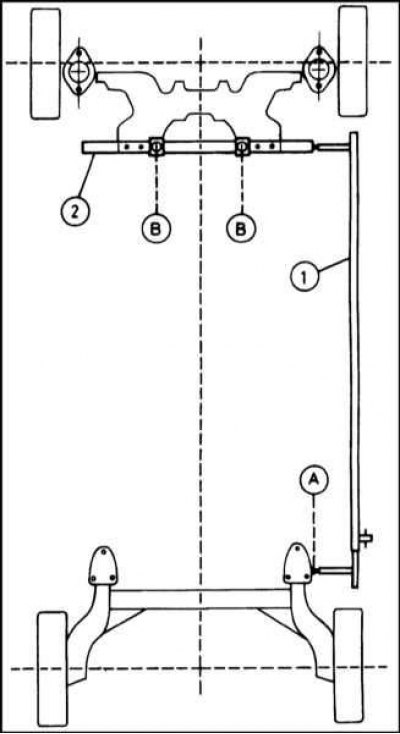
A - Center of rear axle mounting bracket; B - Guide holes in the front subframe
The original can be viewed on: SKODABOOK.ru
1. The possibility of adjusting the geometry of the rear suspension on cars of the brand in question is not provided, but it is important to make sure that the rear axle is parallel to the front subframe. To perform this check, it is best to use a special branded conductor manufactured by Skoda.
2. Support the front wheels with wedges, then jack up the rear of the car and place it on supports.
3. Measure the distance from the rear edge of the front subframe to a line drawn through the centers of the rear axle mounting brackets. This distance should be the same on both sides of the car. Otherwise, the parallelism of the rear axle installation is broken and adjustment is required.
4. To make the adjustment, loosen the axle mounting bracket mounting bolts and move the brackets accordingly. Once the adjustment is satisfactory, tighten the fasteners to the required torque.
5. Make sure the adjustment is correct, then lower the vehicle to the ground.