



Rear suspension shock absorber
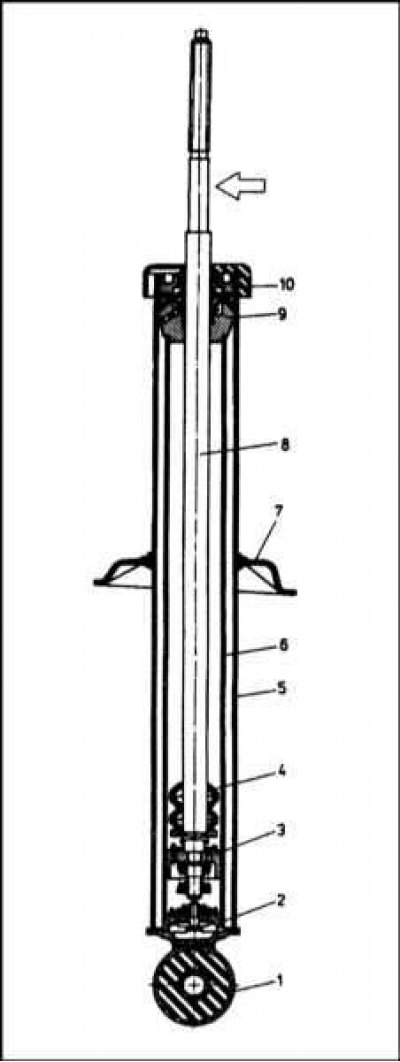
1 - Lower support; 2 - Compensating valve; 3 - Piston; 4 - Damper; 5 - Casing; 6 - Working cylinder; 7 - Spring plate; 8 - Rod; 9 - Guide bushing; 10 - Cork (the arrow indicates the location of the factory marking)
Upper Rear Suspension Strut Components
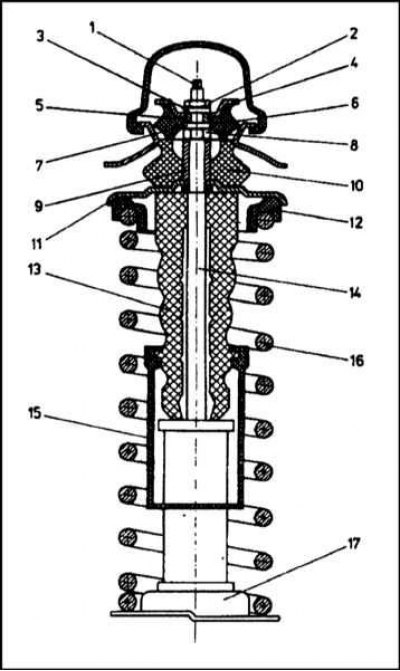
1 - Rod stem; 2 - Nut; 3 - Washer; 4 - Cup; 5 - Bushing; 6 - Small rubber cushion; 7 - Washer; 8 - Nut; 9 - Bushing; 10 - Large rubber cushion; 11 - Spring plate; 12 - Rubber washer; 13 - Compression stroke buffer; 14 - Rod; 15 - Casing; 16 - Coil spring; 17 - Spring seat
Note: Prepare a tool for compressing coil springs. When removing components, remember their exact installation position.
1. After removing the rack from the car, clean it from the outside from accumulated dirt, then clamp it vertically in a vice. Using a special device, compress the coil spring, completely removing the load from the plates. Make sure that the tool is correctly secured to the spring coils (follow the manufacturers instructions strictly).
(The article is located on the website skodabook)
2. Use a wrench to prevent the piston rod of the rack assembly from turning and loosen the upper mounting nut.
3. While noting the correct installation positions of the components, remove the upper support rubber cushion, spacer sleeve, retainer and upper spring plate.
4. Remove the coil spring, then the ring bushing, the rubber compression buffer and the protective sleeve from the shock absorber piston. If necessary, remove the cover from the top of the main shock absorber body, then the lower spring plate.
5. Make sure there are no traces of fluid leaks on the surface of the shock absorber. Check the piston rod along its entire length for cavities, and the shock absorber body for external deformations. Holding the strut vertically, check its proper functioning by moving the piston rod first from stop to stop, then in short jerks of 50-100 mm. In both cases, the resistance to the movement of the rod should be smooth and constant. In the event of jerks or jamming points, as well as any other signs of damage, replace the faulty strut.
6. Check all remaining assembly components for signs of wear and damage. Pay particular attention to the condition of the rubber cushion and spring seat. Replace any defective components.
7. If removed, reinstall the lower spring plate and snap the upper shock absorber cover into place.
8. Place the compression stroke buffer and protective sleeve on the piston, then install the coil spring, ensuring that its lower end is correctly positioned relative to the plate stop.
9. Having fully extended the shock absorber, install the upper spring plate in place and turn it with the stop in the desired direction in relation to the end of the spring.
10. Install the ring bushing, spring retainer, spacer bushing and upper support rubber cushion. Screw on the nut. Secure the shock absorber piston rod from turning and tighten the nut to the required torque.
11. Make sure that the spring is correctly positioned relative to the stops of the upper and lower plates, then release the compression tool and remove it from the stand.