



Contents: General information ⬇ Control Panel ⬇ Air duct deflectors ⬇ General instructions ⬇ Economical use of air conditioner ⬇
General information
Air conditioning (A/C) is a combined device that allows you to regulate the temperature and humidity in the car's interior over a wide range. With the help of A/C, a comfortable atmosphere can be maintained inside the car at any time of the year.
In cooling mode, the air conditioning system functions only when the engine is running and the ambient temperature is above +5°C. Along with the temperature, the relative humidity of the air enclosed in the cabin also decreases, which makes conditions more comfortable in damp weather.
Control Panel
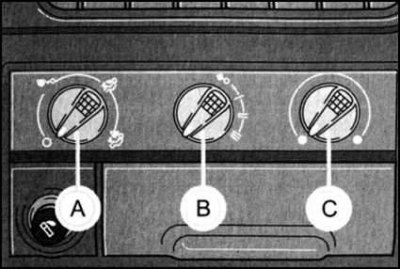
Air distribution direction handle (A)
This handle is used to select the direction of air distribution between the air ducts of the interior heating/ventilation system.
Fan speed/air intake shut-off control knob (B)
This handle regulates the flow of air pumped into the cabin. The handle has five discrete positions (0, I, II, III and IIII). In position 0 of the handle the fan is switched off. If it is necessary to prevent polluted or foul-smelling air from entering the passenger compartment, press button E (closed circuit mode on/off button - see below)
Handle for adjusting the temperature of the air supplied to the passenger compartment (C)
In the extreme left position, the heater is switched off. Smooth increase of the temperature of the forced air is carried out by turning the handle clockwise. The handle can be used to increase the air temperature correction even when the air conditioner is on.
Air conditioner on/off button (D)
 The air conditioning can only be turned on when the engine is running. Pressing the button again turns the air conditioning off.
Air circulation mode on/off button (E)
 When the closed circulation mode is switched on, the supply of outside air to the passenger compartment is completely stopped. The mode can be used both with the air conditioning on and off. In the latter case, the air quickly becomes stale as a result of switching on the mode, and condensation forms on the windows.
Air duct deflectors
The location, purpose and equipment of the deflectors are similar to those described above for models not equipped with air conditioning.
Windshield and side window defrost mode when they are frozen
Move the control panel handle B to position IIII. Set the handle A to position
 . Turn handle C all the way to the right. Close the flaps of air duct deflectors 3. Turn the louvered grilles of air duct deflectors 4 so that the air comes out in the direction of the front door windows of the car.
Preventing fogging of windshield and side windows
At high air humidity (rain, fog, etc.) car windows tend to fog up.
To remove condensation, turn in cold weather, proceed as described above for models not equipped with air conditioning. To speed up the process, turn on the closed air circulation mode (button E).
In hot weather, simultaneous operation of the air conditioner and heater helps to quickly dry the air. Selecting the closed circulation mode will speed up the process.
Accelerated heating of the passenger compartment
See above for models without A/C. To speed up the process, turn on the closed air circulation mode (button E).
Creating comfortable temperature conditions in the car interior
After removing condensation from the glass and warming up the interior, make the following adjustments:
Turn knob B to position II or III. Using knob C, select the required heater heat exchanger capacity. Set knob A to position
 . If the windows fog up again, change the position of handle A, directing the air to blow out the windows. Close the air vents 3. Turn the louvered grilles of the air vents 4 to the optimal position at your discretion.
Optimal air cooling mode in the cabin
Turn the control panel knob B to position II or III (optimum air delivery performance for cooling the air in the cabin), or to position IIII if it is necessary to speed up the process. Turn handle C all the way to the left.
Note: Depending on specific conditions, the discharge air temperature can be increased by changing the handle position accordingly.
Move handle A to position
 . Open the deflectors of air ducts 3 and 4. Press button D to turn on the air handling unit. The direction of the air flow through the deflectors can be adjusted according to the operator's wishes.
In this mode, pre-cooled outside air is supplied to the passenger compartment.
Accelerated air cooling mode in the cabin
Close the doors tightly, close all windows and the roof hatch. Turn on the fan to maximum performance (handle B - in position IIII). Turn handle C all the way to the left. Move handle A to position
 . Open the deflectors of air ducts 3 and 4. Turn on the air conditioning (button D) and set the closed air circulation mode (button E).
In this mode, the supply of outside air to the cabin is completely stopped, and the air trapped in the cabin is quickly cooled, circulating through the air conditioner heat exchanger.
Note: The closed circulation mode should only be used for short periods of time, as the air quickly becomes stale. It is recommended to refrain from smoking while the mode is turned on.
Cabin ventilation mode
To ventilate the passenger compartment, it is necessary to ensure that outside air is supplied to it through air duct deflectors 3 and 4.
Switch off the air conditioner (button D) and switch off the closed air circulation mode (button E). Using the handle B, select the desired fan speed mode. Turn the handle C all the way to the left. Move the handle A to the position
 , or other, depending on the specific situation. Open the air supply through the air duct deflectors 3 and 4.
General instructions
Attention! A properly functioning air conditioning system is capable of cooling the air pumped into the passenger compartment down to a temperature of +5°C. At the same time, prolonged uneven supply (for example only in foot wells) and temperature contrast (for example, when getting out of a car) may cause colds to develop in people who are sensitive to temperature changes.
When the air conditioning is on and there is a certain relative humidity, the condensate that forms on the surface of the system's evaporator can flow from the pan, forming a puddle under the car, the appearance of which is quite natural, is not a sign of a breach in the system's tightness and should not cause panic.
The correct functioning of the elephant's heating/ventilation system is possible only if the air intake grille located in front of the car's windshield is normally passable. Monitor the condition of the grille, clean it from time to time from snow, ice, stuck leaves and other debris.
All control panel handles, with the exception of handles A and B, allow smooth adjustment of the controlled parameters.
Economical use of air conditioner
The operation of the compressor switched on in the cooling mode of the air conditioner leads to an increase in the load on the engine and, as a consequence, an increase in fuel consumption.
When the interior heats up excessively (for example, after a car has been parked for a long time in direct sunlight) the authors of this Guide recommend that before turning on the air conditioning, briefly open the doors or windows to release the hot air outside.
Do not use the air conditioning while the vehicle is moving with the windows or sunroof open.
If it is possible to achieve a comfortable temperature in the cabin by using only the ventilation system, it is recommended to refrain from turning on the air conditioner.