



Contents: Coolant Temperature Gauge (1) ⬇ Speedometer/Odometers (2) ⬇ Tachometer (3) ⬇ Analog clocks (3) ⬇ Digital display watches (4) ⬇ Fuel consumption meter (5) ⬇ Ambient temperature meter ⬇
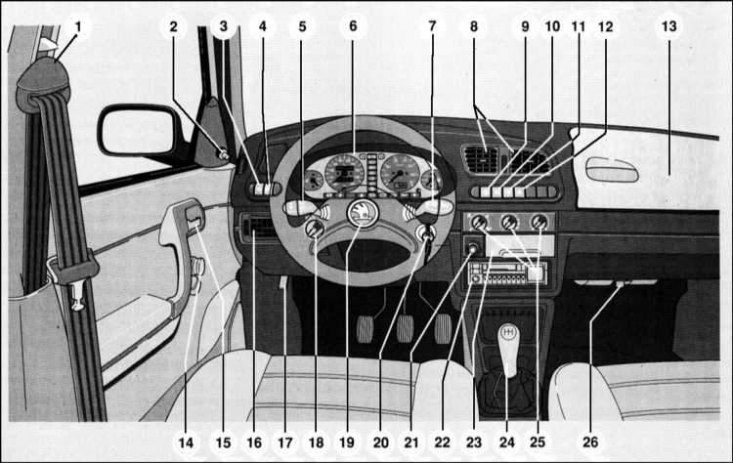
1 - Height adjustable seat belt anchorage; 2 - Handle for adjusting the position of the outside rearview mirror; 3 - Side lights/instrument lighting switch; 4 - Low beam headlight switch; 5 - Combined steering column switch for controlling the turn signals and high beam headlights; 6 - Instrument cluster with instrument cluster; 7 - Combined steering column switch for controlling the operation of windscreen wipers/washers; 8 - Central air vents for the interior heating/ventilation system; 9 - Rear window heating switch; 10 - Fog light switch; 11 - Rear fog light switch; 12 - Hazard warning switch; 13 - Glove box; 14 - Window lifter control handle; 15 - Inner door handle; 16 - Side deflectors for air ducts of the interior heating/ventilation system and defroster of the side windows; 17 - Hood release control lever; 18 - Switch for adjusting the position of the optical axis of the headlights; 19 - Horn button; 20 - Ignition/steering column lock; 21 - Cigarette lighter; 22 - Radio panel; 23 - Ashtray; 24 - Gear shift lever; 25 - Control panel for the operation of the interior heating/ventilation system; 26 - Fuse and relay mounting block
Instrument cluster
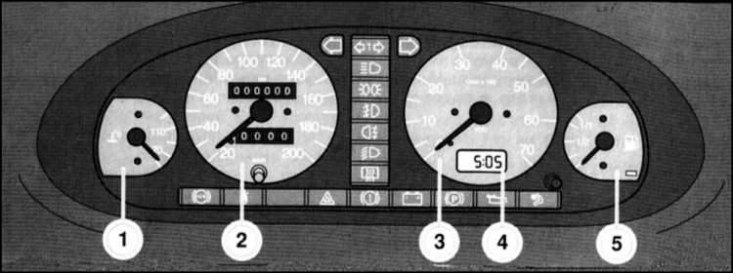
1 - Coolant temperature gauge; 2 - Speedometer with trip meters; 3 - Tachometer/analog clock; 4 - Digital clock display; 5 - Fuel consumption meter
Note: The numbering given in the text corresponds to that shown in the illustration.
Coolant Temperature Gauge (1)
The meter functions only when the ignition is on, taking the operating position with some delay. When the coolant is cold, the instrument needle is at the bottom of the scale. The normal operating temperature range is from 70°C to 110°C. In hot weather, as well as with increased engine load, the coolant temperature may rise up to the upper limit of the normal operating range of the scale. However, under no circumstances should the meter needle enter the red section of the indicator scale. If the needle passes the upper permissible value, this indicates engine overheating. In this case, the car should be stopped and, without turning off the engine, the heater and heater fan should be turned on at full power, then check the fluid level in the expansion tank of the cooling system and make sure that the radiator blower fan is working properly. If the fan does not function, or the fluid level in the expansion tank has dropped below the permissible value, the engine should be turned off immediately. If the fluid and fan are OK, the movement can be continued, but only if the pointer has returned to the permissible range. Otherwise, the engine should also be turned off.
If the coolant level is normal, the cause of engine overheating may be a failure of the cooling system fan. Check the condition of the corresponding fuse, replace it if necessary. If there is a failure of the fan electric motor or failure of its impeller, movement may be resumed after some time (provided that the coolant level is normal), and the car should be driven to the nearest service station. Due to the fact that with a faulty fan the efficiency of the radiator will be determined only by the speed of the oncoming flow, you should try to drive at a good (but not too high) speed, reducing coasting to a minimum.
Attention! Turning on additional headlights installed under the radiator grille reduces the efficiency of the latter and may lead to engine overheating in hot weather or when driving with increased load.
Speedometer/Odometers (2)
The speedometer is an analog one. The unit of division of the dial scale is 10 km/h. In the upper half of the dial field there is a drum of the total mileage counter of the car since its release from the conveyor (odometer). The drum counter located under the axis of the arrow records the mileage of the current trip. The mileage counter of the current mileage is reset using the handle mounted in the lower part of the speedometer dial.
Tachometer (3)
The device registers the engine crankshaft speed at 1000 rpm. Never allow the meter needle to enter the red sector of the dial scale. Remember that timely switching to a higher gear helps save fuel and reduce the noise level of the power unit.
Avoid excessive engine speed increase during vehicle break-in.
Analog clocks (3)
On some models, an analog clock is included in the instrument cluster instead of a tachometer. The time setting knob is located on the right under the clock face.
Attention! Do not get distracted while driving - set the time only when parked!
Digital display watches (4)
The digital clock display is built into the tachometer dial field. The time setting handle is located on the right under the meter block. By turning the handle counterclockwise, the current hour is selected; to set the minutes, the handle should be turned to the right. Try not to press the handle excessively when setting the time to avoid damage to the regulator.
Attention! Do not get distracted while driving - set the time only when parked!
Fuel consumption meter (5)
The meter is activated only when the ignition is on. There is a slight time delay before the pointer reaches the working position. It should be remembered that the fuel tank capacity of carburetor models is about 47 liters, while for models equipped with a fuel injection system it is only 42 liters.
Deviations in the meter readings and short-term illumination of the fuel reserve indicator lamp during maneuvers are associated with the movement of the fuel surface level in the tank and should not cause concern.
Constantly lit indicator lamp indicates that the fuel supply is running low. At the same time, there are still about 6 liters of fuel left in the tank.
Ambient temperature meter
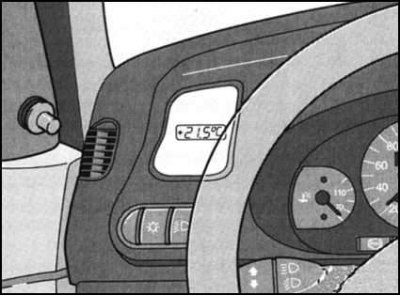
The digital display of the meter is mounted on the left side of the instrument panel. The measurement range is from -45°C to +50°C. The display of the real value of the ambient air temperature is performed with a delay of about 5 minutes. When parked or when driving at low speed, the meter readings may be slightly overstated due to the effect of the heat emitted by the engine on the sensor.
Attention! Remember that icy conditions may occur even at temperatures above 0°C!