



Contents: Connecting rod and piston group -…⬇ Engine 1.3 l ⬇ Diesel engine and petrol engine 1.6 l ⬇ Removal ⬇ Examination ⬇
Marking on the piston bottom
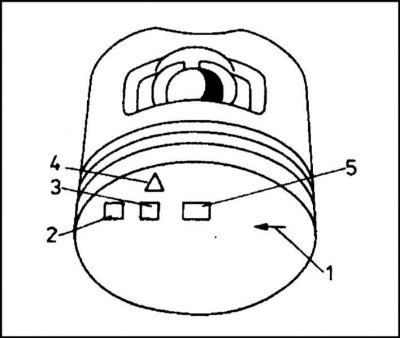
1 - Arrow indicating the direction of rotation of the crankshaft; 2 - Manufacturer's identification number; 3 - Release date; 4 - Manufacturer's trademark; 5 - Piston diameter (designated by the letters A, B or C)
Piston rings
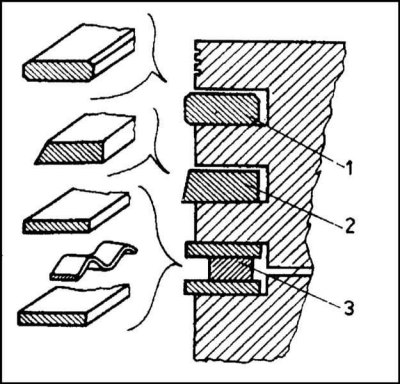
1 - First (upper) compression ring; 2 - Second (lower) compression ring; 3 - Oil scraper ring
Connecting rod and piston group - general information
Engine 1.3 l
Pistons
The pistons are made of aluminum alloy, which is characterized by high heat resistance, significant durability and hardness.
The piston consists of a skirt and a bottom. The shape of the skirt ensures proper adhesion of the piston to the walls of the sleeve/cylinder, eliminating the possibility of it jamming during operation.
A piston pin is installed in the bosses inside the piston, with the help of which the assembly is attached to the upper head of the connecting rod.
The axis of the hole for the piston pin is offset relative to the piston axis. This asymmetry is intended to minimize the loads that occur when the assembly passes TDC.
The pistons used in the engines under consideration have a bimetallic design: in the area of the holes for the piston pin, there are four steel belts that limit the variations in the piston diameter associated with temperature changes. Thanks to such protection, it became possible to reduce the gaps between the piston walls and the cylinder mirror to 0.02 mm.
The piston surface has three grooves for installing piston rings. Above the groove of the first (upper) compression ring, three additional grooves are made, which are intended to limit heat transfer from the hot piston bottom to the upper ring, which is in the most severe operating conditions.
The piston bottom has markings.
Pistons must be matched to liners/cylinders, corresponding to their size groups. When installing connecting rod and piston assemblies in the engine, make sure that the arrow mark is facing the direction of crankshaft rotation (i.e. to the left of the engine).
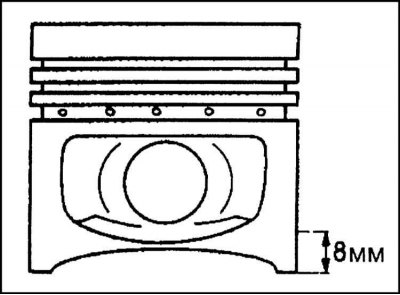
The piston skirt surface has a complex shape, which is why the diameter measurement must be performed strictly in the specified place, at a height of 8 mm from the lower edge of the skirt. The measurement should be performed in a plane perpendicular to the axis of the piston pin. In this case, the temperature of both the piston itself and the measuring tool must be equal to 20°C.
Pistons are produced only in nominal sizes and are divided by diameter into three size groups (A, B and C).
To ensure stable engine operation, all four pistons must have the same mass. To ensure this condition is met, the pistons are weighed during manufacturing. The mass spread is corrected by removing metal from the skirt.
Piston pins
The piston pin provides a hinge connection between the piston and the connecting rod. The pin is made of high-quality steel, ground and polished. The upper head of the connecting rod sits on the middle part of the pin. The ends of the pin are threaded through the holes in the piston bosses. To fix the pin tucked into the assembly, locking rings are used.
The new pin is installed in the piston with a small interference fit, without a gap or with a minimum gap. The pin is seated in the bushing of the upper connecting rod head with a gap. If there is excessive play, the pins begin to knock when the engine load increases.
Before installing the pin, a retaining ring is installed on one side of the piston (use a special device to fit the ring). Then, from the opposite side, a piston pin, lightly lubricated with engine oil, is inserted into the piston. The pin is inserted so that its end protrudes inside the piston by 1÷1.5 mm. Next, the upper head of the connecting rod, also lightly lubricated with engine oil, is inserted into the piston (make sure that the oil flow hole in the upper part of the connecting rod is directed in the direction opposite to that indicated by the arrow on the piston bottom). Next, insert the pin with its end until it stops in the retaining ring inserted into the piston and install the second retaining ring on the other side of the pin.
Piston rings
Each piston is equipped with three piston rings, which are installed in grooves specially made in the upper part of the piston walls. The shape and order of the rings in the grooves are shown in the illustration.
The upper compression ring is made of steel and chromed on the outside to reduce the friction component and protect the metal from the aggressive effects of hot exhaust gases. The ring has a regular round shape and a symmetrical cross-section in the form of a rectangle with truncated corners.
The second (lower) compression ring is made of cast iron and has an asymmetrical cross-section in the form of a rectangle with an inclined outer side. The angle of inclination of the outer edge of the ring is about 1°, due to which the pressure of the ring to the cylinder mirror falls on a very small area. The wear of the contact area ensures a tight fit of the ring.
On one of the end surfaces of this ring there is a mark in the form of the inscription "TOP". The ring should be installed on the piston with this mark facing up.
The oil scraper ring consists of three separate sections: two narrow side rings and a wave-shaped expander placed between them. The total thickness of the assembly is 3 mm.
The oil removed by the ring from the cylinder mirror is discharged through the holes in the groove into the piston and then into the engine oil pan.
All piston rings have a split design. The ring splits are called locks, they provide the ability to install the rings on the pistons, and also serve to compensate for thermal expansion.
The new ring is pressed most tightly against the cylinder mirror in the area of the lock. During further running-in, the clamping force gradually equalizes along the perimeter of the ring, ensuring maximum sealing of the assembly.
Replacing piston rings on a worn engine, whose cylinders have lost their original shape, only results in a short-term restoration of compression, since the ring cannot take the shape of the worn cylinder and its fit is unevenly distributed.
Connecting rods
The connecting rods are forged from special steel. The connecting rod consists of an upper head, a connecting rod and a lower, split head. A bronze bushing is pressed into the upper head of the connecting rod, which acts as a bearing for the piston pin. The connecting rod has an I-section. The lower head is cut in a plane perpendicular to the longitudinal axis of the assembly.
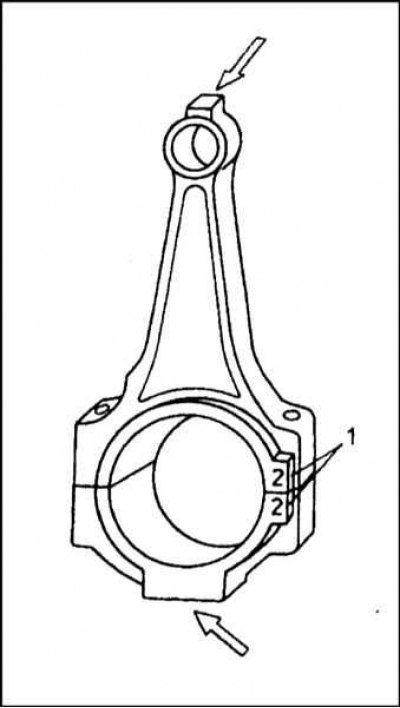
The surface of the beds for installing the connecting rod bearing liners in the split lower connecting rod head is carefully processed. As a result of such processing, the interchangeability of the connecting rod bearing caps is lost, due to which special installation marks are provided on the caps and lower heads. During factory assembly, the marks usually correspond to the cylinder numbering.
The cover is attached to the connecting rod using special high-strength bolts and two nuts with M9x1 threads.
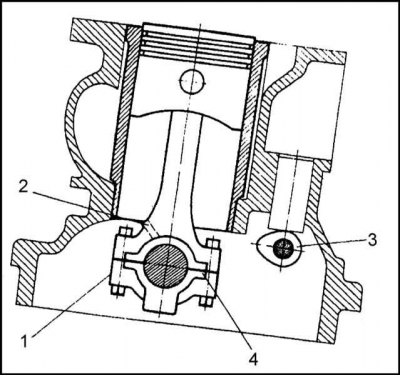
The upper head of the connecting rod has a through hole through which oil is supplied to the cylinder walls during engine operation. When installing the connecting rod, make sure that this hole is directed away from the camshaft.
By weight, connecting rods are divided into two groups. Lighter ones (weight 590÷598 g) are marked with a yellow mark applied to the head. On heavier connecting rods (600÷609 g) the mark is blue. All connecting rods in the engine must have the same weight, and when adjusting, the weight of heavier connecting rods is brought to the weight of lighter ones, and not vice versa.
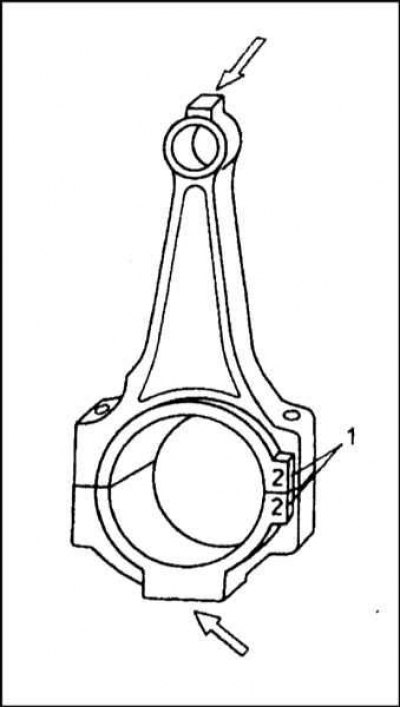
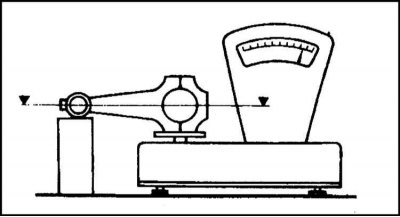
The diagram of the procedure for measuring the connecting rod in the auto service workshop is shown in the illustration. During weighing, the connecting rod must be horizontal. The difference in the mass of the connecting rods weighed from both the lower and upper heads must not exceed 2-6 g. The mass is adjusted by removing material from the upper head and the lower head cover in places indicated by arrows in the illustration. The maximum permissible thickness of the layer removed from the upper head is limited by the distance from the plane remaining after processing to the axis of the hole for installing the piston pin. For strength reasons, this distance must be at least 15 mm. In the case of the lower head, the distance is measured from the processed plane to the axis of the connecting rod bearing and must be at least 35 mm.
Diesel engine and petrol engine 1.6 l
In general, the design of the connecting rod and piston assemblies is similar to that described for 1.3 l engines, with the difference that it is possible to install connecting rods of repair sizes (see Specifications). In addition, in diesel engines, the connecting rods are equipped with oil sprayers for piston cooling.
Removal
Engine 1.3 l
1. Remove the cylinder head, engine oil pan and oil pump gears. Make sure the cylinder liners are securely seated, and secure them with special washers if necessary.
2. Check the connecting rod lower heads and connecting rod bearing caps for identification marks in the form of numbers stamped on the side surface of the components. The markings must correspond to the cylinder numbering (the first cylinder is considered to be the one closest to the valve timing chain).
3. If necessary, mark the chamfers machined on the connecting rods and their caps yourself (use paint or a center punch).
4. Check the axial play of the connecting rods by measuring the clearance between their lower heads and the crank cheeks using a blade-type feeler gauge. If the measurement result exceeds the specified value, Specifications acceptable value, the corresponding connecting rod should be replaced.
5. Turn the crankshaft and bring the pistons of the 2nd and 3rd cylinders to the BDC positions.
6. Loosen the fastening nuts and remove the lower connecting rod head cover with the crankshaft connecting rod bearing shell inserted into it.
7. If dismantling is carried out only for the purpose of replacing the liners, remove the connecting rod from the shaft journal (try not to damage the shaft journal and cylinder mirror - it is better to pull sections of fuel hose onto the bearing cap mounting studs) and remove the upper bearing shell from its head.
(View the original on the website: «SkodaBook»)
8. Store the components removed from each connecting rod separately.
9. Remove the lower connecting rod components of the pistons of cylinders 1 and 4. Proceed with extreme caution so as not to damage the cylinder bores.
10. Remove the carbon deposits from the top of each cylinder.
Engines 1.6 l and diesel
1. Remove the cylinder head, oil pan, oil deflector, oil pump and oil pickup.
2. Having lowered the pistons to the middle position, feel the cylinder mirrors with your finger, checking them for the presence of stepped wear in the area of the upper limit of the piston stroke. The steps must be removed using a special countersink, since otherwise it will be impossible to exclude the possibility of damage to the pistons during the process of removing the connecting rod assemblies.
3. Use a scriber to scratch the number of the corresponding cylinder on the bottom of each piston.
4. Using a blade-type feeler gauge, measure the axial clearance of the connecting rods on the crankshaft journals. Record the measurement results.
5. On a diesel engine, unscrew the mounting screws and remove the piston cooling oil spray nozzles from their sockets.
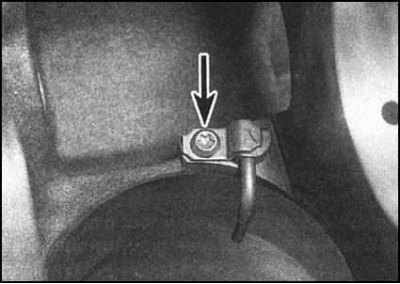
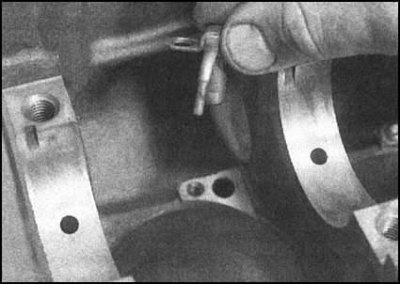
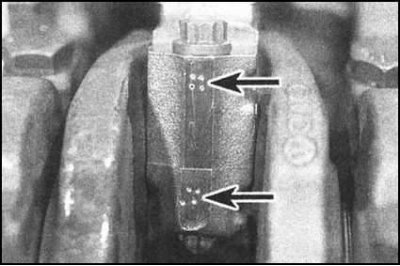
6. Turn the crankshaft and set the pistons of the 1st and 4th cylinders to the BDC positions. If necessary, punch the cylinder numbers on the connecting rods and caps, and use an arrow to mark the orientation of the caps relative to the connecting rods.
7. Try to remember the orientation of the connecting rod and piston assemblies on the engine. Depending on the engine type, the assemblies may be marked in different ways: on the side of the lower heads and their covers facing the timing belt, there are dot marks, risks, or projections of various shapes are provided on the casting. If the factory markings cannot be found, apply the marks yourself.
8. In several stages (half a turn per approach) loosen the cover mounting bolts, remove the cover with the lower insert. To avoid confusion during assembly, glue the insert to the cover with tape. Repeat the procedure for assembly.
9. Using a hammer handle, push the assemblies through the cylinders, remove the upper bearings and tape them to the connecting rods.
10. Proceeding in the same order, remove the connecting rod and piston assemblies of the 2nd and 3rd cylinders.
Examination
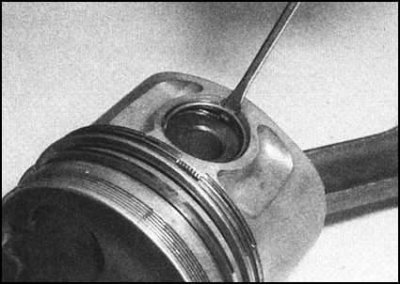
1. Insert the flat tip of a small screwdriver into the specially provided groove and remove the retaining ring. Heat the piston to 60°C.
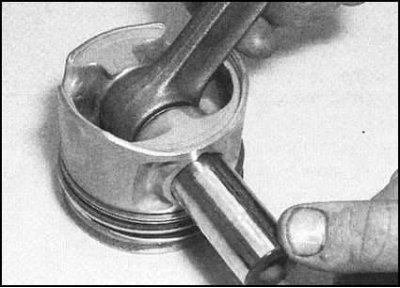
2. Now the pin should freely exit the piston and the hole in the upper head of the connecting rod.
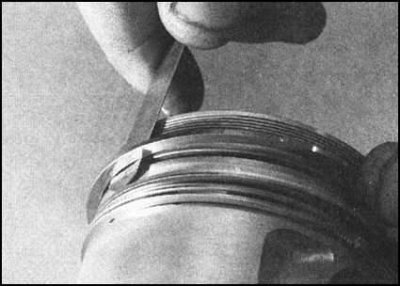
3. Arm yourself with a special tool (or with the blade of an old feeler gauge) and remove the piston rings from the piston. Remember that the rings are made of fragile material and can easily break if the locks are opened too much - take care to protect your hands and eyes. The removed rings can be thrown away - they must be replaced during assembly.
4. Using a piece of an old ring, carefully remove carbon deposits from the piston ring grooves. Try not to damage the walls and bottom of the grooves.
5. Thoroughly clean the piston bottoms of carbon deposits. After scraping off the main layer of deposits, clean the bottom with a wire brush or sandpaper.
Note: Make sure that the piston markings are intact.
6. After cleaning, wash the ring grooves with solvent, then dry the pistons thoroughly. Make sure that the oil return drainage holes in the grooves are clear.
7. Check the condition of the pistons. Normal wear is manifested as uniform vertical wear on the piston thrust surface and is accompanied by a weakening of the fit in the groove of the upper compression ring. If traces of any abnormal wear are detected, the piston should be carefully examined for its suitability for further use, then try to identify and eliminate the cause of the violation.
8. The presence of scratches or scoring on the piston skirt can be regarded as a consequence of overheating caused by a malfunction of the cooling or lubrication systems, or an unacceptable excess of the combustion temperature of the air-fuel mixture. Skirt burnouts are usually caused by a breakthrough of gases from the combustion chambers as a result of wear of the cylinders or piston rings. Burnout of the piston bottom indicates the presence of violations in the ignition timing and detonation of the mixture. Piston corrosion in the form of small cavities indicates the ingress of coolant into the combustion chamber/crankcase of the engine. Try to identify the causes of the violations and eliminate them.
9. Check the connecting rods, pins and caps of the lower connecting rod heads for cracks and other mechanical damage. After laying the connecting rods on a flat surface, check them for signs of deformation (if you are not sure, contact a car service specialist for help). Assess the condition of the connecting rod upper head bushings.
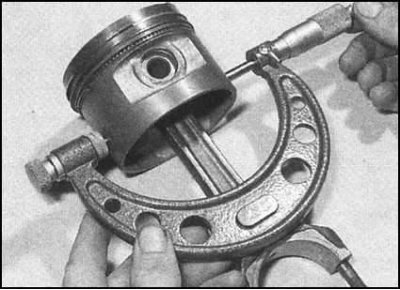
10. Using a micrometer, measure the diameters of all four pistons at a distance of 10 mm from the cut of its skirt in a plane located at a right angle to the axis of the piston pin. If the measurement result is outside the limits specified in Specifications range, the piston must be replaced.
Note: If during the overhaul the cylinder block was bored or the cylinder liners were replaced (1.3 l models), a new set of pistons of the repair size should be selected. Record the measurement results - they will be needed later when calculating the clearances for the pistons in the cylinders (see below).
11. After inserting a new piston ring into the corresponding groove on the piston, measure the ring seating clearance with a blade-type feeler gauge. Check the seating of each piston ring in turn. If the result of any of the measurements is outside the permissible range, the piston must be replaced. Just in case, check the correctness of the selection of rings by measuring their thickness with a micrometer.
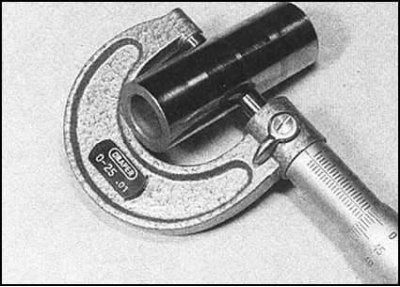
12. Use a vernier Columbus to measure the internal diameters of the piston pin slots in the upper connecting rod heads. Then determine the finger diameters). Subtracting from the results of the first measurements the results of the last, determine the gaps of the fingers in the heads. Compare the calculation results with the requirements Specifications. If necessary, the connecting rod bushing and the piston seat must be machined, and the pin replaced with a new one of repair size. It would be better to entrust this work to car service specialists.
13. On 1.3 l engines, connecting rods are divided into two weight categories, and the corresponding markings are applied to the caps of the lower connecting rod heads. Lighter connecting rods are marked with yellow paint, heavier ones - with blue. When replacing connecting rods, replaceable components from the same weight group should be selected. If there is no marking, you should consult with specialists from the Skoda branded service center.
14. The correct orientation of the pistons on the connecting rods is determined by the markings applied to the bottoms (the bottom must be cleaned of carbon deposits).
15. On 1.3L engines, the arrow on the piston crown should point forward along the engine (towards the location of the oil filter). The connecting rod must be turned with the oil flow backwards.
16. On 1.6 l and diesel models, the arrow on the piston bottom should be facing the timing belt. The connecting rod and its lower head cover are installed with a groove made in their bases in the direction indicated by the arrow on the piston.
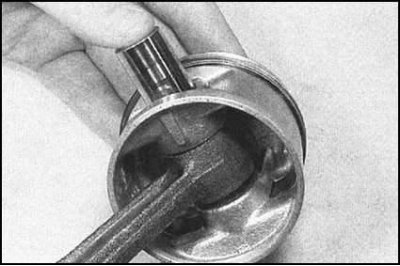
17. Lubricate the piston pin and the connecting rod upper head bushing with clean engine oil. Install the piston on the connecting rod. Secure the pin with two retaining rings, turning their locks 180° from the removable grooves. Proceeding in the same order, mount the remaining connecting rod and piston assemblies.