



Contents: Examination ⬇ Selection of inserts ⬇
Typical examples of crankshaft bearing shell wear
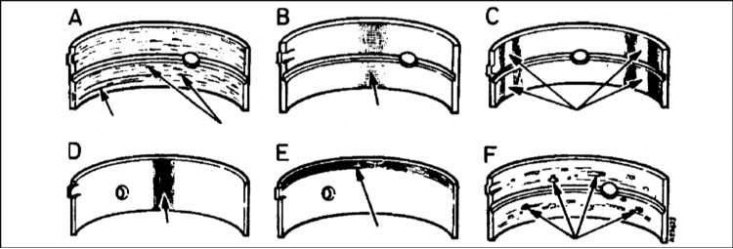
A - Scratched by foreign particles - grains are visible, embedded in the working layer of the liner; B - Lack of oil - top layer is worn off; C - The inserts are incorrectly positioned during installation - there are shiny spots (polished) areas; D - The neck is tapered - the top layer is removed from the entire surface; E - Wear of the liner edge; F - Fatigue failure - craters or pockets formed
Examination
1. Despite the fact that it is mandatory to replace the main and connecting rod bearing liners during a major engine overhaul, the condition of the old liners must be subjected to the most careful study, since the results of such an analysis can provide a lot of useful information about the general condition of the engine.
2. Bearing failure may occur as a result of insufficient lubrication, dirt or foreign particles, engine overloads, corrosion, and other adverse effects. Regardless of the nature of the defect, the cause of its occurrence must be identified and eliminated before the engine assembly begins to avoid recurrence.
3. For inspection, remove the bearings from their beds in the cylinder block/crankcase, main and connecting rod caps and connecting rod lower heads. Lay the removed bearings on a clean, flat work surface in the order of their location on the engine, which will allow you to correlate their condition with the condition of the corresponding crankshaft journals.
4. Dirt and foreign particles enter the engine in various ways. They can be left inside after a major overhaul as a result of careless cleaning procedures, penetrate through filters or the crankcase ventilation system. Often, dirt first gets into the engine oil and then penetrates the bearings along with it. It should not be forgotten that metal filings are inevitably formed during normal engine wear. If due attention is not paid to the engine cleaning procedure after restoration work, abrasive particles will inevitably remain in it. Regardless of the method of penetration into the engine, all foreign particles sooner or later end up embedded in the soft surface of the working layer of the plain bearing liners and are easily recognized during a visual inspection of the latter. The largest particles usually do not get stuck tightly in the liners, but leave deep grooves and burrs on their working surfaces and the surfaces of the corresponding shaft journals. The best prevention of such defects is a conscientious attitude to cleaning the engine after a major overhaul and installing only absolutely clean components during assembly. Also, do not forget about the need to change the engine oil regularly and frequently.
5. Oil starvation can also be caused by several reasons, often closely interrelated with each other. These include engine overheating (leading to oil liquefaction), overloads (as a result of which oil is forced out of the bearings), oil leaks (associated with excessive bearing clearance, oil pump wear, or excessive engine speed) etc. Violation of the oil flow passage, most often associated with carelessness in the installation of components during assembly, leading to misalignment of the oil holes, also causes a reduction in the oil supply to the bearings and, ultimately, failure of the liners. A characteristic sign of oil starvation is the wiping and displacement of the soft working layer of the liners from the steel substrate. Sometimes the temperature rises to such an extent that purple spots form on the substrate.
6. It should be remembered that the driving style also has a significant impact on the service life of bearings. Frequent full opening of the throttle, driving at low speeds, etc. contribute to an increase in the load on the engine. As a result, the oil film is displaced from the working clearance of the bearings, which leads to softening of the liners and the formation of small cracks on their working surface (fatigue deformation). Ultimately, individual fragments of the working layer material peel off and fall out of the substrate.
7. Operating a car in urban conditions often involves making many short trips, which leads to the development of bearing corrosion, since insufficient engine warming up contributes to the formation of condensate inside it and the formation of chemically aggressive gaseous mixtures. Aggressive products accumulate in the engine oil, forming sludge and acid, and since oil continuously flows into the bearings, they ultimately affect the material of the bearing liners, causing its oxidation and destruction.
8. Incorrect installation of liners during engine assembly also leads to their rapid failure. If installed too tightly, the working clearance is unacceptably reduced, which causes oil starvation of the bearings. Foreign particles getting between the backs of the liners and the bearing beds leads to the formation of elevated areas of the working surface of the liners and their destruction during normal engine operation.
(Information presented on the website: skodabook.ru)
9. Try not to touch the working surfaces of the liners with your fingers, as this significantly increases the risk of accidental damage to the soft material of the surface layer and will inevitably cause contamination.
10. As mentioned above in this Section, replacement of liners during major engine repairs must be carried out without fail, regardless of their condition - an attempt to ignore this requirement can only lead to apparent savings.
Selection of inserts
1. First of all, it is necessary to determine the size group of the main and connecting rod journals of the crankshaft, i.e. to find out whether they have a standard size or have been machined. This task is performed by measuring the diameter of the journals using a micrometer and comparing the results obtained with those given in Specifications at the beginning of this Chapter data. See also Section Removal and installation the cylinder head cover.
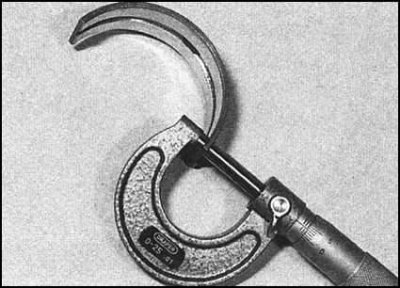
2. Alternatively (only for 1.3L engines), the size group of the journals of the shaft can be determined by the thickness of the bearing shells removed from the engine. The measurement is made with a micrometer, and the size group of the journals is determined by comparing the results with those given in Specifications data. It should be noted that measuring the journal diameters still provides more reliable information, since by the time the need for major engine repairs arises, the bearings are usually far from being in the best condition.
3. Having determined the size group of the shaft journals, you can begin selecting new bearing liners.
4. Main and connecting rod bearing shells are available in both standard sizes and in several repair versions (with varying degrees of humiliation) - cm. Specifications at the beginning of this Chapter.
5. When installing a crankshaft with new liners, the working clearances in the bearings should be checked (see sections Removal and installation the cylinder head assembly with the intake manifold and exhaust manifold and Flywheel - removal, inspection and installation).