



Drive shaft seal
1. Block the rear wheels of the car, apply the handbrake, then jack up the front of the car and place it on axle stands. Remove the front wheel.
2. Drain the transmission oil as described in Section 1.
3. Disconnect the ball joint of the tie rod from the steering knuckle arm (see Section 10).
4. Remove the pinch bolt and disconnect the lower control arm ball joint from the steering knuckle (Section 10).
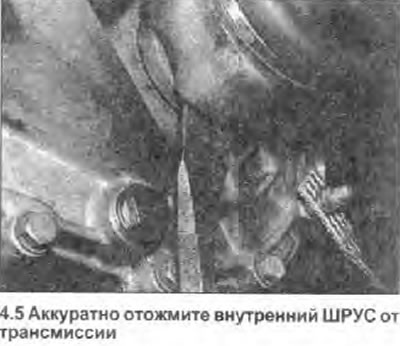
5. Push a suitable flat bar between the inner CV joint and the transmission housing. Carefully press the joint out of the working position, being careful not to damage the transmission housing or the metal flange of the CV joint (see photo).
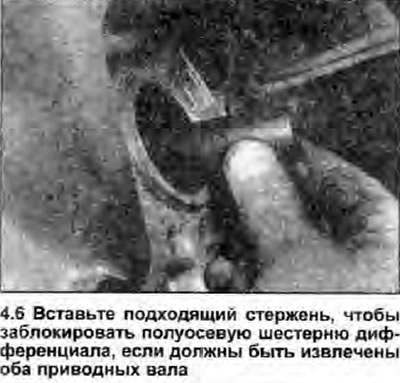
6. Remove the inner CV joint from the transmission and support the drive shaft to avoid damaging the CV joints or their protective boots. If both drive shafts must be removed, block the differential side gear by inserting a clean metal rod or wooden dowel approximately 24 mm in diameter into the transmission (see photo).
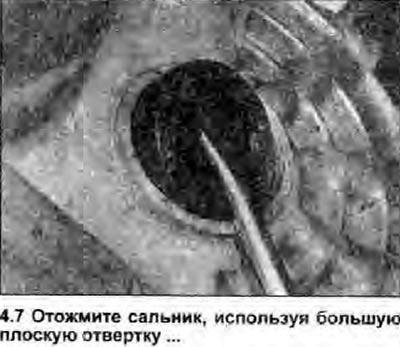
7. Carefully pry the seal out of the transmission with a large flat-head screwdriver (see photo).
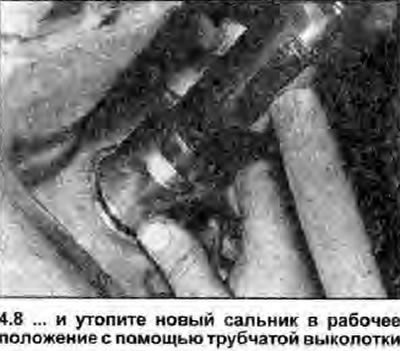
8. Clean away any dirt from around the seal bore, then apply a small amount of grease to the outer sealing lip of the new seal. Install the new seal into the transmission bore and press it into position using a suitable pipe punch (type of nest), which rests only on the hard outer edge of the seal. Make sure that the seal does not become distorted. Continue working with the drift until the seal rests against the mounting flange (see photo).
9. Before installing the drive shaft, make sure that the flange of the inner CV joint is smooth and free of burrs and scratches. Minor damage of this nature can be removed with sandpaper; the presence of serious defects requires replacement of the joint. Inspect the retaining ring, which is installed to the groove machined in the grooves of the inner CV joint, for damage and replace it if there is any doubt about its condition.
10. Clean the drive shaft grooves thoroughly, then apply a thin layer of grease to the sealing lips of the oil seal and the grooves/flange of the inner CV joint. Remove the differential axle pinion locking rod.
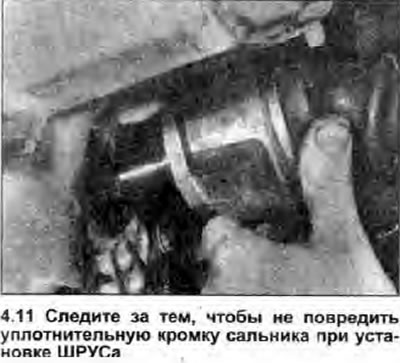
11. Make sure the retaining ring is securely seated in its groove. Insert the grooves of the CV joint into the grooves of the differential half-axle gear, being careful not to damage the seal (see photo). Push the joint into the transmission until it stops and make sure it is securely held by the retaining ring. To do this, grab the CV joint housing and try to pull the drive shaft out of the differential half-axle gear.
12. Install the lower control arm ball joint into the steering knuckle, then connect the tie rod ball joint to the steering knuckle arm (see Section 10).
13. Install the wheel, lower the vehicle to the ground and tighten the wheel bolts to the torque specified in the Specifications (see Section 1 Specifications).
14. Fill the transmission with the correct amount of oil of the required type (see Section 1).
Gear selector mechanism leash shaft seal
15. Park the car on a level place (not downhill), turn off the ignition, make sure the transmission is in neutral and apply the handbrake. Jack up the front of the car and support it securely on axle stands.
16. Using a hammer and punch, knock the cylindrical pin out of the movable rod and disconnect the rod from the transmission. Discard the cylindrical pin - it is subject to replacement.
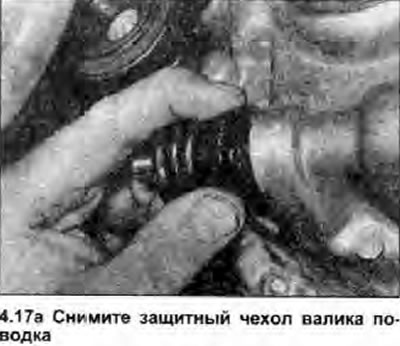
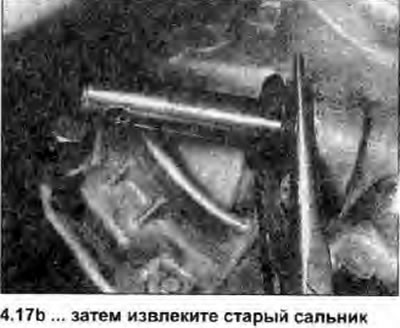
17. Remove the protective cover of the leash roller. Using a screwdriver or long-nose pliers, carefully press the seal out of the casing and remove it from the end of the roller (see photo).
 |
 |
18. Before installing a new seal, check the contact surface of the driver roller with the seal for burrs, scratches and other damage that could damage the edges of the seal during installation. Sometimes it is possible to grind off minor defects of this nature using fine-grained emery cloth. The presence of more serious damage requires replacement of the driver roller.
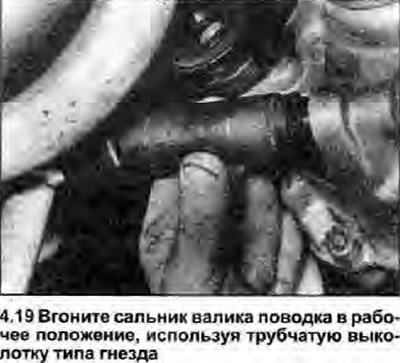
19. Apply a small amount of grease to the outer edge and sealing lip of the new seal, then carefully position it over the shaft and slide it toward the transmission. Press the seal completely into its working position in the transmission housing and install the protective boot, ensuring that it is correctly positioned relative to the flange of the seal (see photo).
20. Connect the movable rod to the camshaft and align the roll pin holes. Drive the new roll pin into position using a hammer and punch, then lower the vehicle to the ground.
[Data taken from an online portal skodabook.ru]
Input shaft seal
21. Remove the transmission as described in Chapter 6, then remove the power plug (see Section 6).
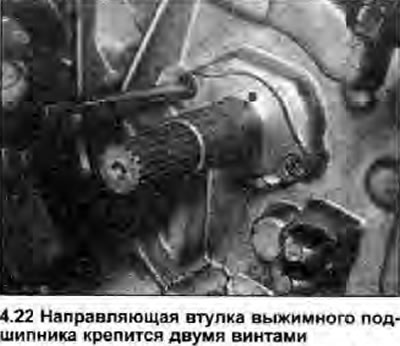
22. Remove the two screws holding the release bearing guide sleeve in the operating position (see photo), then remove the sleeve from the input shaft. Carefully pry the seal out of the guide sleeve using a suitable flat-head screwdriver.
23. Before installing a new seal, inspect the seal contact surface of the input shaft for burrs, scratches, or other damage that could damage the seal lips during installation. It is sometimes possible to file down minor defects of this nature using fine-grained emery cloth. More serious damage requires replacement of the input shaft. Make sure the input shaft is clean and lubricated to protect the seal lips during installation.
24. Dip the new oil seal in clean oil and install it in the guide bushing, remembering that when the bushing is installed, the sealing lip of the oil seal should be facing inward. Carefully place the guide bushing in its working position, then install the mounting screws and tighten them to the specified tightening torque Specifications.
25. Reassemble and lubricate the clutch release mechanism as described in Section 6, then remove excess oil or grease and install the transmission onto the engine.