



Cross section of the engine
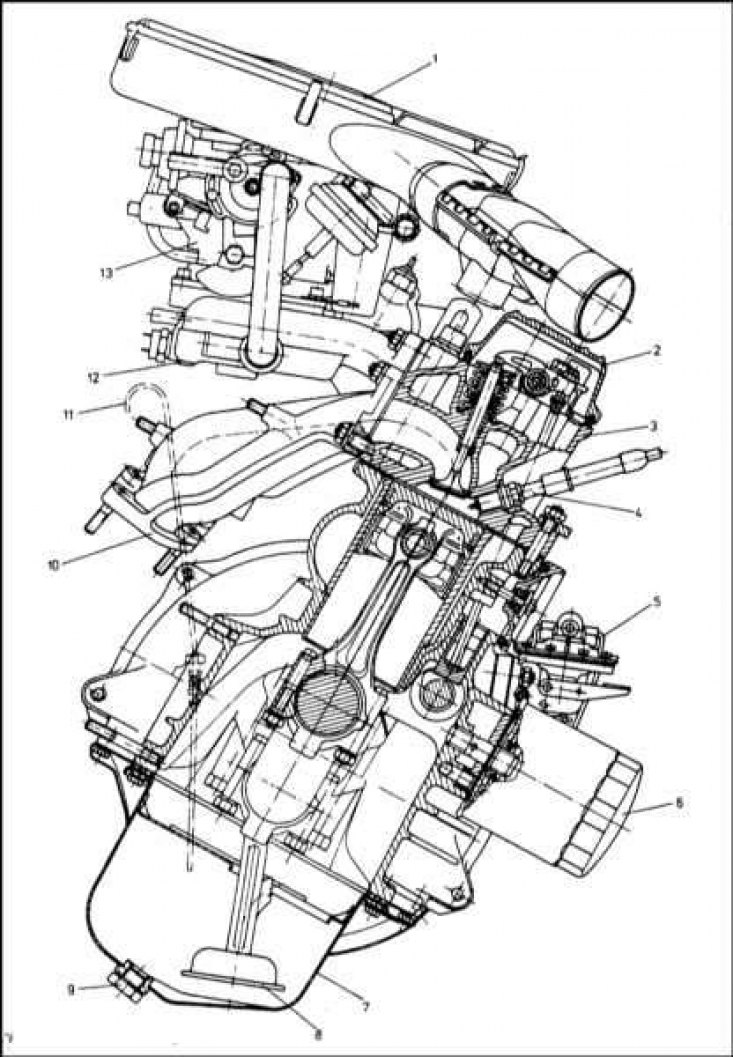
1 - Air filter housing; 2 - Cylinder head cover; 3 - Cylinder head; 4 - Spark plug; 5 - Fuel pump; 6 - Oil filter; 7 - Oil pan; 8 - Oil intake with mesh filter; 9 - Drain plug; 10 - Exhaust manifold; 11 - Full flow oil filter; 12 - Inlet manifold; 13 - Carburetor
Longitudinal section of the engine
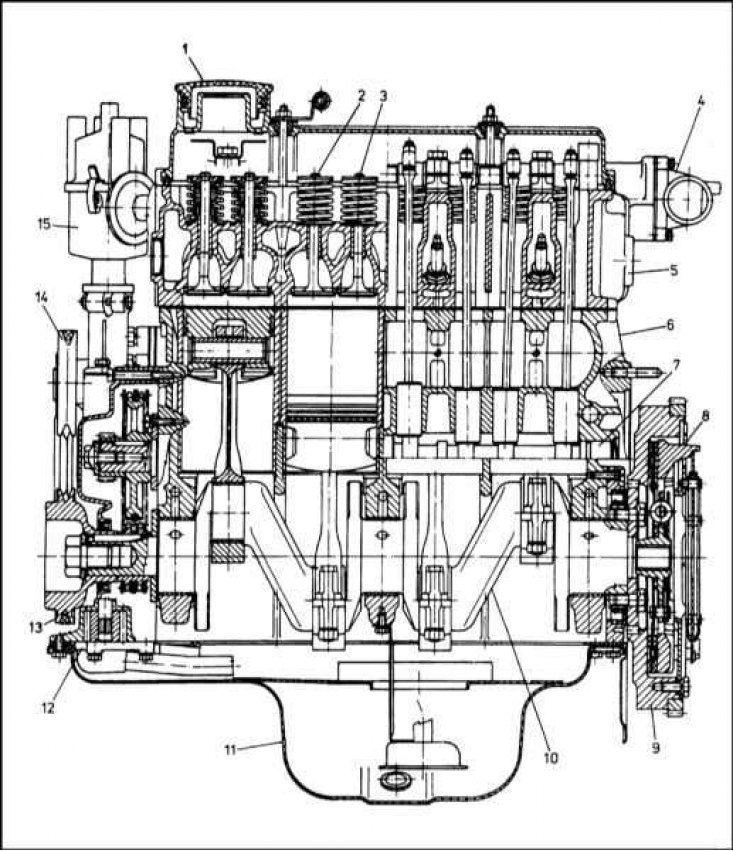
1 - Filler cap; 2 - Inlet valve; 3 - Exhaust valve; 4 - Thermostat housing; 5 - Cylinder head; 6 - Cylinder block; 7 - Camshaft; 8 - Clutch assembly; 9 - Flywheel; 10 - Crankshaft; 11 - Oil pan; 12 - Oil pump; 13 - Crankshaft pulley; 14 - Water pump pulley; 15 - Ignition distributor
Rules for using the material Chapters
This Part of the Chapter is devoted to the repair of a 1.3 L petrol engine that does not involve removing it from the vehicle (in situ).
Most of the procedures discussed herein are written on the assumption that the powertrain remains in its original location in the engine compartment of the vehicle. As such, if the engine has already been removed and installed on a workbench or assembly stand, many of the steps described herein should be omitted.
It should be noted that despite the physical possibility of performing in situ repairs of components such as connecting rod and piston assemblies, this type of work is usually performed after disassembling the engine due to the need to carry out some auxiliary procedures, not to mention the requirements for maintaining the cleanliness of the parts and the absolute passability of the oil flows.
General description of the engine
The engine in question belongs to the family of 4-cylinder gasoline engines with in-line cylinder placement and overhead valves (OHV). The cross-section and longitudinal sections of the engine are shown in the illustrations. The engine is installed transversely in the front of the car and tilted forward at an angle of 20°. The transmission and clutch assemblies are located on the left side of the power unit.
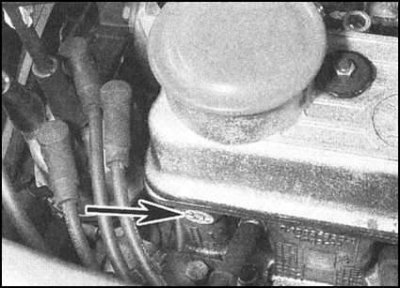
The engines have two main modifications: with a low compression ratio (type 135) and a high compression ratio (type 136), which also differ in piston design (the piston bottoms of the 135th type engines, unlike the 136th, are provided with recesses) and camshafts. Otherwise, the engines are identical. Visually, the engines can be distinguished from each other by the color of the emblem with the Skoda logo, located on the front wall of the cylinder head. On engines of the 135th type, a colorless emblem is used, while on engines of the 136 type, the emblem is painted yellow.
The cylinder block, head and head cover are cast from aluminum alloy. The lower part of the cylinders is lined with cast iron liners. The bases of the liners are equipped with sealing gaskets to prevent coolant from penetrating into the oil pan.
The crankshaft is mounted in three main bearings. The flywheel with the clutch assembly is attached to the flange on the left end of the shaft. The front end of the crankshaft is equipped with a sprocket for installing a double-row camshaft drive chain. The main and connecting rod bearings have a split design and are equipped with two liners. A bronze bushing is pressed into the upper head of the connecting rod, turned to fit the piston pin.
The right end of the camshaft is equipped with a spiral gear for driving the ignition distributor. The oil pump is also driven from the camshaft through the distributor shaft.
The engine's forced lubrication system is organized by means of a gear pump, which takes oil from the oil pan through an oil intake equipped with a mesh filter and supplies it to the internal components of the engine, after passing it through a full-flow replaceable oil filter installed externally in the front part of the cylinder block.
Despite the fact that the engine is not high-speed and does not have much power, it provides the car with quite decent dynamic characteristics.
Due to the fact that the engine is not overloaded, provided that high-quality oil and fuel are used, it is characterized by increased reliability and durability.
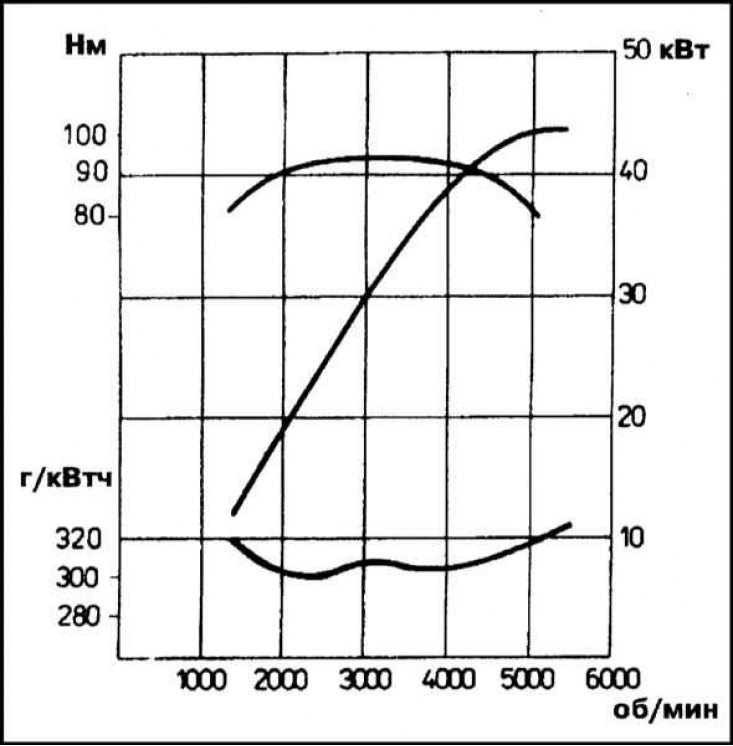
The illustration shows the power and torque curves, as well as fuel consumption, depending on the crankshaft speed of a carburetor engine.
List of repair procedures that do not require removing the engine from the vehicle
The following are engine repair and maintenance procedures that can be performed in situ:
- a) Removing and installing the accessory drive belt;
- b) Removing and installing the cylinder head cover;
- c) Removing and installing the rocker arm assembly;
- d) Removing and installing the cylinder head;
- e) Removing and installing the timing chain cover;
- f) Removing and installing the timing chain with sprockets;
- g) Removing and installing the oil cooler;
- h) Removing and installing the oil pump;
- i) Removing and installing the oil pan;
- j) Decarbonization of cylinder heads and pistons;
- k) Replacing crankshaft seals;
- l) Removal, condition check and installation of the flywheel;
- m) Checking the condition and replacing the powertrain suspension supports;
Information taken from this resource (skodabook.ru)