



Removal
1. Disconnect the negative cable from the battery.
2. Bring the piston of the first cylinder to the TDC position of the compression stroke, then return the crankshaft back a few degrees. To ensure complete safety, the authors of this Manual recommend bringing the pistons to the middle of their stroke. Bring the piston of the first cylinder to the TDC position of the compression stroke, then return the crankshaft back a few degrees. To ensure complete safety, the authors of this Manual recommend.
3. Drain the cooling system and remove the spark plugs.
4. On models with an ignition distributor, remove the distributor cap together with the high-voltage wires connected to it (see Chapter Engine electrical equipment).
5. Remove the air cleaner with the air intake tract components (see the relevant Section of the Chapter Power supply system). Remove the heated air supply hose from the air cleaner pipes and the exhaust manifold housing plate.
6. Remove the rocker arm shaft assembly (see section Removal, condition check and installation of the rocker arm shaft assembly).
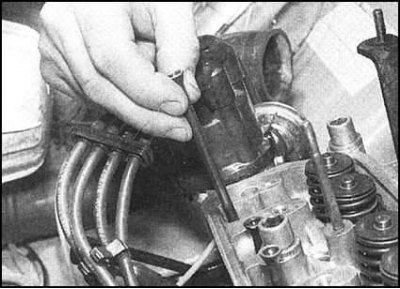
7. Remove the pushrods and arrange them in the order of their location in the head - make a special, clearly marked template-rail out of cardboard. Note that the pushrods of the intake valves are made of aluminum, while steel rods are used to drive the intake valves.
8. The procedures for removing the head assembly with the intake manifold and exhaust manifold are described below. However, the authors of this Manual recommend that the manifold and manifold be removed first (see the relevant Section of Chapter Power supply system).
9. Disconnect the exhaust pipe from the exhaust manifold (see Chapter Power supply system).
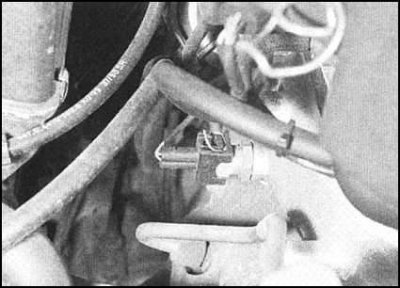
10. For central injection (SPFI) engines, disconnect the following wires and hoses from the intake pipe/throttle body (see Chapter Power supply system):
- a) Fuel supply and return hoses;
- b) Throttle body electrical connectors. Release the wiring from the intermediate clips and move the wiring to the side;
- c) Throttle cable;
- d) Brake booster hose;
- e) Cooling system hose;
- f) Carbon adsorber purge hose;
- g) CTS connector;
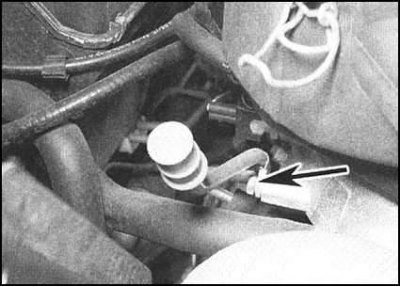
- h) If equipped accordingly, a support bracket for the CO sampling tube.
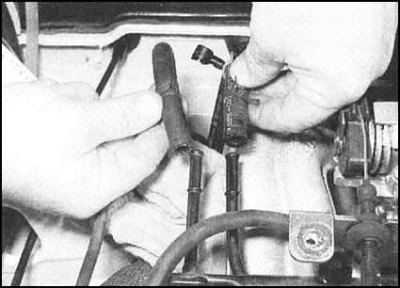
11. On distributed injection (MPFI) engines, disconnect the following wires and hoses from the intake pipe/throttle body (see Chapter Power supply system):
- a) Fuel supply and return hoses;
- b) Vacuum hose from fuel pressure regulator;
- c) Electrical connectors of the power supply system. Release the electrical wiring from the intermediate fasteners and move the wiring to the side;
- d) Electrical connector for intake air temperature and pressure sensor;
- e) Carbon adsorber purge hose;
- f) Throttle cable;
- g) Brake booster hose;.
- h) Loosen the support bolt on the right side of the intake manifold.
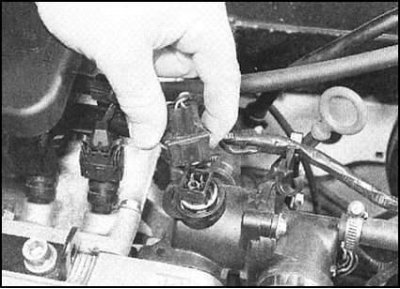
12. Disconnect the CTS electrical connector and hoses from the thermostat housing.
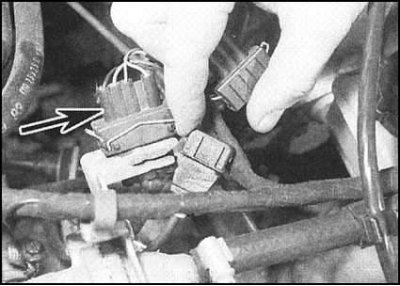
13. Disconnect the electrical wiring connectors λ-probe and from the Hall sensor...
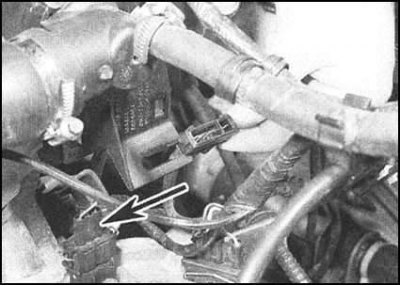
..on models with SPFI, both connectors are located on a bracket fixed to the thermostat housing - to release the connector plug from the bracket, swing it from side to side. On models with MPFI, the Hall sensor is disconnected at the top of the manual transmission housing, the λ-probe connector is located slightly behind and slightly higher. Both are turned with the plugs backwards.
14. On models without a/c, loosen the upper bolt of the generator support adjusting bar. Remove the fastener (nut and bolt) and remove the adjusting bar from the bracket on the cylinder head.
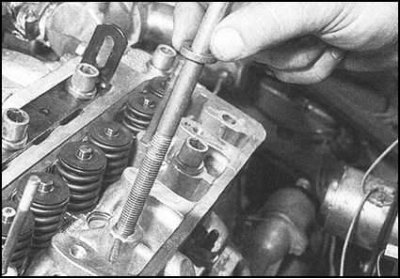
15. Using the reverse order of the steps described later in this Section, loosen the four cylinder head nuts along the front edge of the cylinder head in several stages. Remove the retaining bolt and the alternator adjuster bar bracket (try to remember the installation position of the bracket). Continuing to act in the same order, in several stages (1 turn per approach) loosen the eight cylinder head bolts, two of which are also used to secure the rocker arm shaft assembly (see section Removal, condition check and installation of the rocker arm shaft assembly).
16. Remove all the bolts together with their washers and place them in the order of installation on the engine in specially prepared and carefully marked containers, or a template-rail made of thick cardboard. Note that bolts 8 and 9 (in order of tightening - see below) slightly longer than the others, and bolt 10, on the contrary, is shorter. Try to remember the installation position of the power unit lifting eye bracket, installed three rear bolts.
17. Now it is necessary to carefully separate the head with the sealing gasket from the cylinder block/engine crankcase, trying not to disturb the position of the liners. Despite the greater reliability of the fit and sealing of the liners than is usually accepted for liners engines, there is still a risk of coolant leakage and dirt entering the oil pan as a result of careless actions when removing the head. Carelessness during the procedure can also lead to displacement of the seals in the bases of the liners and the development of leaks after installing the head on the engine.
Attention! If the sealing of the seat is damaged, remove the pistons, extract the liners and replace their seals.
18. To separate the cylinder head, place a lever under the exhaust manifold and, gently rocking the assembly, slide it forward along the vehicle.
19. With the help of an assistant, remove the head assembly from the engine. Remove the sealing gasket.
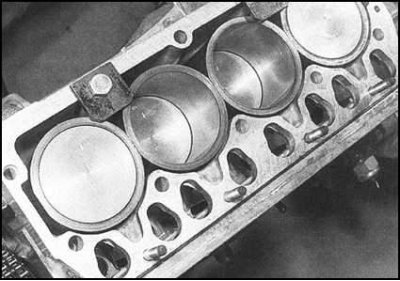
20. Try to avoid accidentally turning the crankshaft after removing the cylinder head from the engine to avoid the liner falling out. If the nature of the procedure requires turning the shaft (for example, for the purpose of cleaning the piston bottoms), extreme caution must be exercised, taking precautions against contamination of the components and securing the sleeves with two bolts and large flat washers.
21. If the engine is to remain disassembled for a long time without securing the liners, a poster with a warning message of the appropriate content should be attached to it.
22. The procedure for disassembling the cylinder head is described in Section Dismantling the power unit and major engine repairs of this Chapter.
Separation of the intake manifold and exhaust manifold from the head
1. The procedures for removing and installing the intake manifold are described in Chapter Power supply system.
2. Loosen the fastening nuts in several stages (during assembly, nuts must be replaced without fail) and remove the exhaust manifold with gasket and intake air heater housing from the cylinder head. On SPFI models, the intake manifold and exhaust manifold are installed on a common gasket, on MPFI models, separate gaskets are used.
3. Thoroughly clean the mating surfaces, install a new gasket, then install the exhaust manifold assembly with the engine intake air heater housing. Screw on new mounting nuts and tighten them to the required torque.
Preparing for assembly
1. Check the condition of the threads of the cylinder head bolts. Being careful not to mix up the bolts, wash them thoroughly, then dry them and assess the degree of wear. Defective bolts must be replaced.
Note: Due to the criticality of the function performed and the magnitude of the applied load, the authors of this Manual recommend replacing the head bolts every time after dismantling the latter, regardless of their condition.
2. Before you start cleaning the piston bottoms (for which you will have to turn the crankshaft several times), take appropriate measures to secure the cylinder liners.
3. Using a scraper made of hard plastic or wood, remove traces of the old gasket material from the mating surfaces, scrape off carbon deposits from the piston crowns. Try to prevent debris from getting into the water galleries and oil drains (carbon particles can completely block the oil supply to the internal components of the engine)- Seal all accessible holes with tape. The gaps between the walls of the pistons and cylinders should be filled with consistent grease for the same purpose, which can then be easily removed with a thin brush.
4. Check the mating surfaces of the block and cylinder head for scratches, burrs and other mechanical damage. Minor defects can be removed with a fine-tooth file. In case of more serious damage, you will have to resort to machine machining.
5. Assess the flatness of the mating surfaces using a special template (steel ruler ribs) and a blade type feeler gauge (if necessary, see Part Dismantling the power unit and major engine repairs of this Chapter).
Assembly
1. Carefully wipe the mating surfaces of the head and cylinder block with a clean, dry cloth. Place a new gasket on the cylinder block, making sure that all the holes are aligned correctly.
2. Carefully place the head onto the mounting studs and lower it onto the cylinder block.
3. Thoroughly wash and dry the mounting bolts and washers. Lightly lubricate the threads and the undersides of the bolt heads with oil, then refill each bolt (except for the two that are used to secure the rocker arm axle supports) into their original holes. Don't forget to install the powertrain lifting eye bracket under the three rear bolts. Carefully fit the bolts and tighten them by hand.
4. Strictly in the same order, insert the push rods into the head, making sure that they are correctly positioned in their push rods.
5. Install the rocker arm shaft assembly (see section Removal, condition check and installation of the rocker arm shaft assembly). Tighten the four small inner mounting bolts to the specified torque and finger tighten the two head bolt axle bearings.
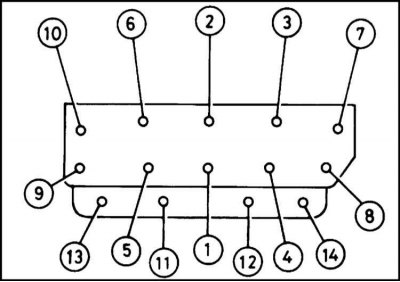
6. Tighten the bolts in several stages in the specified order to the required torque (see below).
7. In the first stage, use a torque wrench and tighten the bolts to the first stage torque (see Specifications).
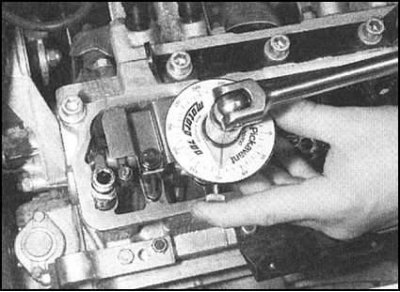
8. Next, acting in the same order, using a regular socket wrench and a protractor, tighten the bolts to the angle of the second stage of tightening (see Specifications).
Note: If you don't have a protractor at hand, make a suitable template from thick cardboard or draw a scale with a marker directly on the surface of the head. Now repeat the procedure, tightening the bolts to the angle of the third stage.
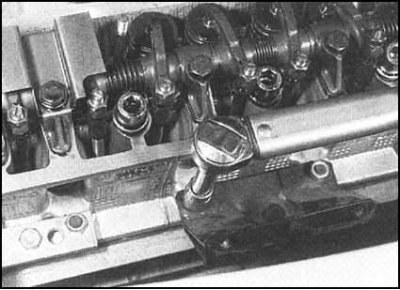
9. After tightening the bolts, lightly lubricate the threads and the bottom surfaces of the fastening nuts with oil. Place washers along the front edge of the stud head and screw on the nuts (if equipped accordingly, do not forget about the generator adjustment bar bracket). Tighten the four nuts in the order shown (from 11 to 14) with the required effort.
10. On models without a CV joint, screw in and tighten the bracket mounting bolt to the alternator adjusting bar and adjust the drive belt tension (see section Removal, installation and adjustment of the tension force of the auxiliary drive belt.
11. Adjust the valve clearances and reinstall the cylinder head cover (see section Removal and installation the camshaft housing cover).
12. Restore the original connection of the CTS coolant hoses and electrical wiring. Replace the standard spring clamps for fastening the hoses with more practical screw or worm clamps.
13. Connect the hoses and wiring to the intake manifold and fuel system components, replacing the clamps with more practical ones if necessary. Connect and adjust the throttle cable.
14. Connect the exhaust manifold to the exhaust pipe (see Chapter Power supply system).
15. Connect the wiring to the Hall sensor and λ-probe.
16. If equipped, install the distributor cap with the high-voltage wires connected to it.
17. Reinstall the air cleaner assembly (see Chapter Power supply system) and connect the negative cable to the battery.
18. Fill the cooling system and install spark plugs.