



Contents: Removal ⬇ Installation ⬇
Removal
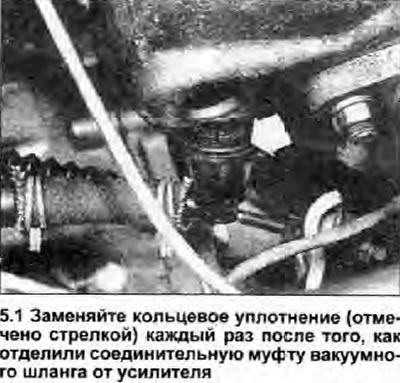
1. Open the hood and disconnect the hose from the vacuum booster unit (see photo).
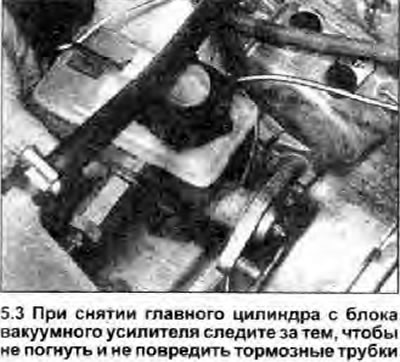
2. Remove the two nuts securing the master cylinder to the vacuum booster unit.
3. Very carefully move the master cylinder forward to free the booster studs and the master cylinder primary piston rod. Be careful not to bend or damage the metal brake lines. If there is any risk of such damage, release the lines from their fastenings on the bulkhead or disconnect them (see Chapter 11) until you remove the master cylinder (see photo).
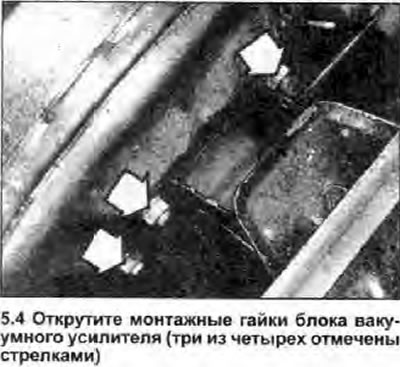
4. Unscrew the four nuts securing the vacuum booster unit to its bracket (see photo).
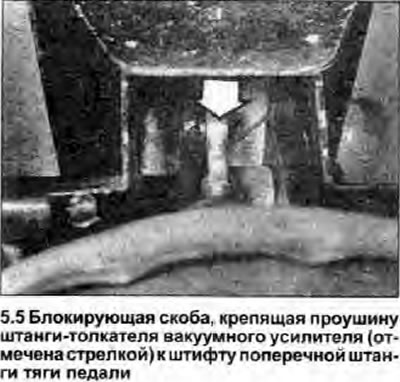
5. With an assistant pressing the brake pedal, move the booster assembly away from the mounting bracket so that you can remove the locking clip that secures the booster pushrod eye to the pedal cross rod pin. Do not bend the pushrod or the piston connected to it may be damaged; carefully move the entire vacuum booster assembly to disengage the push rod from the pin (see photo).
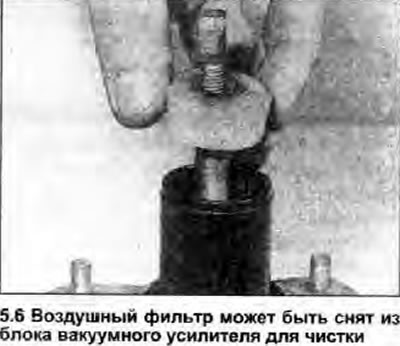
6. If the unit is faulty, replace it (see the Note given in Chapter 1). The rubber boot of the booster pushrod can be replaced separately, as can the washer and seal of the primary piston rod of the master cylinder. The booster air filter can be cleaned. if it is dirty. If any other component is damaged (including air filter), it can only be replaced as part of a complete amplifier assembly (see photo).
Installation
7. Install in the reverse order of removal, paying attention to the following (see photo):
 |
 |
 |
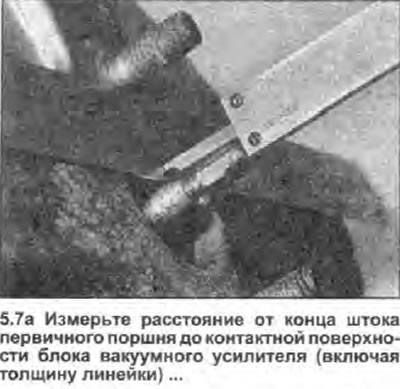
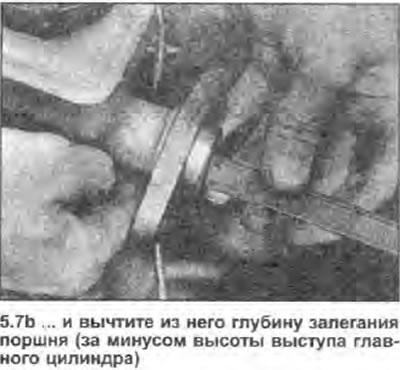
- a) On early models (vacuum booster unit identification number 443.613.000.003), make sure that there is a gap of 0.3-0.6 mm between the end of the primary piston rod coming from the booster and the primary piston of the master cylinder itself. To do this, measure the distance from the end of the piston rod to the contact surface of the booster and subtract the depth of the piston from the contact surface of the master cylinder from the resulting value. To get this depth, measure the distance from the end of the protrusion of the master cylinder to the piston, then subtract the height of the protrusion above the contact surface of the cylinder. If the gap requires adjustment, install a double-ended wrench on the chamfers of the primary piston rod and, holding the rod in this way, screw or unscrew its tip until you achieve the desired length of the protruding part of the rod.
- b) On later models (vacuum booster unit identification number 443.613.000.011) a non-adjustable primary piston rod of the master cylinder is used. The clearance between the rod and the primary piston (0.3 mm) is set during the assembly of the car and is maintained by the design of the components (see Note. This in Chapter 1).
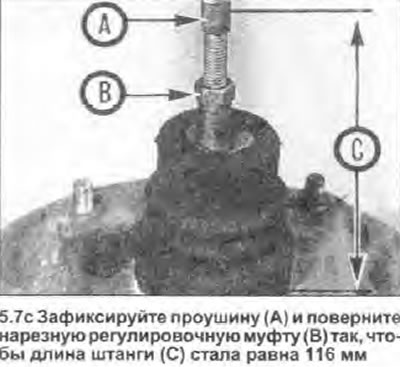
- c) On all models, if a new amplifier is installed (or if this adjustment was violated for some reason), make sure that the center of the push rod eye of the amplifier is 116 mm away from the contact surface of the unit (distance "C" in photo 5.7 s). If adjustment is required, turn the threaded adjustment sleeve of the rod in the desired direction. This will ensure that the basic height of the brake pedal installation is accurate enough to serve as a starting point for its final adjustment after the unit is installed.
- d) Apply a thin coat of general purpose grease to all hinge parts and working surfaces.
- e) Install the booster with the vacuum hose coupling to the vehicle's center tube, being careful not to bend the booster push rod. Be sure to replace the vacuum hose coupling O-ring after each removal.
- f) Tighten the nuts and bolts to the specified tightening torque Specifications (where given).
- g) If the brake pipes have been disconnected, bleed the brake hydraulic system (see Chapter 9) and remove any spilled brake fluid. Check the restored system joints for leaks.
- h) Check and adjust, if necessary, the brake pedal height (see Chapter 3).
- i) Check the operation of the brakes in general and the vacuum booster unit in particular.
(Information taken from this resource: www.SkodaBook.ru)