



Note: See Warnings given in Chapter 1 this Section before you begin working.
Checking the serviceability
Fan thermal switch
1. Perform a quick check of the switch (see previous chapter). If the switch needs to be replaced or more thoroughly checked, it must be removed.
2. To perform a thorough check of the switch, connect a multimeter to it using two spare leads (switched to resistance measurement mode) or a test circuit consisting of a battery and a 12-volt lamp. Hang the switch on a piece of twine in a container of water and heat the water. Measure the temperature of the water with a thermometer. Do not let the switch or thermometer touch the sides of the container.
3. The switch contacts should close (that is, the lamp should light up or the device should show the presence of electrical conductivity), when the water heats up to the operating temperature of the fan (indicated in Specifications). Stop heating the water and let it cool down; the switch contacts must open at the specified Specifications fan switch-off temperature.
4. If the switch operates noticeably differently than described or if it does not operate at all, replace it.
Coolant Temperature Gauge Sensor
5. The constant voltage to the coolant temperature gauge installed in the instrument panel is supplied from the instrument panel power wire, the grounding part of its circuit is controlled by the sensor.
6. The sensor is screwed into the thermostat housing. It contains a thermistor - an element whose electrical resistance decreases according to a certain pattern when it is heated. Thus, until the engine is warmed up, the resistance of the sensor is high, and accordingly the electric current flowing through the pointer is small and the pointer of the device points to the "cold" sector of the scale. If the component is faulty, it must be replaced.
7. If the temperature gauge is out of order, check other devices first; if they do not work at all, check the power supply wire of the instrument panel. If only the temperature gauge is faulty, check its serviceability as follows.
8. If the pointer remains in the "cold" sector of the scale, disconnect the sensor wire and touch it to the cylinder head to ground it. If the pointer deflects (ignition on), the sensor is faulty and must be replaced. If the pointer remains stationary, remove the instrument cluster (see Section 12) and check the continuity of the wire between the temperature gauge and the sensor, as well as the power supply to the gauge. If the circuit is OK and the gauge still does not work, the gauge itself is damaged and must be replaced.
9. If the pointer remains in the "hot" sector of the scale all the time, disconnect the sensor wire. If the pointer returns to the "cold" sector of the scale (ignition on), the sensor is faulty and must be replaced. If the pointer does not move, check the rest of the circuit as described above.
Removal
Fan thermal switch
10. Wait until the engine and radiator have cooled down, then drain the cooling system to the switch level (see Section 1). Alternatively, unscrew the expansion tank filler cap to release any residual pressure and have a suitable plug ready to plug the switch hole while it is removed. If the latter method is used, be careful not to damage the radiator and do not use a crumbly material to make the plug - this will allow foreign particles to enter the radiator.
11. Disconnect the negative cable from the battery.
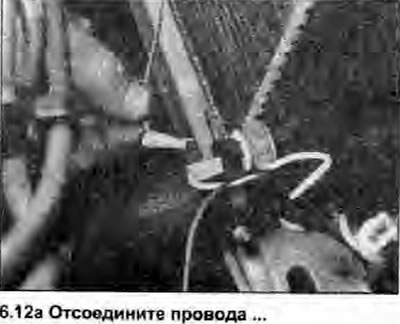
12. Disconnect the electrical wiring connectors from the switch, unscrew the switch and remove it from the radiator (see photo).
 |
 |
Coolant Temperature Gauge Sensor
13. Prepare to remove the component as described in step 10.
14. Disconnect the negative cable from the battery.
15. Disconnect the sensor wiring and unscrew the unit from the thermostat housing.
Installation
Fan thermal switch
16. When installing, replace the O-ring if it is worn or deformed (compressed). Carefully clean the installation area of the switch in the radiator, then push the O-ring and switch into it. Install the locking ring and turn it to clamp it gently. Connect the wires to the switch and battery, then fill the cooling system or check the coolant level if you used the plug (Section 1),
Coolant Temperature Gauge Sensor
17. When installing, apply a suitable sealant to the sensor threads. Connect the wires to the sensor and battery, then fill the cooling system or check the coolant level if you used the plug (see Section 1).