



Components of the brake system with ABS
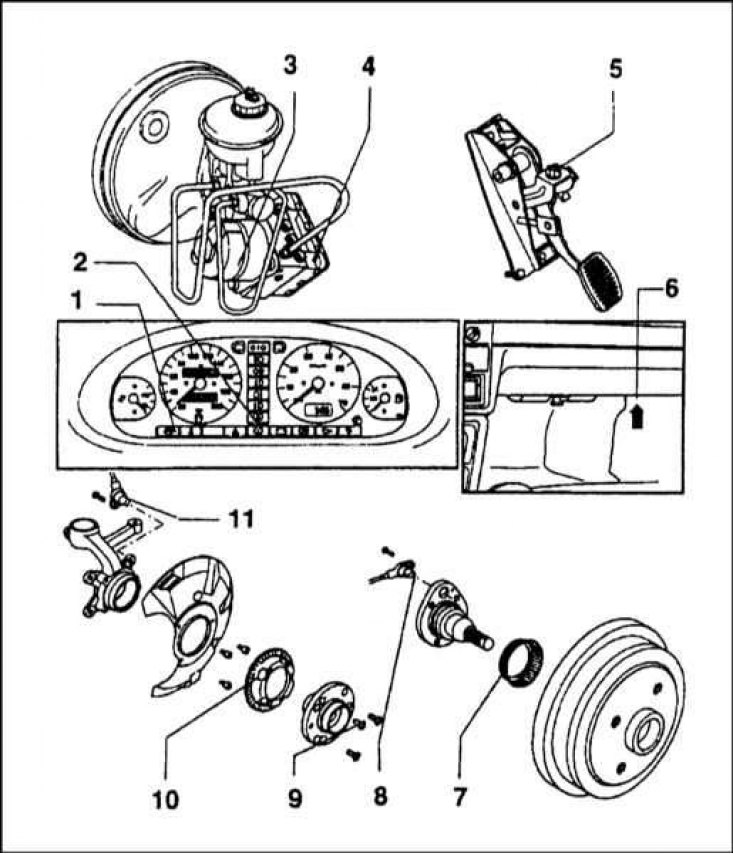
1 - ABS warning light; 2 - Brake fluid level indicator light; 3 - ABS hydraulic pump; 4 - Hydraulic modulator; 5 - Brake light switch sensor; 6 - Location of the diagnostic connector; 7 - Pulse disk (signal rotor) rear wheel sensor; 8 - Rear wheel speed sensor; 9 - Bolt; 10 - Pulse disk (signal rotor) front wheel sensor; 11 - Front wheel speed sensor
Functional diagram of the brake system with ABS
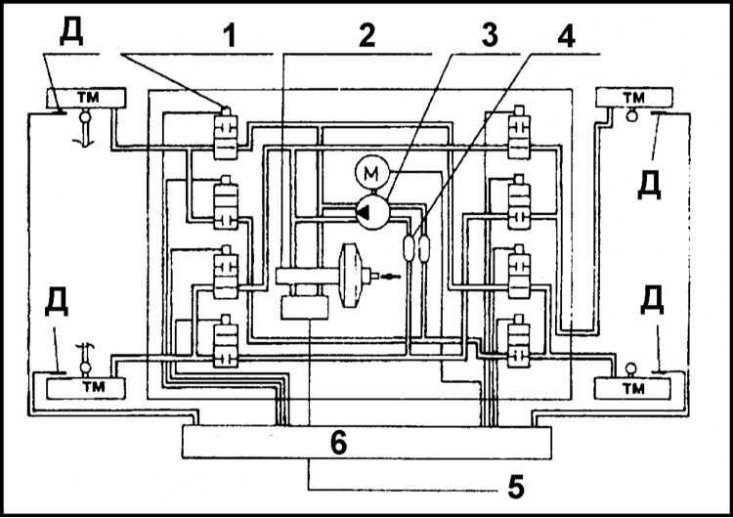
D - Wheel sensor; TM - Brake mechanism; 1 - Electrohydraulic valve; 2 - GTZ; 3 - Pump; 4 - Diagonal circuit splitting valves; 5 - Brake fluid reservoir; 6 - ECU
Front Wheel Speed Sensor Location
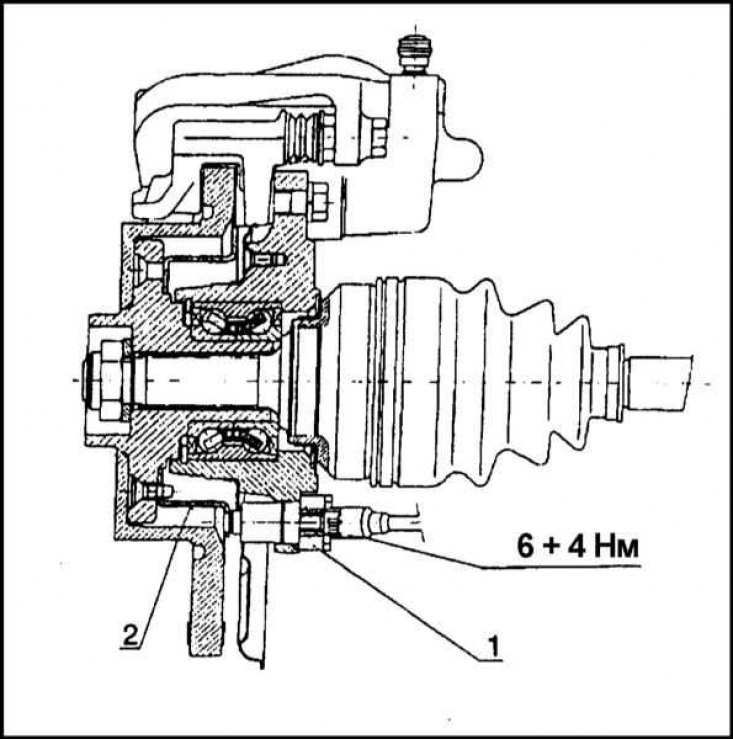
1 - Wheel sensor; 2 - Pulse disk (rotor)
Rear Wheel Speed Sensor Location
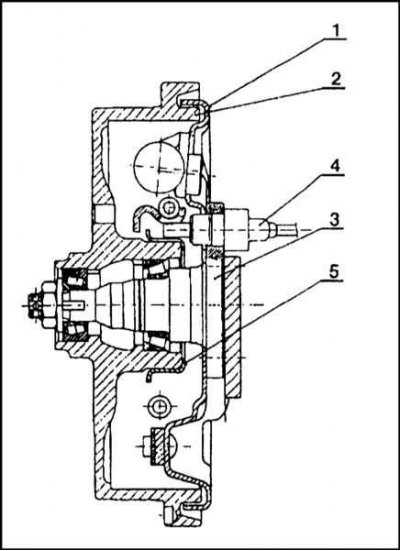
1 - Brake shield; 2 - Brake drum; 3 - Hub; 4 - Wheel sensor; 5 - Pulse disk (rotor)
Note. The cars are equipped with ABS manufactured by ITT Automotive Europe. The kit includes: a 9-inch amplifier, a tandem-type master cylinder (∅ 23.8 mm), a hydraulic modulator and connecting lines. The thread for connecting the hydraulic lines of the right and left wheels on the modulator assembly is different - M12x1 and M10x1, respectively.
[Information taken from this resource: SkodaBook.ru]
ABS is standard on some models, and optional on others. The system consists of a hydraulic modulator with an electronic control unit (ECU) mounted on it and four wheel sensors. The modulator is equipped with hydraulic electromagnetic valves (two for each brake mechanism [one inlet and one outlet]) and an electric pump. The system's task is to prevent premature locking of the vehicle's wheels during sudden braking. This goal is achieved through instantaneous pressure modulations in the hydraulic circuits of the wheel brake mechanisms.
The activation of the electromagnetic valves of the modulator is controlled by the ECU, which continuously receives information about the rotation speed of each of the car's wheels from four wheel sensors. By analyzing the incoming signals, the ECU determines the current speed of the car and uses it as a reference point when determining the moment when each of the wheels begins to lock. Under normal conditions, the braking system functions as a conventional system, not equipped with ABS.
When any of the wheels starts to lock, the ECU issues a command to activate the corresponding release electromagnetic valve of the hydraulic modulator. As a result, this brake mechanism is isolated from the brake master cylinder and the pressure in it stops increasing.
If the rotation speed of the given wheel(s) continues to decrease, the control unit issues a command to open the inlet solenoid valve and activates an electric pump, which pumps the brake fluid back into the master brake cylinder, restoring freedom of rotation to the locked wheel. As soon as the rotation speed of the wheel(s) increases to an acceptable value, the pump is switched off, and the solenoid valve restores the connection of the hydraulic circuit of the corresponding brake mechanism with the master brake cylinder. The cycle can be repeated many times per second, allowing you to maintain control of the car during sharp braking, regardless of the condition of the road surface.
The operation of the electromagnetic valves and the return pump causes pulsations in the hydraulic circuit, so the jolts of the foot brake pedal during ABS operation are a completely natural phenomenon and should not cause concern.
The ABS operation is based entirely on the electrical signals generated by the wheel sensors. To avoid false triggering of the modulator, the ECU is equipped with a special control circuit that monitors all signals coming to the unit. In the event of a questionable signal, or if signs of a decrease in the output voltage of the battery are detected, the corresponding control lamp lights up on the instrument panel, informing the driver of the ABS failure. The braking system continues to function in the normal mode, ensuring adequate braking of the car.
During vehicle operation, ensure that the hydraulic circuit connections are tight and that the electrical wiring is in good condition. ABS components do not require additional maintenance.
In case of ABS malfunction, the vehicle should be taken to the company's service station, where a full diagnostic of the system will be performed using a special reader and appropriate repairs will be made.