



Steering gear assembly
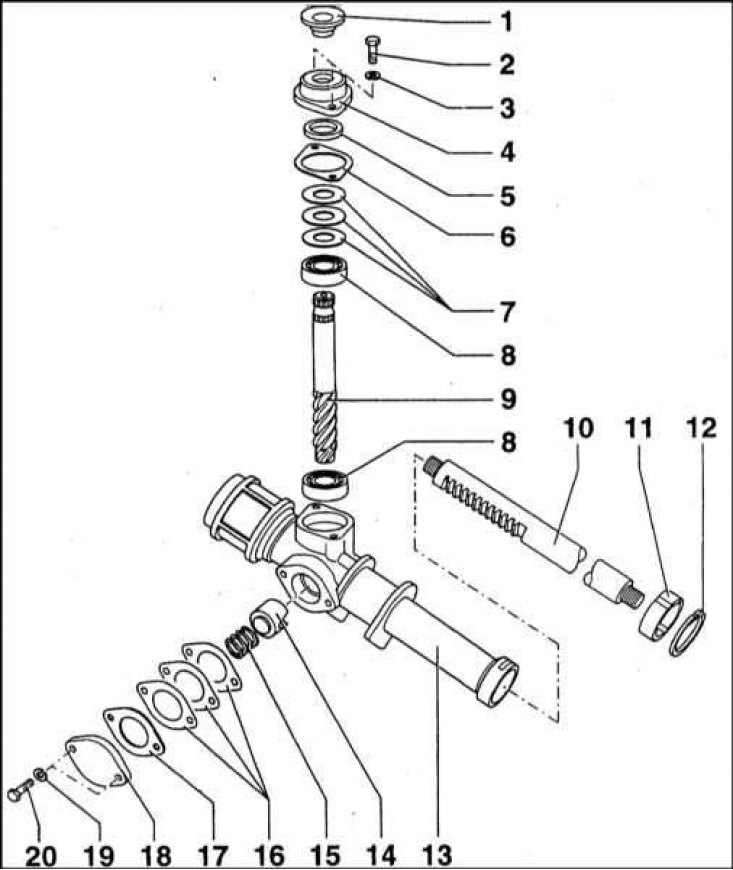
1 - Seal; 2 - Screw (7 Nm); 3 - Spring washer; 4 - Crankcase cover; 5 - Sealing ring; 6 - Sealing gasket; 7 - Adjusting washers; 8 - Ball bearing; 9 - Gear; 10 - Toothed rack; 11 - Bushing; 12 - Retaining ring; 13 - Steering gear housing; 14 - Thrust washer; 15 - Spring; 16 - Adjusting shims; 17 - Sealing gasket; 18 - Lid; 19 - Spring washer; 20 - Bolt (7 Nm)
Steering gear housing
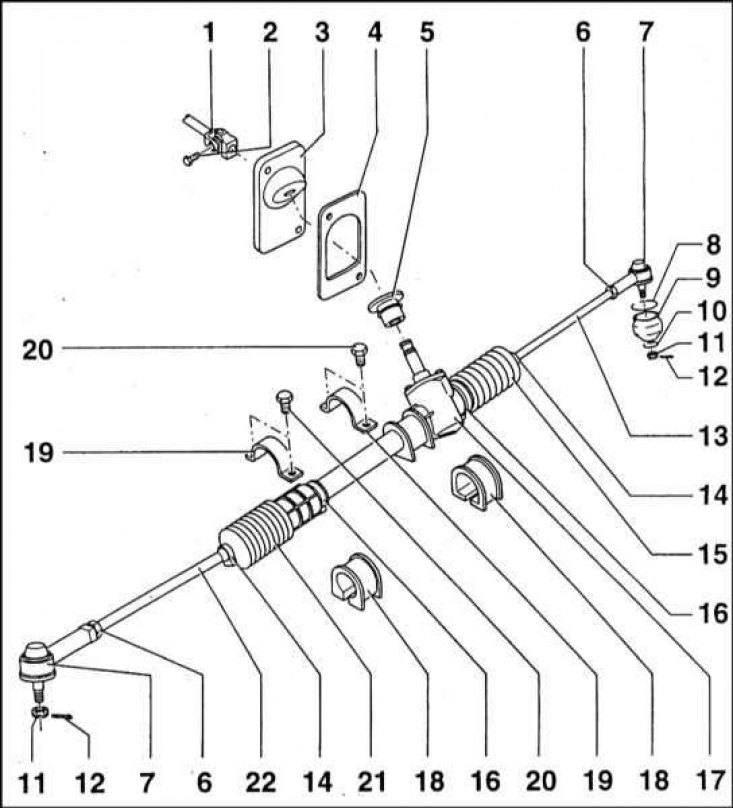
1 - Cardan intermediate shaft of the steering rack; 2 - Bolt (5 Nm); 3 - Protective sheet; 4 - Sealing gasket; 5 - Seal; 6 - Nut (60 Nm); 7 - Tie rod end; 8 - Retaining ring; 9 - Ball joint protective cover; 10 - Ring; 11 - Castle nut; 12 - Cotter pin; 13 - Left steering rod; 14 - Clamp; 15 - Protective cover; 16 - Connecting link; 17 - Steering gear housing; 18 - Rubber cushion; 19 - Rubber cushion clamp; 20 - Bolt (25 Nm); 22 - Right steering rod
Power Steering Component Locations
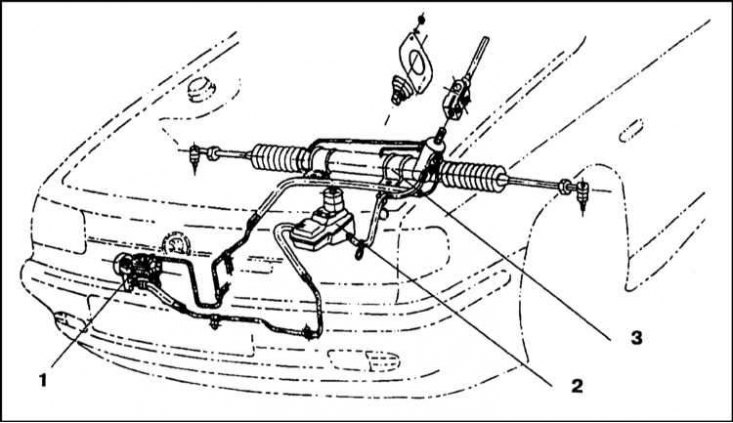
1 - Steering pump; 2 - Reservoir; 3 - Steering gear with distributor and power cylinder
Power steering
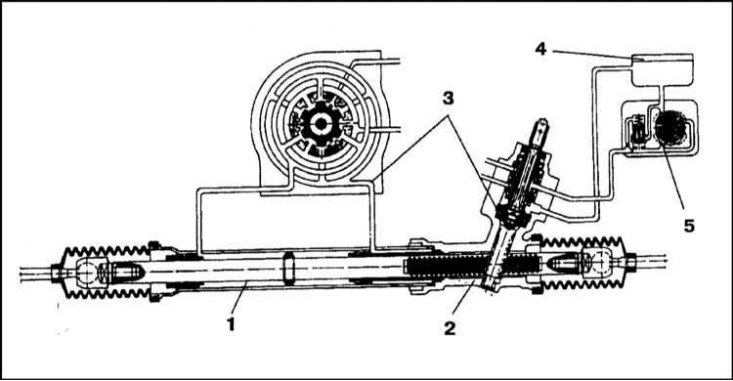
1 - Power cylinder; 2 - Rack and pinion; 3 - Distributor valve; 4 - Reservoir; 5 - Steering pump
Slide steering pump
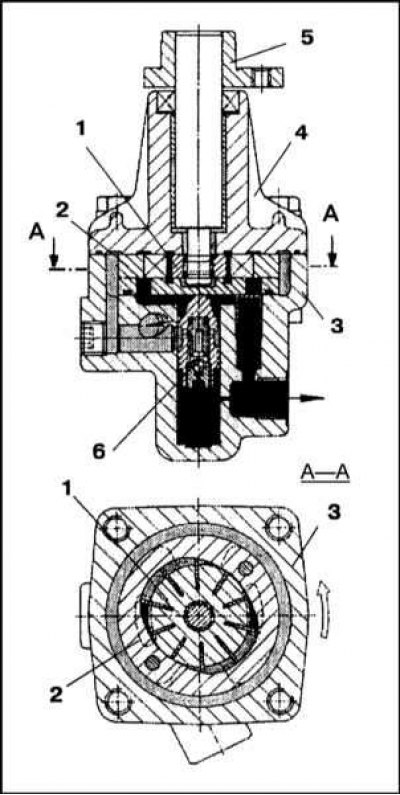
1 - Rotor; 2 - Stator; 3 - Body; 4 - Lid; 5 - Pulley flange; 6 - Safety valve
General information
Models without power steering
The rack and pinion transmission converts the rotation of the steering column into the movement of the rods that turn the steered wheels of the car.
The steering gear housing is made of aluminum alloy. The transmission consists of a drive shaft-pinion and a toothed rack.
The steering gear drive shaft is equipped with a pinion and is installed in the rack housing in two PLC 03-29/1 bearings. The shaft assembly is in constant engagement with the toothed rack, rigidly connected to the steering rods. Rotation of the shaft causes the rack to move to the right or left. The steering rods move along with the rack, causing the front wheels of the car to turn.
The steering gear housing is closed from above by a cover secured with two M6x20 bolts. The cover is installed on a sealing gasket. In the middle of the housing there is a hole through which the steering gear drive shaft passes. In order to seal the assembly, a 17x28x7 seal is installed in the hole.
To eliminate play in the shaft bearings, adjusting washers with a thickness of 0.1 and 0.2 mm are used.
The side opening in the crankcase is also closed by a cover, which is secured with two M6x20 bolts. A sealing gasket is installed under the cover. A bolt passes through the opening in the middle of the cover, designed to adjust the clearance in the engagement of the shaft with the toothed rack. The position of the bolt is fixed with a lock nut. The required clearance in the engagement is maintained by a spring-loaded cracker and an equipped 28x20 sealing ring.
The right side of the steering gear housing is a tube with a bushing inside. The bushing contains a toothed rack. The ends of the rack are connected to the steering rods.
Rubber protective covers protect the steering mechanism from contamination and also prevent leakage of the lubricant that fills the crankcase.
The steering gear is attached to the bracket by the front suspension crossmember on two rubber mounts, which are mounted in holders. Each of the holders is secured with two M8x20 bolts. Both the mounts and the holders are different from each other (larger components are installed closer to the steering gear).
Models with power steering
Power steering components are manufactured by TRW Dusseldorf.
The system consists of a rack and pinion steering mechanism, combined in a single housing with a power cylinder and a distributor valve, a steering pump, a hydraulic fluid reservoir and connecting hydraulic lines.
The steering rods are slightly shorter than those used on models with manual steering. Full steering wheel travel (from stop to stop) is 3.0 turns (versus 3.6 turns in manual models). The decrease in the number of shaft revolutions is associated with a lower gear ratio of the rack and pinion mechanism.
Note: In view of the above, if the power steering system fails, the steering will continue to function, but will require more effort when turning.
When the engine is running, hydraulic fluid is supplied by the steering pump to the rack and pinion valve. At the initial moment of turning the steering wheel (before the rack starts moving) the distributor valve rotates and the fluid is directed into the corresponding cavity of the power cylinder. As long as the driver applies force to the steering wheel, the distributor valve is displaced and the fluid continues to flow into the cylinder. As soon as the wheel stops turning, the distributor valve shifts to the middle position and the supply of fluid to the cylinder stops (the pressure line is connected to the return line). The pump continues to operate in idle mode, freely pumping fluid through the valve. Thus, the power steering is always ready for operation. If the driver, having turned the steering wheel to the stop, continues to apply force to it in the extreme position, the distributor valve remains in the shifted position and the fluid pressure continues to act on the cylinder piston. In this case, the maximum pump capacity is developed and intensive heating of the fluid occurs as a result of the increase in its pressure. In view of the above, you should not hold the steering wheel in the extreme position for too long, risking damaging the device. The degree of amplification depends on the amount of force applied to the steering wheel - the harder the driver presses on the steering wheel, the more the distributor valve shifts, increasing the fluid consumption and the power developed by the amplifier.
When a wheel hits an obstacle (for example, a curb or a stone), the distributor valve tends to shift to the middle position, the fluid pressure decreases, and the force on the steering gear increases. The driver tries to keep the wheels in the desired position; in this case, the distributor valve is displaced from the middle position and directs the flow of liquid into the corresponding cavity of the cylinder, preventing the rack from moving. This is how feedback is provided from the wheels to the driver.
The working path of the hydraulic booster system is filled with a special liquid Pentosin CHF 11 S in the amount of 0.9 l, which simultaneously acts as a lubricant for the components of the steering mechanism and the pump. The hydraulic lines laid between the pump, the valve-distributor, the power cylinder and the hydraulic fluid reservoir are made of metal tubes and rubber hoses. Each section is equipped with special nipple tips.
The main working element of the system is a vane steering pump. A rotor with movable plates rotates in a specially shaped stator. When the pump is operating, liquid enters from the vacuum side and enters the chamber formed by the rotor plates and the stator walls. The volume of the chamber gradually decreases as the rotor rotates, the liquid pressure increases and it begins to be pushed out along the connecting line into the distributor valve. When the maximum permissible pressure is exceeded, a safety valve is triggered, connecting the working cavity with the vacuum chamber. The pressure drops abruptly. The maximum pump performance is achieved at a rotor speed of 500 to 700 rpm. The maximum pressure developed by the pump is 20 kPa. The pump is driven by a multi-rib belt, which is also used in parallel to drive the compressor K/V, generator and pump.
The power cylinder, combined with the steering gear and the valve distributor, is attached to the suspension cross member with M10x1.25 bolts (unlike M8 bolts in the case of manual steering gear).
Power steering is equipped with diesel models and petrol models 1.6 l. The difference is only in the route of the connecting lines.
Removal
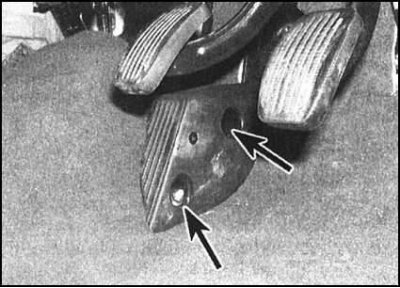
1. In the car interior, loosen the mounting nuts and remove the footrest assembly from the clutch pedal.
2. If so equipped, fold back the carpet and remove the screw and nut securing the steering column base trim cover. Remove the cover to gain access to the lower intermediate shaft universal joint.
3. Use paint or a marker to mark the position of the hinge relative to the rack and pinion drive gear, then remove the hinge assembly pinch bolt.
4. Loosen the nuts, remove the washers and release the sealing plate and gasket installed around the drive gear.
Note: A damaged gasket must be replaced.
5. Firmly set the parking brake, then jack up the front of the car and support it on stands. Remove both front wheels.
6. Remove the cotter pins, then loosen the nuts securing the tie rod ends to the hub assemblies. Release the ends from the hub pivot arms - use a ball joint puller if necessary.
Models without power steering
1. Unscrew the mounting bolts and remove the steering gear mounting clamps from the subframe.
2. Separate the rack and pinion assembly from the intermediate shaft and remove it from under the vehicle. Remove the rubber mounts from the steering gear (the pillows are not interchangeable). Remove the sealing plate with the gasket from the vehicle interior.
Models with power steering
1. To minimize hydraulic fluid loss, use special clamps or clamps to pinch the supply and return hoses near the steering pump reservoir.
2. After marking the connectors, unscrew the union bolts on the steering gear assembly (prepare a drain pan to collect the leaking hydraulic fluid). Disconnect both hoses and remove the sealing washers.
Note: During assembly, the sealing washers must be replaced without fail. Immediately plug the open ends of the hoses and the openings in the steering gear housing to minimize the loss of hydraulic fluid and to prevent dirt from entering the system.
3. Release the hydraulic hoses from the intermediate clamps and move them away from the steering gear assembly.
4. Unscrew the mounting bolts and remove the rack and pinion assembly clamps from the subframe.
5. Separate the rack and pinion assembly from the intermediate shaft and remove it from underneath the vehicle. Remove the rubber mounts from the steering gear (the pillows are not interchangeable). Remove the sealing plate with the gasket from the vehicle interior.
Major repairs
1. The steering rack transmission is one of the most reliable units of the car. The failure-free operation of the mechanism depends on the quality of lubrication of the internal components, the condition of the protective covers, the serviceability of the wheel assemblies balancing, and the amount of play in the steering gear.
2. A distinctive feature of the rack-and-pinion steering mechanism is that any vibration and jerking associated with wheel imbalance, uneven road surfaces and weakening of the wheel bearing preload are inevitably transmitted directly to the steering wheel.
3. In order to perform major repairs, the steering gear assembly must be removed from the vehicle.
4. After dismantling the assembly, it is easy to replace or adjust the oil level in it. The oil is drained by removing the rubber protective covers from the crankcase flanges, for which it is necessary to first remove the fastening clamps.
5. After securing the larger rubber boot, position the steering gear housing vertically and pour the required amount of oil of the required grade into it through the end onto which the shorter boot is placed. Install the second boot onto the housing and secure it with a clamp. Move the housing to a horizontal position and check it for signs of leaks from under the protective boots. Tighten the clamps if necessary.
6. When replacing the rubber protective boots, it is necessary to unscrew the steering rod ends and drain the oil from the crankcase. Now the boots can be removed and replaced with new ones. Then fill the crankcase with fresh oil, secure the clamps and install the rod ends in place.
7. Disassembly of the steering mechanism for the purpose of performing repairs or replacing failed internal components is carried out as follows:
- a) Remove the clamps securing the rubber boots;
- b) Bend back the edges of the covers and drain the oil from the crankcase into a clean container;
- c) Slide the boots towards the tie rod ends;
- d) Bend back the tabs of the flat lock washers securing the nuts at the ends of the rack;
- e) Using a screwdriver, bend back the recess on the edge of the adapter sleeve in the rack groove;
- f) Loosen the nuts and disconnect the traction rods from the rack;
- g) Unscrew the two bolts securing the side cover to the crankcase, remove the spring, cracker and rubber sealing ring;
- h) Remove the steering gear drive shaft with the upper bearing from the housing (clamp the shaft in a vice with soft jaws and pull the housing; if necessary, use a soft-faced hammer);
- i) Using a puller, remove the bearing from the shaft;
- j) Remove the toothed rack from the steering gear housing;
- k) Using a special tool, remove the lower bearing from the crankcase.
8. After replacing the faulty components, assemble the mechanism:
- a) Install the lower shaft bearing into the crankcase;
- b) Lubricate the rack with transmission oil and insert it into the steering gear housing with the smooth side facing the side hole;
- c) Insert the shaft with the upper bearing installed on it into the crankcase and seat the assembly with hammer blows so that the lower bearing is also on the shaft (make sure that the upper bearing does not have movement towards the shaft teeth);
- d) Lubricate the edges of the hole from which the shaft protrudes with a small amount of transmission oil, place the sealing gasket of the upper cover on the mating surface;
- e) Measure the distance between the outer race of the bearing and the top surface of the gasket;
- f) Select the adjusting washers so that their thickness corresponds to the measured distance, plus 0.1 mm (washers are available in thicknesses of 0.1 and 0.2 mm);
- g) Install the washers (first the adjustment ones, then the regular ones), lubricate the cover with a small amount of transmission oil, install it on the assembly and tighten it with the mounting bolts (pre-lubricate the bolt threads with sealant);
- h) Tighten the bolts to the required torque (7 Nm);
- i) Check the freedom of rotation of the shaft, estimate the amount of play in the assembly components;
- j) Lubricate the inside surface of the side hole in the steering gear housing with transmission oil;
- k) Insert the rack cracker, rubber sealing ring and spring into the hole;
- l) Lubricate the mating surfaces of the bore and cover with transmission oil;
- m) Install the sealing washer and tighten the two mounting bolts to the required torque (7 Nm);
- n) Assess the amount of play in the mechanism and make appropriate adjustments if necessary;
- o) Screw new adapter bushings onto both ends of the rack and tighten them with the required force (50÷60 Nm). To tighten the bushings, screw on locknuts and special nuts. Clamp one pair of nuts in a vice, tighten the second with the required force and lock with a locknut. Now clamp the already tightened nut in a vice (together with the counter) and repeat the procedure with the opposite bushing;
- p) Lock the bushings by flaring their edges into the grooves on the rack;
- q) Insert a plate into each of the bushings;
- r) Screw a special nut onto the steering rod with the flat surface towards the rod end;
- s) Lubricate the rod end;
- t) Install a lock washer on the reduction sleeve;
- u) Screw a special nut onto the thread of the reduction sleeve, put on the steering rod. Tighten the nut so that a force of 12.5÷20.5 Nm is required to deflect the rod. Tighten the lock nut with a force of 50÷60 Nm and lock it with a lock washer, bending the flag of the latter onto the slot of the nut and lock nut;
- v) Proceed in a similar manner to secure the opposite rod;
- w) Install protective covers on the rods and secure them with clamps;
- x) Pull the longer boot over the crankcase flange and secure it with a clamp;
- y) Fill the crankcase with fresh oil, then install the assembly on the vehicle.
Installation
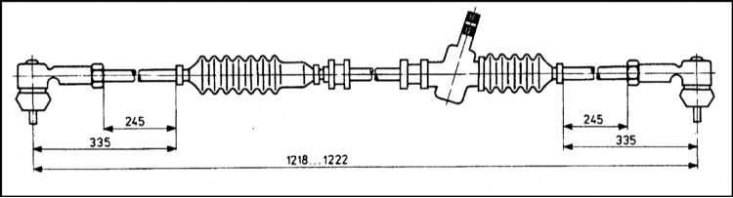
1. Install the rubber support pads on the steering gear, turning them with the flat side down. When installing, it is necessary to observe the dimensions shown in the illustration.
2. Carefully clean the mating surfaces and install the sealing plate and gasket on the inside of the engine compartment bulkhead.
3. Install the steering gear assembly onto its standard one, being careful not to damage the bulkhead sealing plate. Using an assistant, align the mounting marks applied during dismantling and engage the intermediate shaft with the splines of the rack and pinion drive gear.
4. Make sure the rubber pads on both mounts are facing the subframe with the flat sides facing the subframe, then install the mounting clamps.
5. Clean the threads of both mounting bolts, then lightly coat them with a thread locking compound such as Loctite 270. Install the bolts and tighten them evenly in several passes to the required torque.
6. In the vehicle interior, ensure that the sealing plate is correctly seated relative to the steering gear housing, then tighten the mounting nuts securely.
7. Make sure that the intermediate shaft universal joint is installed correctly, then screw in the joint assembly clamp bolt and tighten it to the required torque. If so equipped, reinstall the column base trim cover.
8. Insert the steering rod ends into the steering arms of the hub assemblies. Screw on the mounting nuts, tighten them securely and secure with new cotter pins.
9. Replace the wheels, then lower the vehicle to the ground and tighten the wheel bolts to the specified torque.
10. Finally, check the front wheel alignment angles and make the appropriate adjustments if necessary (see section Car Wheel Alignment Angles - General Information).
Models with power steering
1. Follow the procedures outlined in the Removal subsection.
2. Install new sealing washers on both sides of the hydraulic hose unions, then screw in the union bolts and tighten them to the required torque without removing the clamps/clamps from the hoses.
3. Replace the wheels, then lower the vehicle to the ground and tighten the wheel bolts to the specified torque.
4. Add fresh hydraulic fluid to the steering pump reservoir (see section Removal air locks from the hydraulic circuit of the power steering system).
5. Finally, check the front wheel alignment angles and make the appropriate adjustments if necessary (see section Car Wheel Alignment Angles - General Information).