



Removal
1. Park your car on a spacious, level, horizontal area with a hard surface.
2. Disconnect the negative cable from the battery.
3. Drain the cooling system (see Chapter Routine maintenance).
4. Remove the accessory drive belt (see section Removal, installation and adjusting the tension of the auxiliary drive belt).
5. While squeezing the locking tabs, release the spring clamp and remove the air intake sleeve from the intake manifold cover.
6. Perform the following procedures (see Chapter Cooling and heating systems):
- a) Loosen the clamps and disconnect the radiator hoses from the pipes on the cylinder head;
- b) Loosen the clamps and disconnect the expansion tank hose and the heater inlet and outlet hoses from the pipes on the cylinder head.
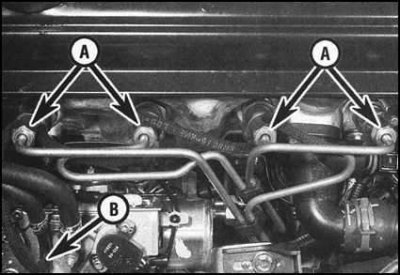
7. In accordance with the instructions given in Chapter Power supply system, perform the following procedures:
- a) Disconnect from the injectors and the injection pump head and remove the fuel supply pipes;
- b) Disconnect the injector return hose from the fuel injection pump return fitting;
- c) After clearly marking the electrical wiring, disconnect all electrical connectors of the power supply system.
8. Acting in the manner described in Sections Bringing the piston of the first cylinder to the top dead center (TDC) position at the end of the compression stroke, Removal and installation the timing belt and its covers, Removal and installation the cylinder head cover, follow these steps:
- a) Remove the cylinder head cover;
- b) Remove the outer timing belt covers and slide the belt off the camshaft sprocket;
- c) Remove the timing belt tensioner, as well as the camshaft and fuel injection pump gears.
9. Once the timing belt has been removed, the engine can be lifted back to its original position and the right engine support connected.
10. To avoid accidental contact between the pistons and the valves during head removal, the authors of this Manual recommend turning the crankshaft back to a position several degrees before TDC.
11. Remove the mounting screws and remove the inner timing belt cover.
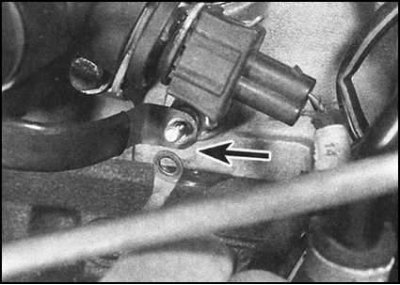
12. In accordance with the instructions of the Chapter Power supply system Chapters Engine electrical equipment perform the following procedures:
- a) Under the vehicle, remove the mounting bolts and separate the exhaust pipe from the exhaust manifold flange;
- b) Remove the EGR valve and its connecting fittings from the intake manifold and exhaust manifold;
- c) Unbolt the supply wire from the glow plug of the fourth cylinder.
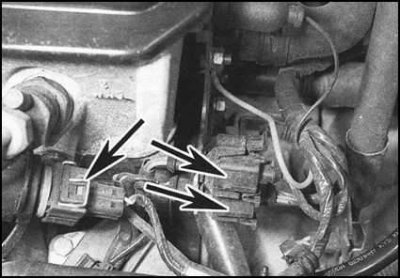
13. Disconnect the CTS wiring connector and the two connectors located in the adjacent bracket.
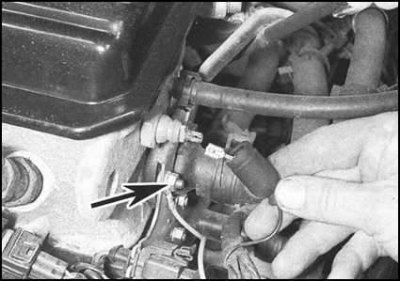
14. Disconnect the electrical wiring from the engine oil pressure switch and the ground bus located below.
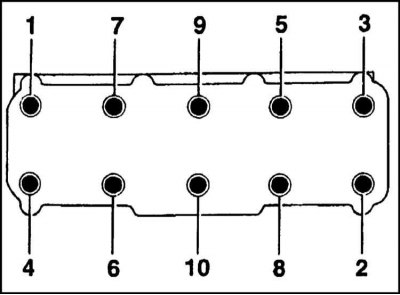
15. Acting in the order shown in the illustration, in several steps (half a turn per approach) loosen the head mounting bolts enough to be able to unscrew them by hand. Bolts must be replaced during assembly.
16. Make sure that no communication lines remain connected to the cylinder head. Remove the head from the cylinder block (if necessary, use the help of an assistant, especially if the head is removed together with the pipeline and manifold).
17. If the head is "stuck" and cannot be separated from the block, do not try to knock it off with a hammer under any circumstances - do not forget about the guide pins! Instead, carefully rock the assembly by the pipe/manifold - do not try to insert a lever between the mating surfaces!
18. Remove the gasket from the surface of the block mating with the head. Do not throw it away, save it as a template. Check the tightness of the guide pins, if necessary, remove them from their sockets.
Separation of the intake manifold and exhaust manifold from the head
1. With the head on a workbench, remove the five bolts securing the intake manifold cover. Remove the cover and its sealing gasket.
2. Unscrew the mounting bolts and remove the four intake pipes with the pipeline from the head. Remove the sealing gasket.
3. Loosen and unscrew the fastening nuts in several steps (during assembly, defective nuts must be replaced) and remove the exhaust manifold with the gasket from the cylinder head.
4. Thoroughly clean the mating surfaces, install a new gasket, then install the exhaust manifold. Screw on the new mounting nuts and tighten them to the required torque.
(Information presented on the website: SkodaBook)
5. Place a new gasket on the head, then install the intake manifold assembly onto it. Install each intake manifold one at a time, then install the mounting bolts and tighten them to the specified torque.
Preparing for assembly
1. Using a scraper made of soft material, thoroughly clean the mating surfaces of the head and block. Remove all traces of old gasket material and carbon deposits from the surfaces. Clean the piston crowns as well. Try to keep debris out of the water galleries and oil drains (carbon particles can completely block the oil supply to the internal components of the engine) - Seal all accessible holes with tape. The gaps between the walls of the pistons and cylinders should be filled with consistent grease for the same purpose, which can then be easily removed with a thin brush.
2. Check the mating surfaces of the block and cylinder head for scratches, burrs and other mechanical damage. Minor defects can be removed using a fine-tooth file or fine-grained sandpaper. In the case of more serious damage, you will have to resort to machine machining. Assess the flatness of the mating surfaces using a special template (steel ruler ribs) and a blade-type feeler gauge.
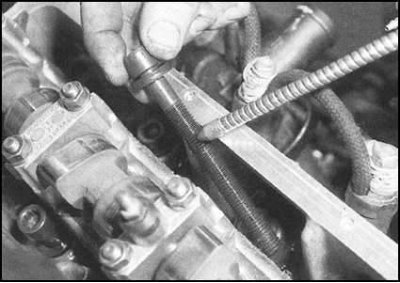
3. Tap the bolt holes in the cylinder block with a suitable tap, cleaning the threads and restoring damaged threads.
Note: If you don't have a suitable tap at hand, the holes can be cleaned using a homemade device made from a long pin with a thread sawn along the length.
4. To avoid damage to the pistons and valves, the authors of this Manual recommend that before installing the head, move the crankshaft 90° back from the TDC position (if necessary, refer to the materials in Section Description of the main units and mechanisms).
Assembly
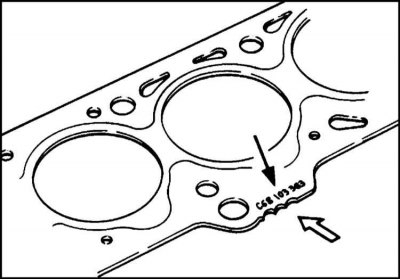
1. Make sure that the replacement gasket matches the size removed from the engine. Identification markings may be in the form of punched holes, marks, or a letter number located along the edge of the gasket. If the pistons have not been replaced, the engine must be fitted with a gasket of the same size as the one removed during dismantling.
2. Otherwise, a new gasket is selected based on the results of measuring the protrusion height of the new pistons.
3. Carefully wipe the mating surfaces of the cylinder head and block with a clean, dry cloth, then place a new gasket on the block, carefully sliding it onto the guide pins. If guide pins are not provided, a pair of thread cleaning devices made in accordance with the instructions in paragraph 4 of the subsection Preparation for Assembly can be screwed into the bolt holes of the block instead. The gasket should be placed with the marking facing up.
4. Using an assistant, carefully place the head assembly with the manifold and pipe onto the guide studs. Before finally lowering the head onto the block, make sure the gasket is positioned correctly once again.
5. Lightly lubricate the threads and undersides of the mounting bolt heads with machine oil.
6. Carefully insert each bolt into its hole and tighten by hand.
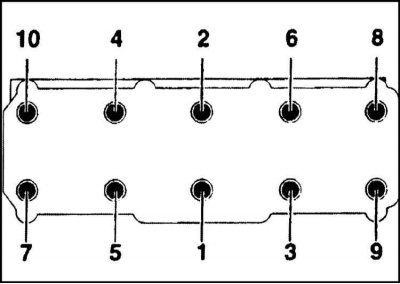
7. In the given order, tighten the bolts in several stages with the force of the first tightening stage, then repeat the procedure and tighten the bolts with the force of the second tightening stage.
8. After tightening the bolts to the second stage, use a special angle gauge or a template made of thick cardboard and tighten the bolts to the third stage tightening angle. Finally, tighten the bolts to the fourth stage tightening angle.
9. Install the inner timing belt cover in place and tighten its mounting bolts securely.
10. Bring the engine to the TDC position (see section Bringing the piston of the first cylinder to the top dead center (TDC) position at the end of the compression stroke).
11. Support the engine, disconnect the right support and lower the power unit slightly (see section Removal and installation the timing belt and its covers). Now reinstall the timing belt sprockets (see section Removal and installation the tensioner and timing belt gears). Install the belt and adjust its tension, then reinstall the outer covers and crankshaft pulley (see section Removal and installation the timing belt and its covers).
12. The engine can now be lifted again and installed in place of the powertrain mount (see section Removal and installation the timing belt and its covers).
13. Install the accessory drive belt and adjust its tension (see section Removal and installation the timing belt and its covers).
14. Further installation is carried out in the reverse order of dismantling:
- a) The installation procedures for the EGR valve and glow plug supply wire are described in Chapter Power supply system;
- b) Following the instructions given in Chapter Power supply system, connect the fuel supply hoses to the injectors and the injection pump head. Restore the original connection of the fuel system wiring. Connect the return hose to the corresponding nipple of the injection pump;
- c) Don't forget to connect the multi-pin connector of the engine wiring harness;
- d) Reinstall the cylinder head cover (see section Removal and installation the cylinder head cover);
- e) Refer to the materials of the Chapter Cooling and heating systems restore the original radiator and expansion tank hose connections. Reconnect the wiring to the CTS;
- f) Connect the negative cable to the battery.
15. Finally, fill the engine with the required amount of motor oil of the required grade.