



Ignition system diagram with contactless sensor-distributor
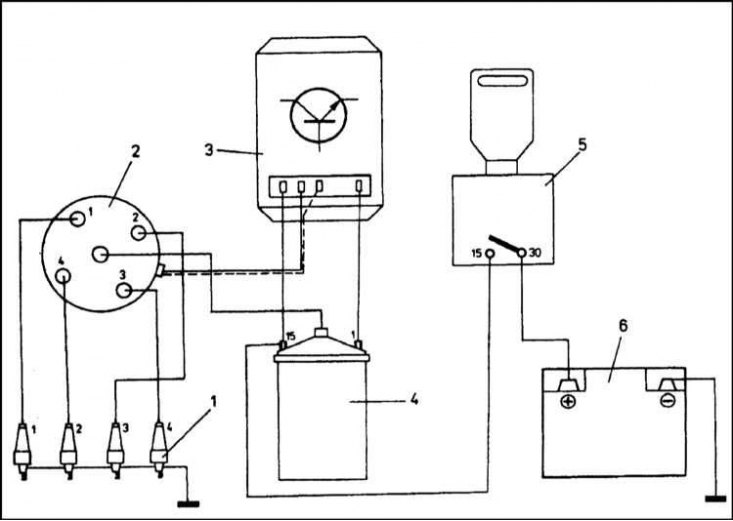
1 - Spark plugs; 2 - Ignition distributor; 3 - Switch; 4 - Ignition coil; 5 - Ignition switch; 6 - Battery
Note: The Bosch Mono-Motronic, Simos 2P and Magneti-Marelli 1AV systems are subsystems of a single engine management system that controls fuel supply and ignition timing. This Part of the Chapter deals only with ignition related components.
Carburetor models
The ignition system is designed to convert low voltage current coming from the battery or generator into high voltage current, and also to supply this high voltage at the appropriate moments to the spark plugs, which ignite the air-fuel mixture in the engine cylinders.
The carburetor models of the cars in question use an ignition system with a contactless sensor-distributor and a switch. The diagram of such an ignition system is shown in the illustration.
In the low-voltage circuit of the ignition system, current flows through the contacts of the ignition switch to terminal "15" of the ignition coil, and then from terminal "1" of the coil to the switch.
In the high-voltage circuit, induced in the secondary winding of the ignition coil (is created at the moment of interruption of current in the primary winding of the coil) the current goes to the central terminal of the distributor cap and then, through the rotor and high-voltage wires, to the spark plugs.
Bosch Mono-Motronic and Magneti-Marelli 1AV
Both systems consist of four spark plugs, five high-voltage wires, a distributor, an electronic ignition coil, an electronic control unit (ECU), as well as a set of information sensors, actuators and connecting electrical wiring. The layout of the system components is slightly different, but the operating principle of the systems is almost identical.
The ECU supplies the reference voltage to the input stage of the ignition coil, exciting the primary winding of the coil. The reference voltage is periodically interrupted by the ECU, which leads to the folding of the magnetic field of the primary winding and the generation of high-voltage voltage in the secondary. Then, the high voltage created in the coil is fed through the distributor via the high-voltage wires to the spark plugs, which generate a powerful spark during the ignition stroke of the piston of each of the cylinders. The spark is formed between the electrodes of the spark plug at the moment the high-voltage voltage is applied to it and ensures the guaranteed ignition of the air-fuel mixture injected into the cylinder. The ignition advance angle and the duration of the closed state of the interrupter contacts are determined and controlled by the ECU, based on the information received from the engine management system sensors about the engine speed, the position of the crankshaft and the depth of the vacuum in the intake manifold. Other parameters that influence the choice of ignition timing include the position and opening speed of the throttle valve, intake air and coolant temperatures, and in the Magneti-Marelli system, also the detonation of the air-fuel mixture (information is sent to the ECU from the corresponding sensors).
Control of air-fuel mixture knock is provided on 1.6 l models equipped with Magneti-Marelli 1AV injection system. The knock sensor is installed on the cylinder block and by increasing vibrations detects the moment when ignition becomes too early. Having received information from the sensor in time, the ECU retards ignition, preventing the occurrence of sound effects associated with detonation. Then the ECU returns the ignition advance angle to the normal value in several stages. If detonation occurs again, the cycle is repeated.
Idle speed control is performed partly by means of an electronic throttle position module mounted on the throttle body wall, and partly by the ignition system by timely adjustment of the ignition advance angle. In view of the above, there is no need for manual speed control, and the system design does not provide for the possibility of its implementation.
In some systems, the ECU is able to organize multiple ignition when starting a cold engine. When the engine is turned by the starter, the spark plugs generate a spark multiple times on each stroke, which significantly increases the efficiency of ignition of the mixture and facilitates engine starting.
It should be noted that the diagnostics of system faults described in this Chapter is possible only with the use of special electronic equipment. If the cause of the failure is identified during the execution of the procedures listed in Section Diagnosis of ignition system faults and checking the condition of its components this Chapter, the vehicle must be taken to a service station. Descriptions of the procedures for removing and installing failed components are given in the relevant Sections of the Chapter.
Simos 2P
The Simos 2P system uses static ignition (without distributor). The ignition system consists of two ignition coils enclosed in casings and combined into a single module. The model is installed directly above the spark plugs, and therefore no high-voltage wires are provided.
Each of the module's coils serves two cylinders (one - 1st and 4th, the second - 2nd and 3rd).
According to the commands issued by the ECU, the coils generate two ignition sparks in the cylinders - one on the compression stroke and one on the exhaust stroke. The spark plug breakdown voltage on the compression stroke is quite significant as a result of the pressure increase. On the exhaust stroke, when the compression is insignificant, a very weak spark is generated, which has no effect on the exhaust gases released from the cylinder and is called an idle spark. This ignition scheme eliminates the need to install a separate coil on each spark plug.
The ECU controls the system operation based on signals received from various information sensors. Based on incoming information about engine temperature, current load and revolutions, the ECU determines the parameters for adjusting the ignition timing and coil charging time. At idle, the ECU, by adjusting the ignition timing accordingly, changes the engine torque in order to maintain revolution stability. The system operates in close contact with the throttle position potentiometer.
The ignition system also includes a knock sensor. Installed in the rear part of the cylinder block, the sensor reacts to changes in the engine vibration frequency and determines the moment when detonation of the mixture in the cylinders begins. Based on the information received from the sensor, the ECU promptly makes step-by-step adjustments to the ignition advance angle, preventing further development of detonation.