



Contents: Removal ⬇ Installation ⬇
Longitudinal section of the generator
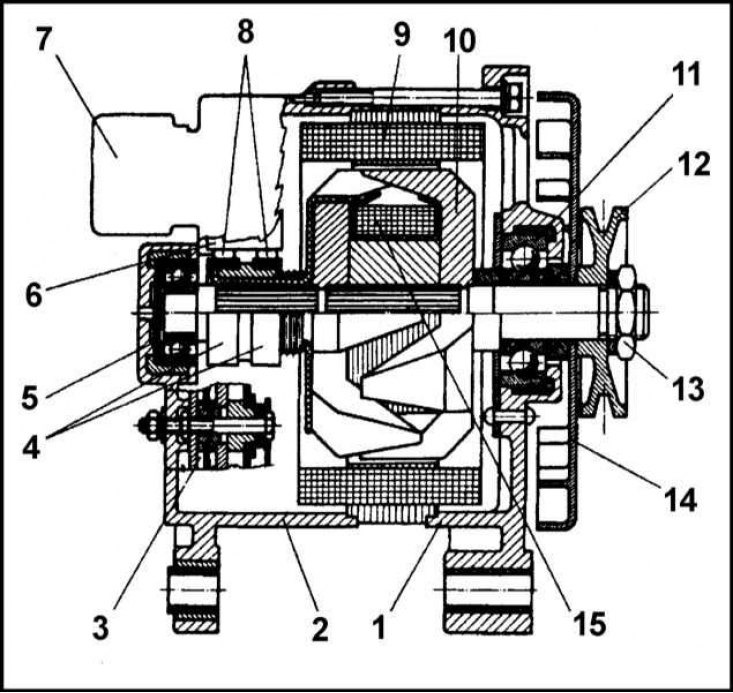
1 - Front cover; 2 - Back cover; 3 - Board with diodes; 4 - Slip rings; 5 - Rear bearing; 6 - Brush holder; 7 - Voltage regulator; 8 - Brushes; 9 - Stator with windings; 10 - Rotor; 11 - Front bearing; 12 - Pulley; 13 - Nut; 14 - Impeller; 15 - Rotor winding
Generator winding connection diagram
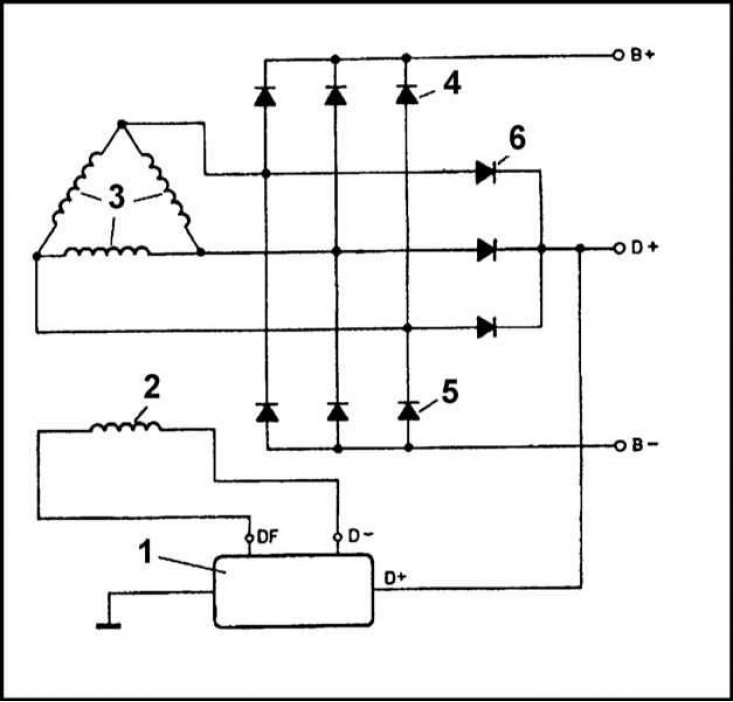
1 - Voltage regulator; 2 - Excitation winding; 3 - Stator winding; 4 - "Positive" rectifier diodes; 5 - "Negative" rectifier diodes; 6 - Excitation winding diodes
The vehicles in question use a synchronous alternating current generator with a built-in rectifier.
In principle, all generators used for assembly (see Specifications) are constructed identically. A partial longitudinal section of the generator is shown in the illustration, the winding connection diagram is shown in the illustration below.
The generator body consists of two covers (front and back), fastened with three long through bolts M5. The stator is fixed inside the housing. Three wire windings are wound on the insulated metal plates of the stator, connected to each other in a triangle. The stator windings are connected to nine rectifier silicon diodes placed on boards and brackets inside the generator housing. The diodes rectify the alternating current generated in the windings.
In both covers of the generator housing there is a ball bearing, in which the rotor shaft is seated. On the rotor shaft there are magnets of a characteristic "beak-shaped" form, covering the excitation winding. On the same shaft there are contact rings. The rings are insulated from the shaft and connected to the terminals of the excitation winding.
The spring-loaded carbon brushes rest against the contact rings. One of the 5 brushes is connected to the D+ terminal, the second to the D- terminal. The wires from both terminals are routed out through the rear cover. When the ignition is turned on, when the engine has not yet started, the following electrical circuit is powered: positive battery terminal - ignition switch contacts - control lamp - voltage regulator - generator excitation winding - ground. At the same time, the control lamp in the vehicle's instrument panel lights up.
After the engine has started, when the crankshaft speed exceeds 900 rpm, the generator is excited and begins to generate alternating current, which is then rectified by the diode assembly. Voltage appears at the D+ terminal and, since there is no longer a potential difference on the control lamp, it goes out. Current enters the excitation winding through three diodes (6) and a voltage regulator. The diodes, called excitation diodes, work similarly to diodes (4) and (5), with the only difference being that their load is only the excitation winding and the voltage regulator, due to which they are smaller in size and do not need heat-dissipating radiators.
The current between the generator and the battery can only flow in one direction - from the generator to the battery. The diode rectifier assembly does not allow it to flow in the opposite direction.
The magnitude of the voltage created by the generator is regulated by changing the excitation current in the rotor winding. This function is performed by the voltage regulator.
The pulley with the blower impeller is attached to the rotor shaft using a locked M14 nut.
The bracket of the adjustment bar for adjusting the drive belt tension force is attached to the cylinder head using the head mounting nut. The nut is screwed onto the M8x20 bolt.
Removal
1. Disconnect the negative cable from the battery.
2. Remove the accessory drive belt from the alternator pulley.
Models 1.3 l
1. Remove the protective cap, remove the nut with washers and remove the power wire terminal from the generator contact stud.
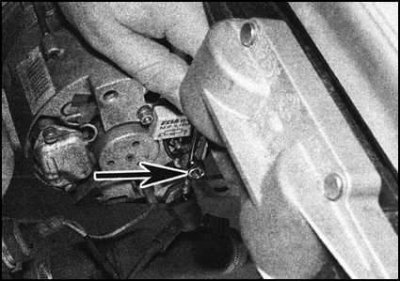
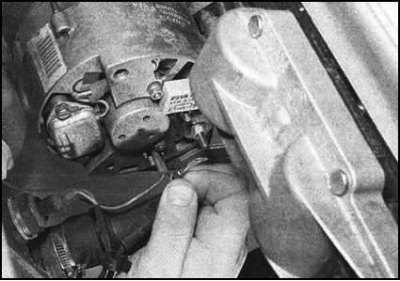
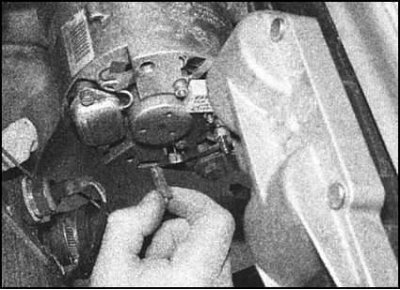
2. Disconnect the signal wire from the generator.
3. Loosen the generator upper support bolt.
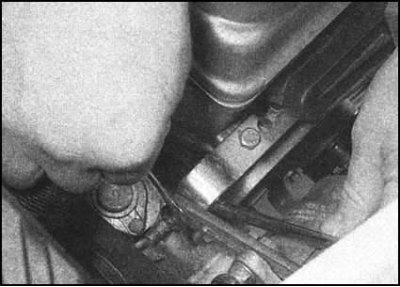 |
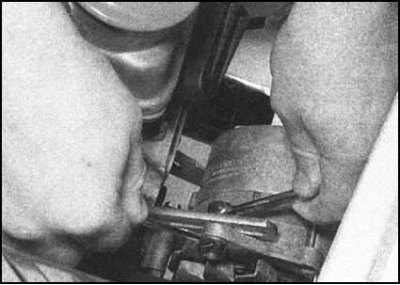 |
4. Loosen the lower support mounting bolt nut and rotate the generator assembly toward the radiator to provide sufficient working space.
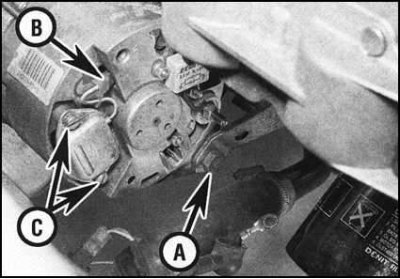 |
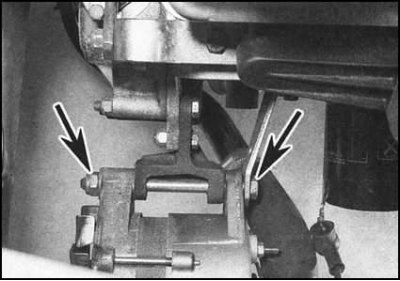 |
5. Remove the lower through bolt and remove the generator from the support bracket.
Diesel and 1.6L models
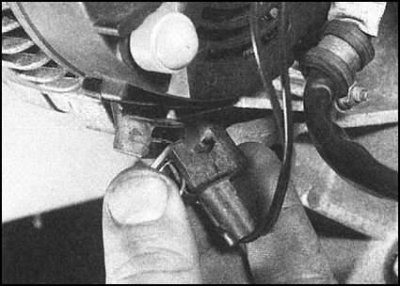
1. Disconnect the signal wire connector on the generator.
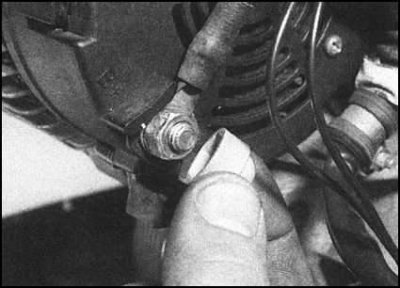
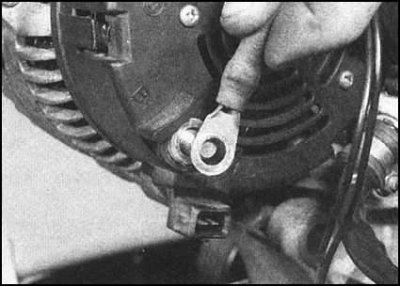
2. Remove the protective cap, loosen the nut, remove the washers and disconnect the power wire terminal from the generator.
 |
 |
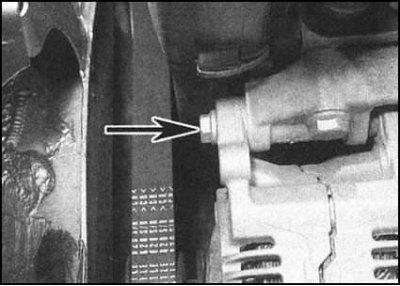
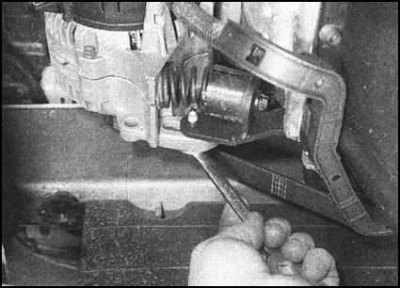
3. Remove the lower and upper alternator mount bolts, then remove the alternator from its bracket. If equipped, rotate the alternator drive belt tensioner pulley outward to gain access to the lower mount bolt.
 |
 |
Text copied from this resource: www.SKODABOOK.ru
All models
If there is a need to remove the brush holder/voltage regulator module, refer to the materials in Section Replacing the brush holder/voltage regulator module.
Installation
1. Installation is carried out in the reverse order. Make sure that the drive belt is correctly laid and adjusted for tension.
2. Tighten all fasteners to the required torque.