



Removal
1. Park your car on a spacious, level, horizontal area with a hard surface.
2. Disconnect the negative cable from the battery.
Note: If your vehicle's stereo system is equipped with a security device, make sure you have the correct code to activate the audio system before disconnecting the battery.
3. Drain the cooling system and remove the spark plugs.
4. Remove the air cleaner with the air intake tract components (see Chapter Power supply system). Remove the heated air supply hose from the air cleaner pipes and the exhaust manifold housing plate.
5. Release the residual pressure in the fuel system (see Chapter Power supply system).
6. Remove the distributor cap with the high-voltage wires connected to it, also remove the rotor and protective screen. It is not necessary to remove the cylinder head (it will be enough to disconnect the high voltage wire from the ignition coil), however, this will significantly expand the working space and facilitate access to the distributor.
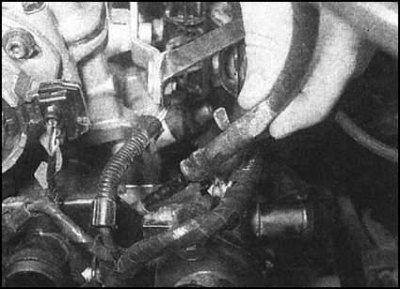
7. If necessary, referring to the materials in Chapter 3, loosen the fastening clamps and disconnect the cooling system hoses from the thermostat housing.
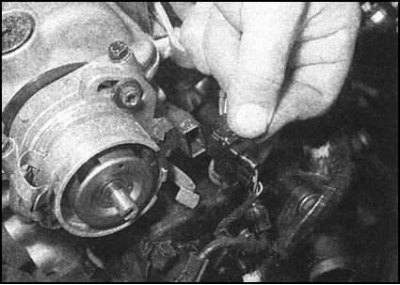
8. Disconnect the electrical wiring connectors of the following components:
- a) Knock sensor and λ-probe. Release both connectors from the bracket fixed above the flywheel;
- b) Intake air temperature/pressure sensor on the intake manifold;
- c) Throttle control unit;
- d) Hall sensor from the ignition distributor;
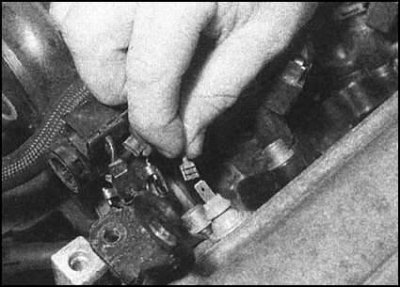
- e) Oil pressure switch on the rear wall of the cylinder head.
- f) Fuel injector and wiring harness on the intake manifold (if necessary, see Chapter Power supply system). Release the tourniquet from the intermediate clamps and put it aside);
- g) Coolant temperature sensor (CTS) on the thermostat housing;
- h) After disconnecting all connectors, release the harnesses from the intermediate clips and move them to the side.
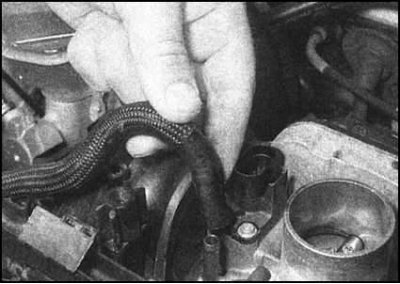
9. Disconnect the following hoses:
- a) Hose connecting the inlet pipe to the charcoal canister purge solenoid valve (on the mudguard of the left wheel arch);
- b) Brake booster vacuum hose from intake manifold;
- c) Fuel supply and return hoses from the fuel line. Try to remember the direction of flow and the color marking of the hoses. Be prepared to collect any spilled fuel. Immediately plug the open ends of the hoses and fittings to prevent dirt from getting into the fuel system and to minimize fuel loss.
10. At the rear of the thermostat, release the wire fasteners securing the housing to the water pump feed pipe that runs behind the engine block. Disconnect the remaining parts from the thermostat housing (try to remember the order in which they are connected).
11. Remove the accessory drive belt (see section Removal, installation and adjustment of the tension force of the auxiliary drive belt).
12. Remove the outer timing belt covers and crankshaft pulley (see sections Bringing the piston of the first cylinder to the top dead center (TDC) position at the end of the compression stroke, Removal and installation the timing belt and its covers). Remove the timing belt from the camshaft sprocket.
13. After removing the timing belt, the engine can be raised back to its original position and the right support of the unit connected.
14. To avoid accidental contact of the pistons with the valves during the process of removing the head, the authors of this Manual recommend turning the crankshaft back to a position several degrees before TDC.
15. Remove the intake air heater plate from the top of the exhaust manifold.
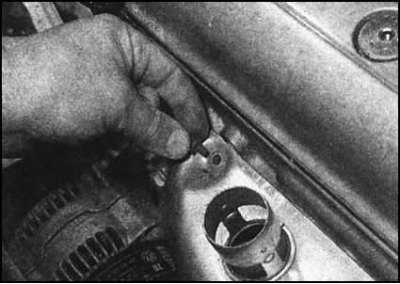
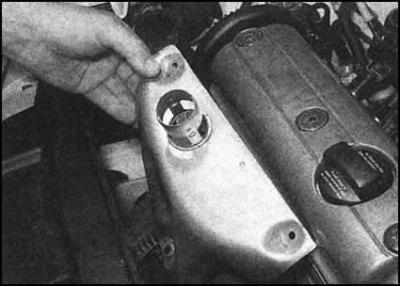
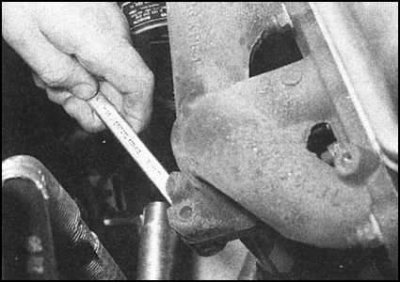
...disconnect the exhaust pipe from the manifold. Remove the gasket.
16. Loosen the bolt securing the engine oil dipstick guide tube to the rear of the cylinder head. If equipped, loosen and remove the intake manifold support bracket.
17. Disconnect the throttle cable (see Chapter Power supply system).
18. Remove the cylinder head cover (see section Removal and installation the cylinder head cover).
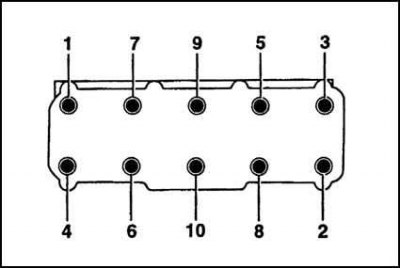
19. Proceeding in the order shown in the illustration,...
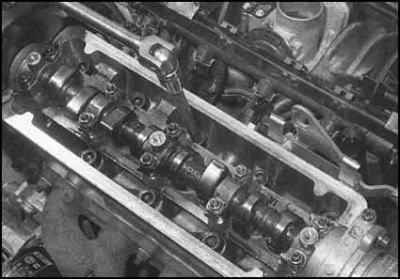
...in several stages (half a turn per approach) loosen the head mounting bolts enough to be able to unscrew them by hand.
20. Make sure that no communication lines remain connected to the cylinder head. Remove the head from the cylinder block (if necessary, use the help of an assistant, especially if the head is removed together with the pipeline and manifold).
21. Remove the gasket from the head mating surface of the block. Do not discard it, save it as a template.
22. If major repairs of the head are expected.
Separation of the intake manifold and exhaust manifold from the head
23. The procedures for removing and installing the intake manifold are described in Chapter Power supply system.
24. Remove the remaining fastening nuts in several stages (during assembly, nuts must be replaced without fail) and remove the exhaust manifold with gaskets from the cylinder head.
25. Thoroughly clean the mating surfaces, install new gaskets, then install the exhaust manifold. Screw on new mounting nuts and tighten them to the required torque.
Preparing for assembly
1. Using a scraper made of soft material, thoroughly clean the mating surfaces of the head and block. Remove all traces of old gasket material and carbon deposits from the surfaces. Clean the piston crowns as well. Try to keep debris out of the water galleries and oil drains (carbon particles can completely block the oil supply to the internal components of the engine) - Seal all accessible holes with tape. The gaps between the walls of the pistons and cylinders should be filled with consistent grease for the same purpose, which can then be easily removed with a thin brush.
2. Check the mating surfaces of the block and cylinder head for scratches, burrs and other mechanical damage. Minor defects can be removed with a fine-tooth file. In case of more serious damage, you will have to resort to machine machining.
3. Assess the flatness of the mating surfaces using a special template (steel ruler ribs) and a blade-type feeler gauge.
4. Check the condition of the head bolts, paying special attention to their threaded portion. Wash the bolts in solvent, then dry thoroughly. Defective bolts are subject to replacement. Measure the length of each of the mounting bolts to detect signs of their stretching (this test cannot be considered unambiguous, since all bolts may be stretched to the same length). The authors of this Manual recommend replacing the head mounting bolts regardless of their condition.
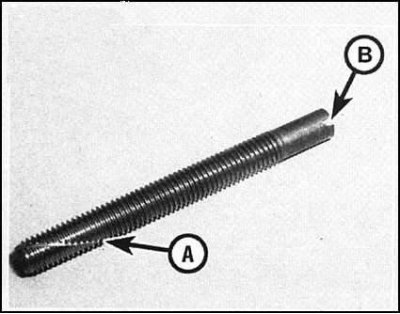
5. Tap the bolt holes in the cylinder block with a suitable tap, cleaning the threads and restoring damaged threads.
Note: If you don't have a suitable tap at hand, the holes can be cleaned using a homemade device made from a long pin with a thread sawn along the length.
6. To avoid damage to the pistons and valves, the authors of this Manual recommend that before installing the head, move the crankshaft 90° back from the TDC position (if necessary, refer to the materials in Section Description of the main units and mechanisms).
Assembly
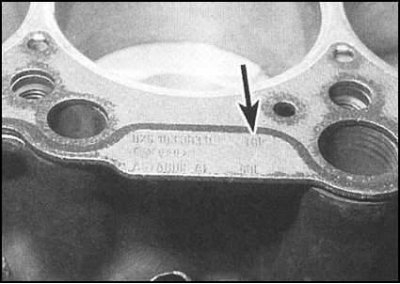
1. Make sure that the replacement gasket matches the size of the one removed from the engine. Carefully wipe the mating surfaces of the head and cylinder block with a clean, dry rag, then place the new gasket on the block, making sure that all the holes are aligned correctly. The gasket should be placed with the marking facing up. Screw long studs with a slot sawn into the end part for a screwdriver into a pair of bolt holes in the block. These studs will be used as guide pins when installing the head.
2. Make sure that the timing marks on the camshaft gear and the inner timing chain cover are correctly aligned (see section Bringing the piston of the first cylinder to the top dead center (TDC) position at the end of the compression stroke). Try to prevent the shaft from turning during the installation of the head.
3. Using an assistant, carefully place the head assembly with the manifold and pipe onto the guide studs. Before finally lowering the head onto the block, make sure the gasket is positioned correctly once again.
4. Lightly lubricate the threads and undersides of the mounting bolt heads with a high-quality, high-temperature grease.
5. Carefully insert each bolt into its hole and tighten by hand.
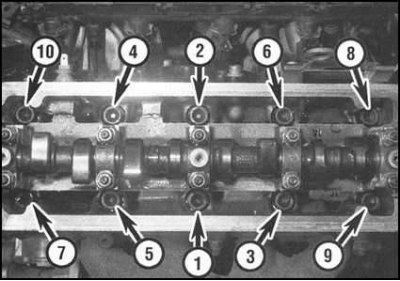
6. In the given order...
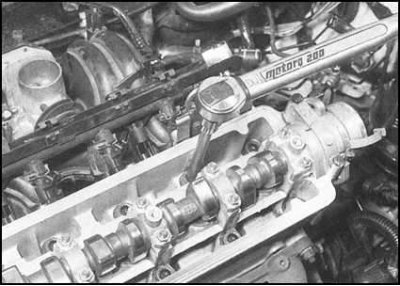
..tighten the bolts in several stages using the first stage tightening force.
7. Proceeding in the previous order, tighten the bolts to the second stage torque.
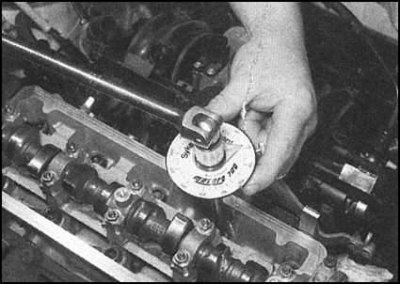
8. Using a special angle gauge or a template made of thick cardboard, tighten the bolts to the angle of the third tightening stage.
9. Finally, tighten the bolts to the fourth stage corner.
10. Reinstall the cylinder head cover (see section Removal and installation the cylinder head cover).
11. If removed, reinstall the distributor components (see Chapter Engine electrical equipment).
12. Install the hose clamp of the supply pipe union on the thermostat housing.
13. Connect the throttle cable and adjust it if necessary (see Chapter Power supply system).
14. Install the engine oil dipstick guide tube onto the head. Tighten the mounting bolt.
15. Connect the exhaust manifold to the exhaust pipe (see Chapter Power supply system). Install the intake air heater housing plate.
16. With the timing belt removed, bring the engine to the TDC position (see section Bringing the piston of the first cylinder to the top dead center (TDC) position at the end of the compression stroke).
17. Support the engine, disconnect the right support and lower the power unit slightly. Remove the outer timing belt covers and the crankshaft pulley (see section Removal and installation the timing belt and its covers).
18. The unit can now be lifted and its right support can be connected (see section Removal and installation the timing belt and its covers).
19. Install the accessory drive belt and adjust its tension (see section Removal, installation and adjustment of the tension force of the auxiliary drive belt).
20. Further assembly is carried out in the reverse order of dismantling:
- a) Restore the original connections of all hoses and electrical wiring;
- b) Reinstall the air cleaner assembly (see Chapter Power supply system);
- c) Fill the cooling system and check the engine oil level;
- d) Connect the negative cable to the battery.