Note: Before you begin, please refer to the Note given at the beginning Chapters 9 and the Warning given at the beginning Chapters 13 (regarding asbestos dust).
Inspection
Note: To ensure equal and effective braking, both front brake discs should be replaced at the same time, even if only one is damaged.
1. Jack up the front of the vehicle and support it securely on axle stands, then remove the wheel.
2. Rotate the brake disc slowly so that you can fully inspect its surface on both sides; remove the brake pads (see Chapter 13). if better access to the inner surface is required. Light scratches in the area covered by the brake pads are acceptable, but if deep grooves are found, the disc must be replaced. The only alternative is to grind the disc until its surface is smooth again, but the thickness of the disc must not be less than specified in Specifications minimum value.
3. It is quite normal for the disc to have a protrusion on its periphery caused by rust or dust. This thickening can be scraped off. However, if the thickness difference is due to wear of the area covered by the pads, measure the disc thickness with a micrometer. Take measurements in several places, in the area in contact with the pads and outside it. If at least one of the measurements is equal to the value specified in Specifications minimum thickness or less, replace the disc.
4. If the disc is suspected of being warped, check it for runout using a micrometer (5 mm from the outer edge of the disc). Alternatively, slowly rotate the disc and use feeler gauges to take several measurements of the clearance between the disc and a fixed point, such as the caliper mounting bracket. If the measurements are equal to or greater than the specified Specifications maximum, the disc is deformed and must be replaced. However, first check the condition of the hub bearings (Sections 1 and/or 10). Try also removing the disc and turning it 180° relative to the hub; if the disc runout is still excessive, the disc should be replaced.
5. Check the disc for cracks, especially around the bolt holes, and any other damage or wear. Replace the disc if any are found.
Removal
6. Jack up the front of the car, securely place it on axle stands, then remove the wheel.
[View the original on the website: SKODABOOK.ru]
7. See. Chapter 14 and unscrew the two bolts securing the caliper bracket to the steering knuckle, then remove the caliper assembly, set it aside and tie it to the body, being careful not to stretch or bend the brake hose. Place an improvised clean spacer between the pads (the same thickness as the brake disc), to prevent them from shifting.
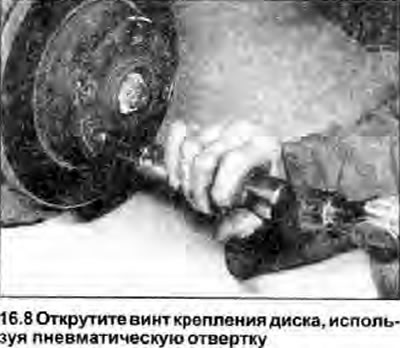
8. Using chalk or paint, mark the alignment marks on the disc and hub, then unscrew the mounting screw and remove the disc. The screw may be very tight, in which case you will need a pneumatic screwdriver (see photo).
Installation
9. Install in the reverse order of removal, paying attention to the following:
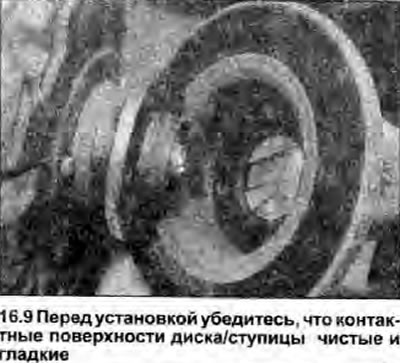
- a) Make sure that the contact surfaces of the disc and hub are clean and smooth (see photo).
- b) Align the marks made before removal.
- c) Tighten the disc screw, caliper bracket mounting bolts and wheel bolts to the specified tightening torque Specifications.
- d) If a new disc is being installed, use a suitable solvent to remove the protective coating from the disc.