



Installing a thermostat
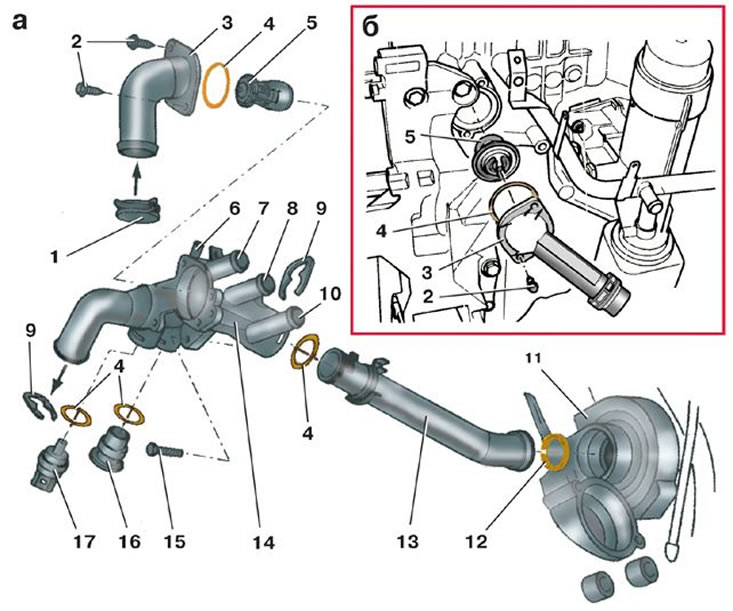
a – gasoline engine; b – diesel engine; 1 – spring clamp; 2 – cover mounting bolt; 3 – thermostat housing cover; 4 – sealing ring; 5 – thermostat; 6 – expansion tank hose fitting; 7 – pipe for supplying liquid to the heater; 8 – branch pipe of the hose for draining liquid from the expansion tank; 9 – bracket; 10 – heater fluid drain hose branch; 11 – water pump housing; 12 – sealing ring; 13 – coolant pipe; 14 – thermostat housing; 15 – thermostat housing mounting bolt; 16 – cork; 17 – coolant temperature sensor
If the engine temperature regime is not correct, remove, check and, if necessary, replace the thermostat.
1. Remove the engine cover (see subsection 2.1).
2. Drain the coolant (see subsection 5.13).
3. Loosen clamp 1 and disconnect the hose from cover 3 of the thermostat housing.
4. Unscrew the two mounting bolts 2 and remove the thermostat housing cover 3 from the engine.
5. Turn thermostat 5 90° counterclockwise and remove it from the housing.
6. Install thermostat 5 into the housing and secure it there by turning it 90° clockwise.
7. Replace the sealing ring 4 if it is torn or has lost elasticity. It is recommended to replace the ring with a new one, regardless of its condition.
8. Before installing a new thermostat, check that it is in good working order and that there are no foreign particles on the valve seat that could prevent the valve from closing completely.
9. Install the sealing ring 4 on the thermostat cover 3, after cleaning and lubricating the ring with clean coolant.
10. Install thermostat cover 3 on the engine and tighten bolts 2 that secure it.
11. Connect the hose to the thermostat housing and secure it with a clamp.
12. Fill the cooling system with fluid (see subsection 5.13).